Buy anything from 5,000+ international stores. One checkout price. No surprise fees. Join 2M+ shoppers on Desertcart.
Desertcart purchases this item on your behalf and handles shipping, customs, and support to Romania.
🔌 Charge smarter, protect better, power longer.
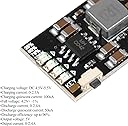
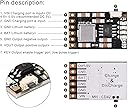
The MakerFocus 6pcs 2A 5V Charge Discharge Integrated Module is a compact, high-efficiency PCB designed for 18650 lithium batteries. It combines charging, discharging, battery level indication, and multi-layer protection (over-current, over-voltage, short circuit, and over-temperature) into one module. With a stable 5V output at up to 2.4A and smart load detection, it’s ideal for powering portable devices, car charging retrofits, and DIY mobile power projects, ensuring safety and reliability in a sleek form factor.
| ASIN | B07PZT3ZW2 |
| Best Sellers Rank | #540,268 in Tools & Home Improvement ( See Top 100 in Tools & Home Improvement ) #2,472 in Power Converters |
| Brand | MakerFocus |
| Color | As Shown |
| Customer Reviews | 4.3 out of 5 stars 246 Reviews |
| Input Voltage | 5 Volts |
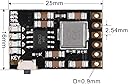
| Item Dimensions | 0.98 x 0.63 x 0.39 inches |
| Item dimensions L x W x H | 0.98 x 0.63 x 0.39 inches |
| Manufacturer | MakerFocus |
| Mfr Part Number | 1468720264RM7BC61XM |
| Output Voltage | 5 Volts |
| Plug Format | Type B |
| Plug Type | Type B |
| Power Source | rechargeable battery |
| UPC | 673400168474 |
| Unit Count | 6.0 Count |
R**N
Great for some but not for all.
The bad: It says 2.1A output current but I tested two of them and got ~250mA and other things you might not like is the four LEDs are on while charging and discharging (not good for low power circuits but good for showing remaining power) and the output is on (with no way to turn off) while charging. The good: The output voltage is a solid 5V and while pulling the max I got of ~250mA the voltage only dropped to 4.89V. You can take all the LEDs off without affecting the circuit or just leave the one "100%" marked one and it'll only turn on when fully charged. The form factor is great and the gold contacts are cool. TLDR: Not the best for higher current projects 250mA+ or low current projects under ~5mA! All numbers were my results, yours may differ. I like it.
C**F
Well made
These look nice, but I really wish it was easier to use the 5V output. Sending a signal every 5 seconds with a micro controller is a pain. I mostly just would love to find a module that can charge a lithium ion battery over micro-USB and have it also have a built in 5V regulator too. I know the Adafruit Powerboost does that, but they cost $15-$20 each. This device is so close to doing that. Edit: I found out why I had to keep activating this module to keep the power output on. This module auto detects current draw. If it is high enough it will keep the 5V output on. I was trying to keep an Arduino in a low power state then occasionally waking it up to transmit a radio signal which can draw a lot of power for a few seconds. My current draw on the Arduino was way too low so this module would shut itself off. The only way to keep it on was to send the button input on the board a low signal every so often to prevent it from turning off. I couldn’t find any detailed information on these modules, but I figured these out when I tried using them again for a portable LED project. When I woke up the module and the brightness on my LED board was high it would stay on indefinitely. If my brightness was low when it first woke up it would shut off by itself after 30-45 seconds. If it woke up on high brightness and I switched it down to low without restarting it then it would still stay on indefinitely. Kind of odd behavior, but now that I understand these modules these are great for many use cases. I love how the push button on the side acts as a power switch. Press once to wake it up and press it twice to turn it off.
N**X
High s
I really would give this a 5 because it is an incredible little board. Being able to power 5 volt devices from single cell lipos and have a charged circuitry in one board is pretty great. But I have found that the self discharge rate is just too high. Every time I go to grab my battery powered devices the battery is dead. So now I actually have to add a power switch online with the battery, which adds a whole layer of complication. If the self discharge rate were slower, I would give this five stars.
J**N
Can’t believe I went this long without these!!!
These are awesome for any 5V projects that will need to be powered off 3.7V Lipo batteries! I pushed this thing hard by powering a raspberry pi with LCD screen pulling over 1.2A of current. There was a voltage sag as expected but still kept above 4.75V and it did not need additional cooling. Charging worked as expected too. Without a load the Vout was 5.14V which is great. Nice work whoever designed this I was impressed.
R**J
Quiescent current is 50x higher than rated
So, this is not a 50uA quiescent current device. It is more like 3mA. Put another way, as advertised, a cell would discharge 500mah in about 415 days. In reality, it is more like 6 days. And that is with literally nothing attached to the inputs or outputs- just the battery. So, you would end up with a switch on the battery, not the load. Not a huge deal, except that you have to either leave the load on while you charge (which doesnt do well- the output while charging droops significantly), or have two switches or a DPDT etc which is just a waste of time and money. If the chip behaved as advertised, it would not be an issue. A second significant problem is that the controller will not shut down at 3v. It will take your cell literally to 0v if left on, even with its advertised 'low voltage protection.' And this isnt at 50uA, it is at the same basic rate. I ran a 100ma load on 5v out (USB) until low-voltage cutoff, on an 800mAh cell. By the next morning, the cell read 0.3v. So, yea, this thing is sort of helpful for a very few applications, but with the drain current at 3ma+, it just isnt practical for anything that sees significant off time relative to cell capacity (i.e. 1 week idle on a 1000mAh cell is likely to take the cell to near 0v). If the chip was not a clone, and met the spec, then you are looking at 3-6 months, which is much more reasonable for anything that sees periodic use.
G**B
Good Charger Boards
Easy to connect (must have a good ability to solder wires to the board). Charges 18650 batteries while indicating the level of charge of the cell. The only thing I would change is to make the charge indicators different colors instead of all red LEDs.
C**N
Great working SMALL BMS board.
I bought these for a series of single LED flashlights Iw as building. I was looking for a small form factor when I got these, and boy it sure is small. I love the battery status LED's on the side of the board. It added functionality that I wasn't originally planning to add. My biggest problem with these boards is because they are so small. it's easy to let the smoke out while soldering the wires to the board. That issue is 100% my fault though, and wouldn't be an issue if I could have soldering the wires to this board first. But my design didn't allow that.
C**D
Catastrophic, flaming failure; "protection" is useless
tl;dr: "protection" chip actually caused the battery to catch fire. 0/10, do not recommend. On paper, this looked like a great module: all-in-one charging and battery protection with a 2A current limit, perfect for converting a powered screwdriver over to a lipo. So I wired it up, 3d printed a new handle for the driver to hold the electronics, and tested out my newly souped-up screwdriver. Everything looked good... That night, I was rudely awakened by a loud pop and a vigorous lithium battery fire. Fortunately, I was nearby and could put it out within a few seconds, but between the fire itself and the flaming chunks of plastic it threw across the room, things could have gotten very ugly very fast. The pics show the aftermath and an attempt at a post-mortem. After pulling the module from the wreckage, I measured around 5 ohm between the pads where the battery was connected--after desoldering the controller chip, that jumped to the megaOhm range. Measuring the isolated chip showed <1 between the pin connected to the battery and several other pins, leading me to believe the failure began in the chip, subsequently shorting the battery and causing unplanned fireworks.
R**B
Good
arrived quickly
D**L
Pas le meilleur choix
4 fonctionne sur les 6. l'un a les led qui ne s'allume pas et l'autre qui ne charge tous simplement pas, mais si non avec quelque soudure et un peut d'imagination vous pouvez les faire fonctionner. charge parfaitement les battery 5v, pas les 3.7V . Attention j'en est brûler 2. un en me trompant de polarité sur une connexion et l'autre en soudant les connecteur, j'ai fait un court-circuit. Pas de protection. ATTENTION bas de gamme mais pas cher Avous de voir.
E**O
eficiente desempeño
funcion a la perfrccion
Trustpilot
1 month ago
2 weeks ago