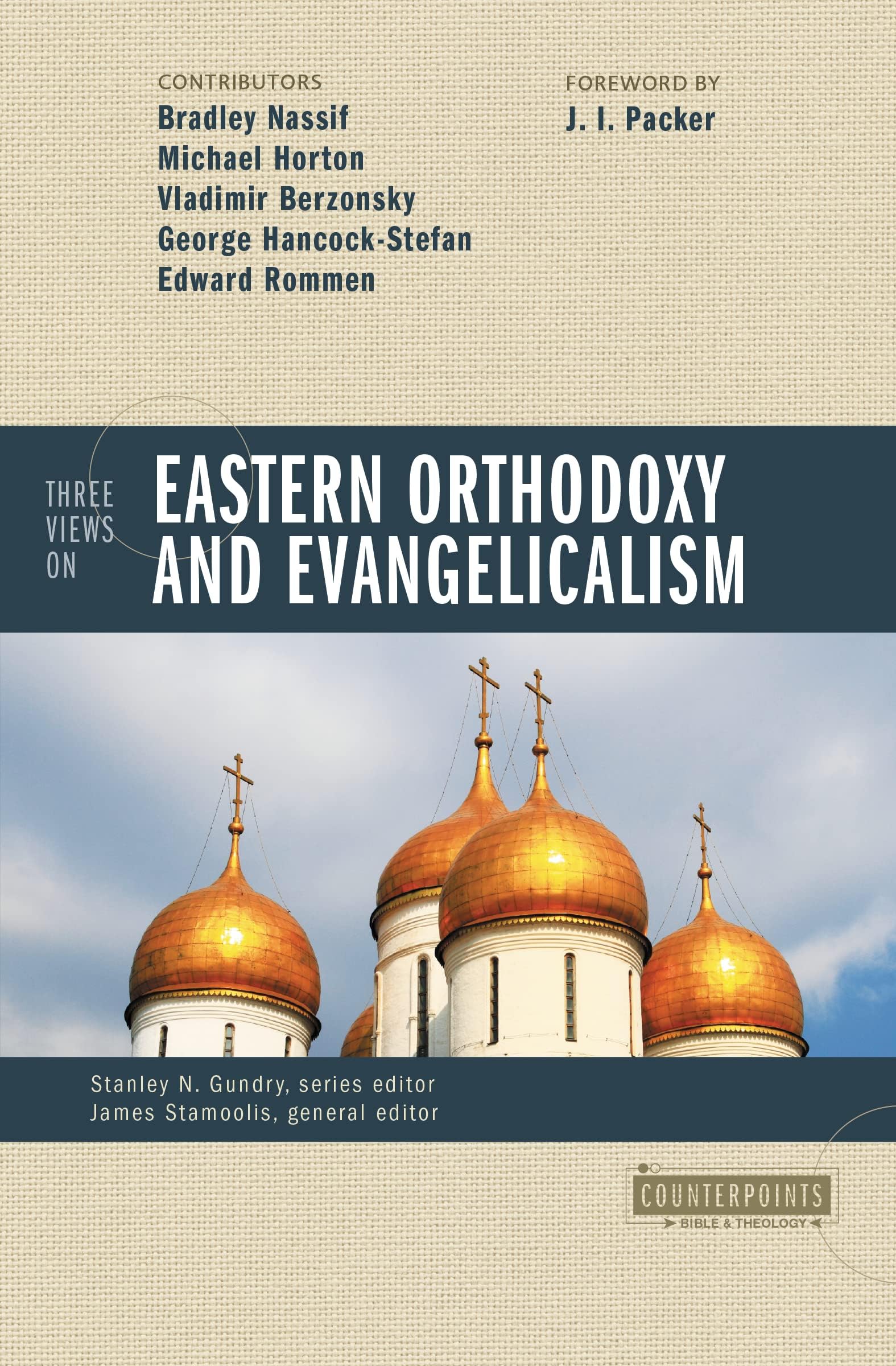
Three Views on Eastern Orthodoxy and Evangelicalism (Counterpoints)
Product ID: 302154281
Buy anything from 5,000+ international stores. One checkout price. No surprise fees. Join 2M+ shoppers on Desertcart.
Desertcart purchases this item on your behalf and handles shipping, customs, and support to Romania.
Are Eastern Orthodoxy and evangelicalism at all compatible? To some Western evangelicals, the practices of Eastern Orthodoxy seem mysterious and perhaps even unbiblical. From an Orthodox perspective, evangelicals lack the spiritual roots provided by centuries-old church traditions. Are the differences between these two branches of Christianity as sharp as they seem? Or is there room for agreement? This book allows five leading authorities to present their different views in a respectful manner, have them critiqued by their fellow authors, and then respond to those critiques. Writing from an Orthodox perspective with a strong appreciation for evangelicalism, Bradley Nassif makes a case for compatibility. Michael Horton and Vladimir Berzonsky take the opposite stance from their respective evangelical and Orthodox backgrounds. And George Hancock-Stefan (evangelical) and Edward Rommen (Orthodox) each offer a qualified "perhaps." The interactive Counterpoints forum is ideal for comparing and contrasting the different positions to understand the strengths and weaknesses of these two important branches of Christianity and to form a personal conclusion regarding their compatibility. Review: Informative and enlightening - The book is composed of essays that examine the differences and similarities between Eastern Orthodoxy and Evangelicalism. As one who works in both the Evangelcal and Orthodox worlds I found this format to be benefical. In addition to this topic being a difficult topic in and of itself the generalities are often broad. Eastern Orthodoxy has a variety of expressions that range from Ethiopian to Russian. Evangelicalism is all over the map from Pentecostal to Reformed, and everything in between. For the most part (I speak in broad terms) the Orthodox view in this book is Eastern European, while the Evangelical views are mostly American Reformed. The book is written in a format that allows free expression of ideas in the form of essays and an opportunity for agreement and rebutal by the other essay writers. It is an easy read and very informative. There is common ground on the Gospel and I believe both Orthodox and Evangelical readers will find the book to be encouraging to our common faith. The most striking difference between Orthodoxy and Evangelicalism is the view of the atonement and the doctrine of salvation. Orthodoxy can learn from Evangelcialism in their zeal for the Gospel and salvation by faith apart from works. Evangelicals can learn from Orthodoxy concerning the doctrines of Christ and His incarnation. Far from being enemies the reader will find that we are brothers in Christ. Review: A worthwhile read - I found this volume to be excellent on the whole, particularly contributions by Nassif, Horton and Rommen, with Stefan-Hancock's more visceral challenge from experience on the differences between Orthodox treatment of Evangelicals in the West vis-à-vis in lands in which the Orthodox are more dominant. A significant omission was the absence of any voice from the Pietist/Holiness/Methodist/Wesleyan side of the Evangelical spectrum, with which the are some further parallels with Orthodox theology, in not ecclesiology.









| Best Sellers Rank | #426,499 in Books ( See Top 100 in Books ) #344 in Ecclesiology Christian Theology (Books) #424 in Christian Orthodoxy (Books) #734 in Christian Apologetics (Books) |
| Customer Reviews | 4.5 out of 5 stars 39 Reviews |
P**K
Informative and enlightening
The book is composed of essays that examine the differences and similarities between Eastern Orthodoxy and Evangelicalism. As one who works in both the Evangelcal and Orthodox worlds I found this format to be benefical. In addition to this topic being a difficult topic in and of itself the generalities are often broad. Eastern Orthodoxy has a variety of expressions that range from Ethiopian to Russian. Evangelicalism is all over the map from Pentecostal to Reformed, and everything in between. For the most part (I speak in broad terms) the Orthodox view in this book is Eastern European, while the Evangelical views are mostly American Reformed. The book is written in a format that allows free expression of ideas in the form of essays and an opportunity for agreement and rebutal by the other essay writers. It is an easy read and very informative. There is common ground on the Gospel and I believe both Orthodox and Evangelical readers will find the book to be encouraging to our common faith. The most striking difference between Orthodoxy and Evangelicalism is the view of the atonement and the doctrine of salvation. Orthodoxy can learn from Evangelcialism in their zeal for the Gospel and salvation by faith apart from works. Evangelicals can learn from Orthodoxy concerning the doctrines of Christ and His incarnation. Far from being enemies the reader will find that we are brothers in Christ.
M**N
A worthwhile read
I found this volume to be excellent on the whole, particularly contributions by Nassif, Horton and Rommen, with Stefan-Hancock's more visceral challenge from experience on the differences between Orthodox treatment of Evangelicals in the West vis-à-vis in lands in which the Orthodox are more dominant. A significant omission was the absence of any voice from the Pietist/Holiness/Methodist/Wesleyan side of the Evangelical spectrum, with which the are some further parallels with Orthodox theology, in not ecclesiology.
M**S
Five Stars
Very interesting analysis of similarities and differences between Eastern Orthodox theology and evangelical theology. Well done.
J**J
First 100 pages...
I'm giving this book five stars because of the first section. Nassif does an incredible job at showing how Eastern Orthodoxy is basically the epitome of the criterion for Evangelicalism, as defined by Evangelicals. The scheme he uses is the Bebbington quadrilateral, which may be becoming dated, but is still quite useful. The other sections are hit or miss, but Nassif covers most of what anyone would need to know for such an introduction to the dialog.
C**N
Insightful and Well Educated Scholars.......Well, Almost
This book gets four stars because of both the great idea of comparing the two Christian traditions and Bradley Nassif. The other authors were very unprepared for the book. Michael Horton does the best job of the evangelicals but still gets some aspects of Orthodox theology wrong. Vladimir Berzonsky was the worst writer by far because he equated all evangelicals with Anabaptists in their theological views (particularly with the Sacraments). This is not his fault though, because the book itself does a horrible job explaining what evangelicalism is. The two evangelicals are (I think) Baptist and Presbyterian (or Reformed), but there are huge differences in these traditions, and I am truly shocked that none of the writers were Confessional Lutherans even thought the historical meeting between the Patriarch of Constantinople and the Lutheran scholars of Tubingen is brought up in nearly every chapter. This means no writer defends the view of Lutherans that the bread and wine in the Sacrament of the Lord's Supper have the real presence in them after they are blessed (with the exception of Dr. Nassif who also understands that the term usually applied for this which is Consubstantiation is a very poor term nearly no competant Lutheran and/or Episcopal scholar uses)! Nassif also used the best methodology in his analysis of doctrine (that of Christological Maximalism) thus showing many views, particularly of the Sacraments (if I may dare call them that) in the evangelical churches were argued over in the past by councils who found such views contrary to the doctrine of the Trinity and the Incarnation which all branches of non-heretical Christianity accept. My review should not be seen as a praise of just the Orthodox. Nassif happens to be an Orthodox writer who was at one time an evangelical and it shows in the quality of his presentation (even though I would say he should have made his position a maybe). The worst writer, Berzonsky both commits the aforementioned oversimplification but he also made it seem as if all the differences between the two were the lack of tradition (which in some ways I agree with), but also the denial of the council in which the iconodules won over the iconoclasts, which not all evangelicals would disagree with (i.e., not all evangelicals are iconoclasts.....i.e. me). Overall I think that the book should have been much longer and should have been much more thought out by the last four writers. Nassif gets the gold medal....everyone else needs to repeat Seminary, or really read and try to understand either "The Orthodox Church" by Bishop Kalistos Ware (and the Philokalia for the mystically minded) or Calvin's "Institutes of the Christian Religion" (and Luther's Large Catechism and the Book of Concord). This book is worth it for the first chapter. The responses are just kissing up to each other....usually :-).
A**R
Reformers JI Packer, Michael Horton & Brad Nassif eye opener
23 years as an evangelical preacher/missionary, studying over 15,000 books and commentary from every Bible believing popular pastor and author I could find, reading the Bible cover to cover about 14 times and many books of the Bible 50-100 times, teaching the Word of God daily, and yet I learned more from this book about Christ and His Church than all of my seminary and Bible college professors combined! I have read what some Orthodox and Bible believers have said about this book, so I thought I would also add my experience of this great book's logical and strong propositions for the hopeful blessings to all. Until I read this book, I had no idea how The early Christian Church understood and applied The Bible. I had heard of many books of the early Church quoted in my apologetics courses , but never read them until this book challenged me. This book led me to spend over 450 hours of research in a period of 1 1/2 years to counter the arguments for Orthodoxy. What I discovered about our reformation founders was shocking! I had no idea that sola fide sola scriptura doctrine of Martin Luther including a clear belief in the literal understanding of John 6 regarding The presence of Christ in Holy Communion. Once my eyes were opened, The Scriptures came alive when Jesus said: Verily, verily, I say unto you, Except ye eat the flesh of the Son of man, and drink his blood, ye have no life in you. Whoso eateth my flesh, and drinketh my blood, hath eternal life; and I will raise him up at the last day. For my flesh is meat indeed, and my blood is drink indeed. He that eateth my flesh, and drinketh my blood, dwelleth in me, and I in him. As the living Father hath sent me, and I live by the Father: so he that eateth me, even he shall live by me. This is that bread which came down from heaven: not as your fathers did eat manna, and are dead: he that eateth of this bread shall live for ever. Of course this makes sense now; Had not the Word of God taught us that if we partake of The Holy Cup of Communion unworthily, we could get sick and die! How come I had not seen it earlier? In my Dallas Seminary and nondenominational professor's understanding of The Bible, I had totally missed this simple Biblical Truth! I wrote many professors at several seminaries and every popular Bible teacher I trusted to try to get some answers to justify my Baptist and nondenominational understanding of The Bible's theology, but all their answers could not come close to what I found out in this great book! JI Packer is one of my all time favorite authors, so when I found this book in my Christian Bookstore, I had to pick it up and read it. Michael Horton with his great book on Amazing Grace had helped me in the first 1/2 of his book many years past, although I had a hard time justifying the last 1/2 of his book with the Bible, but I knew he was a very intellectual giant of understanding the reformation pastors. After reading arguments in this book, I also was shocked to find out that to this day, our Bible believing Lutheran brothers faithfully practiced the Sacrament of confession and Baptismal regeneration! What a shock, but once I found out that the early Christian church had taught this for 2000 years among all the nonRoman Catholic brothers around the world, whether in Antioch, Corinth, Ephesus or wherever we found Godly Pastors' writings, The Bible was opened up to me as never before. Had not the scriptures taught us in Romans 6: Know ye not, that so many of us as were baptized into Jesus Christ were baptized into his death? Therefore we are buried with him by baptism into death: that like as Christ was raised up from the dead by the glory of the Father, even so we also should walk in newness of life. For if we have been planted together in the likeness of his death, we shall be also in the likeness of his resurrection: Knowing this, that our old man is crucified with him, that the body of sin might be destroyed, that henceforth we should not serve sin. For he that is dead is freed from sin. Now if we be dead with Christ, we believe that we shall also live with him. How could I have missed such clear teachings of The Bible? Because I had neglected what God's Word had told all believers in 2 thess 2:15 "Therefore, brethren, stand fast, and hold the traditions which ye have been taught, whether by word, or our epistle. " I had not realized that God had commanded us to follow the traditions of the early Christian church whether they were given in writing or by preaching as told to us here and in numerous other writings of the very early Church of the first centuries Biblical times. Until I read this book, I did not even know that we had no record of the complete canon of the new testament that matched our Bible until 367 A.D. when St. Athanasius wrote a list down in a letter to the Church, but all the other lists of the canon of The Bible were either missing several books of the Bible or had other books that the early Church considered very sacred like Shepherd of Hermas or letter of Apostle Clement or letters of Pastor and Martyr Ignatius to the 7 churches when he was on the way to be eaten by lions as an old man who had faithfully served Christ to the end after being taught and commended by our Apostles and Christian Churches everywhere. I have to admit I could not identify much with the folks trying to tell this muslim convert to Christianity that he was somehow not a believer because he did not belong to The Orthodox Church, but as I studied the writings of the early church and tried to find arguments against what was presented in this book, I could see how my Baptist and nondenominational understanding of The Bible had me jumping through theological hoops often to justify what I had been taught according to modern understanding rather than according to the way The Bible had always been taught and believed from the early Church to present. I can see why these Orthodox authors wanted us to return to the path of the early Church, but I also found out that our Baptist and Reformed arguments against the experience of Orthodox in several parts of the world is also seemingly legalistic and only cultural rather than true to the Orthodox Faith that was being held tightly and truthfully for 2000 years and by these beautiful believers. Who am I to judge another though, but it is true that many don't even take communion but once per year and sadly so many who call themselves Orthodox, go to Church on Sunday and then walk away from their faith the rest of the week . God is Merciful, but I learned from Brad Nassif that St. Symeon the new theologian and other trusted pastors of the Orthodox Church spoke strongly against those who had been baptized Orthodox to not think that just by virtue of being baptized or just by the fact that they were even living as monks that they were already saved. Infact, the concept of Salvation is so relational and whole in the early and Orthodox understanding that it brought together ALL The Biblical verses on Salvation rather than try to dissect them into so called "dispensations". I was shocked to find out through introduction of this book and research, that sadly Martin Luther had such a hard time with the roman catholic view of works that he never got the relational whole Salvation aspect taught by the early Church, so he ended up ripping out the book of James and throwing it down the river and for 100+ years, when James or 2John or Jude or 3John were put in the KJV and reformers Bible, it was categorized as "deutrocanonical" or less than canon. Thankfully the Orthodox Church did not follow the example of our sola scriptura Bible believers but kept The Faith whole despite many pressures from Muslims, Roman Catholics and some protestant reformers to dilute The Faith once delivered to all the Saints. I could not believe that John Calvin, who I had seen as a hero of the faith, had actually burned alive those who held simliar views to our Baptist free for all theology of the Bible and me alone. Calvin and the reformers knew that the Creeds of the early Church were given by The Holy Spirit's guardian of True Doctrine to the Church, so they could not accept those nondenominational disciples and pastors who wanted to throw out the early Church's writings like some modern popular pastors (i.e. Joel Osteen) want to do. I'm obviously not condoning or even remotely accepting burning them alive, but certainly was amazed that this truth of fervent adherence to the teachings of the early Church including how the Bible was applied and understood by them was vital to the understanding of the reformers. Unfortunately, as this book helped me find out , many of the reformers did not have access to some great books we have"just" discovered like "the teachings of the apostles/didache" from around 50 AD giving us understanding of the theology of the early Church, nor did they read the 7 letters of Ignatius or knew of the recently excavated Churches around 270 AD showing us the Icons of the preConstatine faithful Church of the early Martyrs. It was amazing to discover as a result of this book, that Constantine did not corrupt The faithful in the Church. This modern attack on the early faithful martyrs and pastors I found out has no logical ground to stand on, since after Constantine, there were other emperors who tried to change The Faith, but preachers like John Chrysostom stood up to them and even died as a result of their faithfulness to The Gospel of Christ. The believers everywhere joined in unison against the heretics who tried to change the church to make them like modern day watchtower followers (arians), and would not give an inch of ground to them whether they came from muslims, gnostics or arian side. And amazingly we now have many documents from before Constantine which show us how the early Church practiced The Faith (i.e. Anthony giving up all his riches to follow Jesus as a full time prayer warrior in the desert tackling demons in the name of Christ and making the sign of the Cross as faithfully taught by the apostles down. He lived from 250 AD (many many years before Constantine to 365 AD and even Constantine had to bow to him in respect for Christ after constantine tried to force Anthony with Roman troops to come to honor Constantine). Infact, as a result of this book, I discovered that we have a great historical book following the book of Acts, called Church history by eusebius and there we find Emperor of Rome Constantine bowing down in honor of Christ to pastors with missing limbs, gouged eyes and tortured bodies; rather than try to force his power on them. I wish our modern evangelical faithful knew about these great writings of the early Church and taught us to read the great books of the early Church so we could fulfill our reformers dream to be faithful to the Doctrine of the early Christian Apostolic faithful and not just choose between Rome and not Rome. In fact, this book does a wonderful job of showing us that besides the church of Rome, there were many other nonRoman Churches who never gave into papal infallibility and all the other stuff that sadly took over Rome after they tried to force their will on Churches in Antioch, Alexandria, Jerusalem and Constantinople and everywhere else. Amazing that as an evangelical Bible believing preacher, in all the books I had read, I had missed out on such a great Christian Heritage. I owe Brad nassif a lot for his balanced presentation on the necessity of our evangelical zeal with the necessity of our being part of Orthodox Churches in communion with Saints in Heaven and on earth. I finally logically had nowhere else left to go, but to accept and join the faithful Orthodox Church and all the great work of The Holy Spirit done with her faithful pastors, martyrs and laity through the ages and was baptized and chrismated Orthodox to become more true to the early Church's practice and the Living Faith of Christ's ONE Body. Not that my evangelical brothers and sisters are not Christians obviously, but that I had missed the fullness of The Faith. I still have a lot to learn and grow , but now I am doing it in the context of the work of The Holy Spirit's "Mysterion" Body rather than just act like a liberal attacking The Church while saying I am a conservative Bible believer. Thank God for my faithful evangelical authors. I hope to continue to learn what they have to share in their zeal for the Gospel, but also want to have us all return to the Oneness we have in Christ inside of The Mysterion Orthodox Church so we can work out our Salvation as One Body with Christ as our Head rather than as 25,000+ denominations split over every small thing who are missing the Unity of The Spirit found among The Orthodox Faithful. While the Orthodox Church is obviously far from Perfect in application by its members, The Theology and Life of the Church is amazingly ONE with Christ and our brothers and sisters in Heaven. Must be because of The Holy Spirit's work , cause The Orthodox Church does not rely on one man as a vicar of Christ or on just organizational oneness like Rome does, but they have kept The Faith once delivered even in the midst of islamic persecution and persecution by even Rome and the 4th crusade. When they have fell, God has led them to repent. Now, we need to have all of us as ONE with The Father, Son and Holy Spirit reaching out to the lost who need Christ for Eternal Life now and forever. One thing i wish the book had done was gotten more into what Michael Horton has discovered regarding Orthodox faithful Incarnational theology giving so much glory to our God and Savior Jesus Christ. I hope this could be part of a follow up to the book some day since Athanasius and so many faithful Pastors wrote of this important fact that God becoming Man is central to our Living Relationship with God! humbly in Christ, Anthony
P**N
Pretty Much Useless
Books comparing rival theological systems should primarily be about translating across schemes. This is what people want in reading these kinds of books. They are in one view and they want to understand the other view. To effectively meet this end, one has to be familiar with both sides, that is, one has to know how to speak the language of the other guy. Unfortunately this isn't accomplished. While the two Orthodox writers give a basic overview of Orthodox teaching, they fail in two basic ways. First, they fail to grasp the language and system of their Protestant interlocutors and therefore do not adequately address their objections. They show a very superficial understanding of Reformation theology. Second, they fail to get to the heart of the differences which lie in Trintarian theology, Christology and theological method. A much more effective exposition and hence argument could have been made. The Protestant participants suffer from the same kinds of problems plus others. The baptist contributor forcuses on abuses mainly in the Russian jurisdiction. This is hardly a fair tactic, for the abuses, theological, moral or administrative are anecdotal, that is, they are limited to his experience. Second, considering that the Russian Church was practically exterminated by the Soviets, it is understandable if its laity/clergy who were prohibited from learning the Bible or going to seminary are ignorant of basic Christian teaching and moral praxis. In fact the baptist contributor ultimately confesses ignorance as to what the real issues are between Reformation and Orthodox soteriology, indicating that he shouldn't even be a participant. Horton's contribution is better but suffers from the same general failure to grasp the theological system and langauge of the people on the other side, and thereby mount and effective critique. Granted that the Orthodox representatives failed to give an adequate articulation of the Orthodox view of justifiction, it certainly wouldn't have been hard to find one. There are a number of such articles readily available in Orthodox scholarly journals. (See for example, Church and Justification. An Orthodox Approach to the Issue of Justification and Collective Faith, The Greek Orthodox Theological Review 28 (1983)). And Horton follows his usual modus operandi of tarring people with positions that they do not affirm. For example because he isn't familiar with understand the Orthodox teaching on faith, he simply denotes it as the same teaching as Roman Catholicism, specifically the idea of "implicit faith." Horton makes this kind of move on a number of occasions, reducing Orthodox teaching to Catholic teaching to make it easier to criticize. In point of fact though, the Orthodox while having some superficial similarities to Catholicism, understand things differently because they have a different Trinitarian theology, Christology, soteriology and anthropology. Horton shows nothing more than a superficial understanding of Orthodox theology because he simply hasn't done any substantial reading in it, as is evidenced in his use of only a few fairly popular sources and his constant inability to draw the appropriate conclusions. If you are coming from an Evangelical/Reformation background and you want to understand Orthodox teaching from the inside out, below are some works that will save you time and money in the long run. An abosolute must is Joseph Farrell's Free Choice in St. Maximus the Confessor, which is an analysis of Maximus' theology and ends with a comparison with Augustinianism. Hard to find, but well worth it. Maximus is a central theological figure for Orthodox theology. Just as it is not possible to understand western theology apart from Augustine, so it is not possible to understand Eastern theology apart from Maximus. Farrell's translations of the Disputation with Pyrrus and Photius' Mystagogy of the Holy Spirit are short, inexpensive and packed with information. Farrell knows how to translate ideas and spell out the conceptual connections. John Romanides, Ancestral Sin, is a helpful exposition of the Orthodox teaching on anthropology, and the Fall and a critique of western conceptions. John Meyendorff's Christ in Eastern Christian Thought, is also a must to understand the centrality of Christology to Orthodox theology and how the Orthodox understand Christology. Meyendoff's, Salvation in Christ: Lutheran-Orthodox dialog, is also helpful, though somewhat overly optomistic. Michel Barnes, The Power of God, and David Bradshaw's, Aristotle East and West are both vergy good works and should be read together-Barnes first, then Bradshaw. Richard Haugh's Photios and the Carolingians: The Trinitarian Contoversy, is short but very helpful. Henri Crouzel's Origen. Origen is one of the most important figures in Christian theology, for he is the source of most of the debates in Christology and Trinitarian theology in the first millenium of the church. While not Orthodox, other helpful works are, Arvin Vos, Aquinas, Calvin and Contemporary Protestant Thought, and, Harry McSorely's Luther: Right or Wrong, Rupert Davies, The Problem of Authority in the Continental Reformers.
J**R
A Good Comparison of the Issues Between Orthodox and Evangelicals
My one real disappointment was the article by Dr. Hancock-Stefan. While writing from the "maybe" evangelical position, he nevertheless reduces the maybe to a "maybe, but why would you wan to?" kind of critique. His viewpoint is heavily colored by his experiences with evangelism in the Romania, and Protestant inability to make any traction against a monolithic ethnically orthodox church. Yet, it seems his concerns lie mostly with volk Orthodoxy rather than with the theology of the living Church. His (sometimes accurate) claim that Orthodox Christians are disinterested in the faith and have no personal relationship with Jesus Christ is far too one handed; he chooses to paint this picture of Orthodoxy as if it were authoritative while holding up Evangelicalism as the paragon of having a personal relationship to Jesus, though never choosing to see that among Evangelicals there are in fact just as many who have no personal relationship with Jesus and no interest to acquire it, despite a public face otherwise. I know; I used to be one. Thus, rather than being a "maybe" from an Evangelical perspective, this article quickly degenerates into a solid no based on unequal points of comparison.
Trustpilot
2 days ago
4 days ago