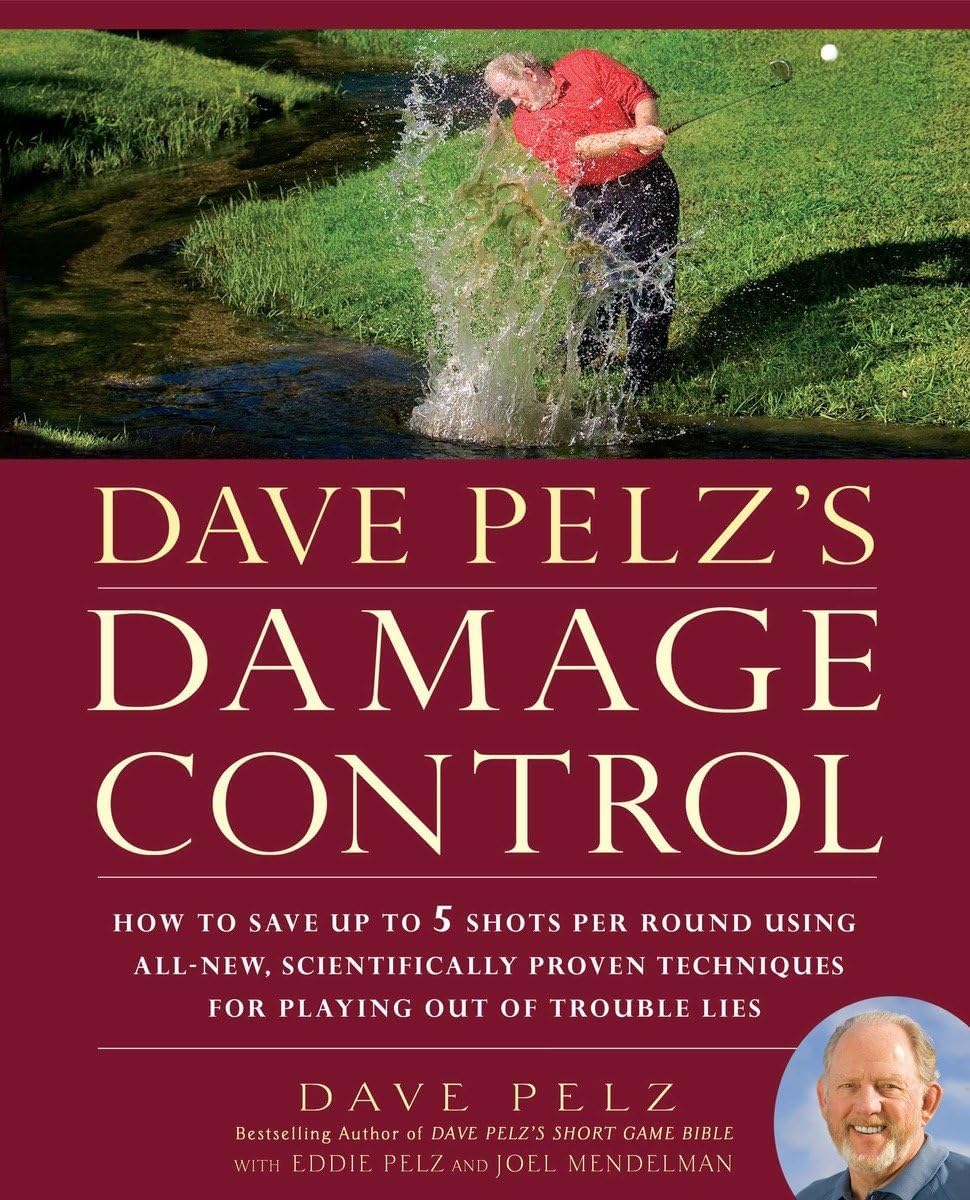
Dave Pelz's Damage Control: How to Save Up to 5 Shots Per Round Using All-New, Scientifically Proven Techniq ues for Playing Out of Trouble Lies
Product ID: 4437401
⛳Save up to 5 shots/round
📊Data-driven pro insights
📸Full-color drills & photos
Desertcart purchases this item on your behalf and handles shipping, customs, and support to Romania.
⛳ Transform your golf game with science-backed damage control!
Dave Pelz's Damage Control is a groundbreaking golf instruction book that teaches players how to save up to 5 shots per round by mastering recovery from trouble lies. Using decades of data analysis and pro-amateur comparisons, it offers scientifically proven techniques, full-color photos, and practical drills to help golfers avoid costly disaster holes and improve their scores.
| Best Sellers Rank | #404,868 in Books ( See Top 100 in Books ) #151 in Sports Reference (Books) #262 in Golf (Books) #286 in Sports Encyclopedias |
| Customer Reviews | 4.4 out of 5 stars 85 Reviews |
R**R
Just what I expected
This is just what my game needs and it did not disappoint. Well written - detailed and beautifully illustrated - this book provides the information, drills etc to master the mental & physical skills to minimize the effects of trouble situations on the course. No only does the author provide the explanations of how to extricate oneself from problem lies, he provides a practice plan complete with do-it-yourself accessories that you can use in your own yard before you take it to the course. Looking forward to re-reading the book, putting together my practice aids and taking the knowledge gained to the course. Have used some of the information already with success. Can't wait to get started on my 'back yard' practice. Great book.
R**K
Great book
Very good book. Attacks problem of 1-2 bad holes that even good golfers have on many rounds. Once again, Pelz approach consists of close observations of pros and amateurs plus lab data. Emphasis is on understanding first, then knowing what to do differently then drills to help your head & body learn the right techniques. Better pictures than earlier books. Somewhat repetitive, but that's Pelz's style: tell them, explain/prove it to them, then teach them.
J**.
He seems to enjoy the
My husband has the 'Bible' and now is on damage control. He seems to enjoy the book
J**D
Golf is a game of damage control
Being a great fan of David Peltz and having read the Short Game Bible many times, and it is actually on my bed stand dare I say in no offense to the golf god, like a bible. I preordered Damage Control which I got for the holidays and have read through it with great delight while the weather this winter has made golf a near memory. I am always amazed at the number of golfers I play with that know golf is a game of strategy but do not ever seem to actually use strategy or think through their next play. To read this book and understand it you have to be open to the idea that much of the game involves trouble shots. This is why the golf courses are becoming 7500 yards with endless bunkers, buck grass you could hunt duck in, trickery of the eye, super fast greens and really rough rough. I should mention that I am a passing middle age high handicapper beginner of 3 years playing from the red tees. (Please don't tune me out yet just because I am a female golfer!) I am also an engineer and so is Peltz. His many years at NASA taught him how to problem solve and the golf courses today are an engineer's dream of problem solving. In this book he starts with some basic statistics about how often from the Tee you will end up in trouble, somewhat based on handicap and not being a professional that practices 40 hours a week. Once you embrace this simple truth then you are prepared to evaluate probably more than half of your lies as difficult situations. After he has you convinced to accept this as part of the game he uses the rest of the book to demonstrate how you extricate yourself from these common problem areas. What I found most interesting was the idea of keeping the spine angle as aligned with the terrain as possible to allow for enough room to open your hips and get a fairly good shot, even if you are on your knees. It is discussed in most books briefly in the section on uphill/downhill lies, ball above/below feet. His review has finally brought this into focus for me and I find the few times the weather has allowed me to play and I am in these situations I think about this first thing and it really makes a difference. It is the type of book you read through once then return to each section, usually after you have encountered the situation on the course and you need a refresher about why he says to do what will best give you the chance to escape trouble. As a beginner I would have to say that I will follow all of his advice and keep referring to this book probably after every round I play. However, I would like to also say that as a beginner I reserve the right to call an unplayable lie, such as a buried ball in the sand since I will most likely take 5 strokes to get free and injure myself in the process!
L**N
Only read the first 20 pages and it saved me at least 2 strokes
Only read the first 20 pages and it already saved me AT LEAST TWO strokes during my golf round today. When faced with a difficult lie, blocked by a row of trees, with the ball sitting on a pile of mulch, no matter what shot option I selected, my next shot wasn't going to reach the green. My first choice would have been to hit a big old looping hook with a 7-iron. After reading only the first 20 pages, the probability of being able to hook a 7-iron off a pile of mulch to get out of a trouble situation with OB to the right looked a lot more like a marginal success shot than before I read the first 20 pages. I asked myself, "can you hit a hook with a 7-iron"? The answer was - YEP almost every time I try. The next question was, "have you EVER practiced hitting a hook with a 7-iron off a pile of mulch"? The answer to that one was - NOPE. The next question was, "how bad is the penalty if you miss this shot" The answer was - INTO THE FIRE! So instead of trying to hook a 7-iron off a pile of mulch, I hit it less than 20 feet forward to open up a less challenging flight path to the green. Next shot was onto the green, and I still had a realistic possibility of saving a par. Walking off the green with a bogey and thinking, had I been successful with hooking a 7-iron around a row of trees and off a pile of mulch, I still would have likely had a bogey. But if I missed that 7-iron off the mulch it would have been OB and a 7 or an 8. Three holes later, with my ball nestled down into the rough with 105 yards to the flagstick. My first reaction would have been to pull out the 105 yard club (SW) and take a rip at it. But after reading the first 20 pages, I asked myself; "what's the statistical shot pattern going to look like on being able to pull off hitting this 105 yards out of 4" rough"? Not very likely, so I added one full club to a 120 yard wedge, choked down two inches on the shaft, took a shorter swing at the same tempo, and stuck it 10 feet past the stick. I was now looking at a realistic birdie opportunity simply by mentally assessing my likely shot-pattern from 105 yards out of 4" rough? It's possible I might have been able to pull it off, but I believe I may have increased the statistical likelihood of the outcome simply by changing clubs. I was explaining the results with my playing partner today, and mentioning I was reading the new Pelz book "Damage Control". He's an 8 handicap I'm an 11 handicap. No handicap strokes were involved and I beat him 3-up in match play and by 4 shots today. He was laughing and says, "if you can save 3 shots by only reading the first 20 pages what's going to happen when you finish the book"? I'm going to have to finish reading the book to answer that question.
M**C
Awesome book!!
This is a great book for every amateur golfer. It provides help for those couple of holes each round amateurs have that destroy their score. Great pictures and explanations for easy solutions on trouble shots you can take to the course. It also has a chapter on helpful practice drills. I am recommending it to all my friends.
D**S
I love Pelz's Short Game Bible so I decided to take ...
I love Pelz's Short Game Bible so I decided to take a chance on this one. The methodology is good to try to eliminate high scores on a hole once you do get into trouble. There are typically a couple of holes a round that can potentially impact your overall score. I bought the book used on Amazon and it was in great shape. Excellent deal.
R**D
Golf from a science guy
Pelz analyzes golf. Really breaks it down. If this isn't the way you think or learn, you will not like this book. He does not have a great writing style, so you have to grin and bear it a bit. Very redundant and invents words to describe that aren't very intuitive to understand or remember. All that aside, he has a number of pearls that have really helped lower my handicap. I find the best way to use his books is to rove around as you need. Read what you need to get the point and review what is important. BTW, I actually used one of his techniques that is so farfetched I never thought I would ever use it. I was on the upper lip just above a steep sandtrap, with no room to place my feet other than awkwardly standing 1/2 in and 1/2 out of the trap. He recommended standing facing away from the hole, holding the club so that a backward swing with one arm would send the ball towards the hole. Be damned if it didn't work! Who'd a thunk? He also tells you to play high % shot selection. Duh! It is good to remember anyways... Love to try the inside out cross draw fade/hook shot that Tiger might make.... 8-)
W**A
Good advise - now follow it!
It made common sense out of "hero" shots and the reason not to try them (you're not as good as you think you are). Many times I have wasted strokes just to do something daring and it often came back to bite me in the butt, extra shots, higher score. Take the safe way and lower your score.
H**T
Umfassend und kompetent
Da hat sich einer mal recht viel Mühe gegeben. Für praktisch jede Problemlage gibt es hier die passende Anleitung und hilfreiche Tipps. So etwas gibt es in deutscher Sprache leider nicht.
Trustpilot
2 weeks ago
2 weeks ago