Desertcart purchases this item on your behalf and handles shipping, customs, and support to Romania.
🧵 Sew like a pro, finish like a boss — don’t let your projects wait!
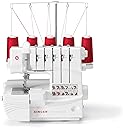
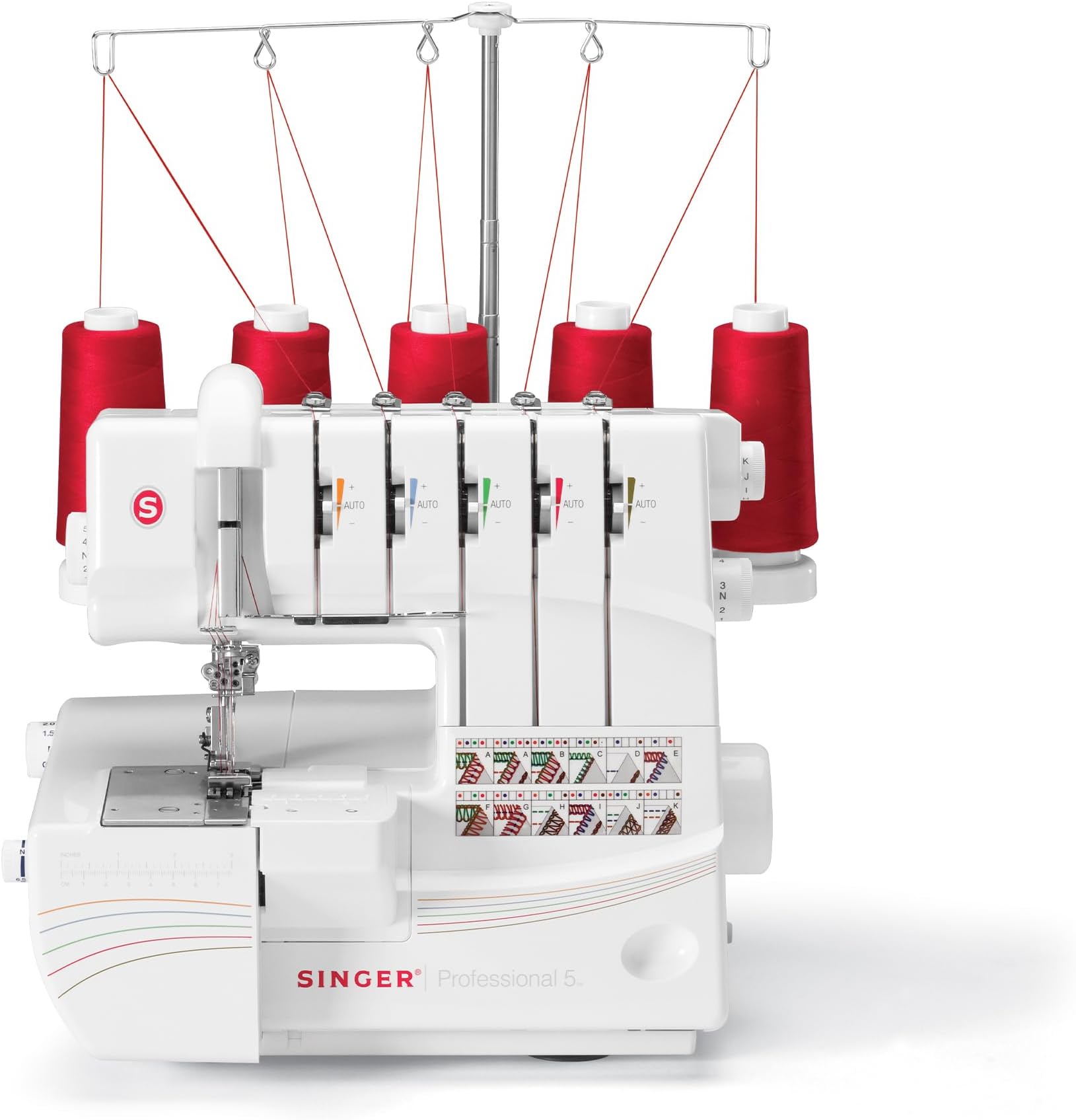
The SINGER Professional 14T968DC Heavy-Duty Serger Overlock is a powerhouse sewing machine offering 2-5 thread stitch options, a high-speed 1,300 stitches per minute rate, and a fully automatic self-adjusting tension system. It includes a comprehensive accessory kit valued over $100 and features an easy threading diagram for quick setup. Perfect for professionals and passionate hobbyists alike, it delivers store-quality seams and finishes with unmatched efficiency and precision.


| ASIN | B002PDZTT2 |
| Best Sellers Rank | #83,010 in Arts, Crafts & Sewing ( See Top 100 in Arts, Crafts & Sewing ) #14 in Sergers & Overlock Machines |
| Brand | SINGER |
| Brand Name | SINGER |
| Color | White. |
| Customer Reviews | 4.2 out of 5 stars 1,500 Reviews |
| Global Trade Identification Number | 00037431882684 |
| Included Components | Coverlock Machine + Accessories |
| Item Dimensions D x W x H | 10.5"D x 13.5"W x 11.5"H |
| Item Type Name | Serger |
| Item Weight | 18.6 pounds |
| Manufacturer | Singer |
| Material | Metal, Plastic |
| Model Number | 14T968DC |
| Number of Items | 1 |
| Part Number | 14T968DC |
| Power Source | ac |
| Product Dimensions | 10.5"D x 13.5"W x 11.5"H |
| UPC | 037431882684 |
| Warranty Description | 25-year limited warranty |
G**E
Great stitch quality, fast, easy to thread
UPDATE July 21,2021: I have now bought a second copy of this machine. Keeping one setup for coverstitch and the other for overlocking. For the Amazon price, around $450, this is a no brained setup. I whipped through making 10 tshirts in about an hour with not having to change between coverstitch and overlocking. The one machine would honestly have been fine, but at this price, really a no brained. Plus, with two identical machines, nothing new to learn and always have a backup for the other. Great machine. Tip: I see that some third party sellers are selling for $800. Definitely wait for Amazon to have back in stock or check the Singer website for their stock. The real going price for this right now is $450. —- UPDATE June 14, 2020: So after a few days of sewing, the knife stopped moving. I cracked open the cover to look under the hood and immediately saw the issue. The metal pin in the joint of the arm assembly for the moveable knife had fallen out along with the small set screw on the arm. Putting the pin back in and tightening up the set screw was relatively quick and easy except for removal of the plastic cover which was tighter and more of a pain than it should have been to remove and put back on. I recognize that this issue would likely have caused a return or a repair trip for the average sewer. It didn't look like the set screw had any threadlock on it and with how much overlockers vibrate with normal use, I imagine the screws could get loose and will need to be maintained. I fixed this because I am somewhat mechanically inclined, but buyers should be aware that with machines like this, some mechanical maintenance will probably be required similar to industrial machines. That said, they should have tightened down the set screw better when manufacturing so it didn't loosen up in the first week. Still a great machine when its screws aren't loose! —- ORIGINAL REVIEW: This machine has to be the best deal going for a serger that can also cover lock. On sale, it was around $449. For that money, you get beautiful overlock stitches, automatic tensioning, nice wide swing arm, up to 5 thread coverstitch, and excellent speed. There are machines that are literally 8x the price that don’t give you all of these features. Singer’s own other brands use the same internal mechanism for 3x the price. In my view, air threading saves very little time and isn’t worth the extra thousand or two for the literal one minute of time savings when changing configurations. I was confused by some of the lower ratings and read those reviews. It appears that there are a number of reviewers that were simply intimidated by the machine and the threading. Know this, this serger is an extremely simple machine. Much simpler than a computerized sewing machine. On this machine, you can thread up to three needles and two loopers. Depending on the stitch, you may only need a single needle and single looper, or two needles and single looper etc. So the most common configurations generally won’t require more than 3 spools and 2 of them will be needles (this is true of all sergers). All of the configurations possible are listed on a handy dandy quick reference page in the manual (worth copying that page and keeping it close to the machine). The needles are incredibly easy to thread, about 10 seconds each. The loopers have a specific pathway that is clearly marked with color coded dots. Once you know the pathway, each looper will take about 30 seconds to thread. So I can go from 3 thread overlock to 5 thread coverstich in about 3 minutes. If someone is spending hours, they’re doing it wrong! Changing thread for the same configuration is the same as any other machine, just tie off the old thread to the new thread and pull it through. Again, a 2 minute operation for 4 spools. This is a hidden gem of a machine, not just for the variety of stitches and speed, but the quality of the stitching compares to industrial machines. All for under $500. If you’re in the market, highly recommend this machine. You can take the thousands you’ve saved and either buy fabric or buy stock and retire earlier.
T**L
Incredible machine for the price
UPDATE: I upgraded from the Singer Pro 5 to a Babylock Evolution (which is about 8x the price of the Singer) and wanted to share the pros and cons of each machine now that I've had experience with both of them. The Singer is the hands-down winner in the value-for-price category, and it has several features that the Babylock doesn't have. If you're considering buying this serger and want all the capabilities of a high-end machine, I would not hesitate; buy the Singer. I mostly sew garments, so I primarily use the 3- and 4-thread overlock stitches, and the coverstitch to finish hems. During the course of a project I'll generally switch from the overlock to the coverstitch multiple times. I sew knits, fleece, lightweight wovens like rayon and silk, heavyweight wovens like denim, and technical fabrics like DWR nylon. The stitch quality on both machines is superb. I haven't had any problems with tension or loopy stitches, assuming the machine was threaded correctly. PROS of the Singer: Large work area: The Singer's sewing arm is longer. That means there's more space to the right of the needle to hold fabric, allowing you to sew decorative stitches down the center of the fabric without it all bunching up. Better presser feet: It comes with a clear presser foot by default. The Babylock comes with an opaque steel foot so you can't see your fabric as it's passing under the needle. The Singer also comes with an accessory pack of six additional presser feet (I haven't tried them yet). Babylock charges around $50 per additional foot, including a clear presser foot. Wide flatlock: on fleece, the wide flatlock creates a seam that lies flat and is still stretchy. The Babylock doesn't have this stitch, only a narrow flatlock. The Singer does this one beautifully. Trim bin: the Singer comes with a plastic bin that attaches to the front of the machine and catches the seams and threads as the knife trims them during sewing. The Babylock doesn't come with this bin; you can purchase one for extra cost, but it has to hang off the front of your workspace (which doesn't work for me). Seam guide with 1/8" markings: the Babylock doesn't have a way to measure a precise 5/8" seam allowance, just a sticker printed on the plate with tick marks. It's up to you to use a ruler to figure out which tick mark lines up with the desired seam allowance width. The Singer has this printed on the cover plate. CONS of the Singer: Jumpy motor: when you step on the pedal, the motor hums until you press down hard enough, and then it jumps forward suddenly. There's no "slow start" as with the Babylock; it feels like it's all or nothing. Threading takes longer: threading is actually quite easy with both machines. With practice, you can probably thread them both in the same amount of time, though the Babylock's Jet-Air threading system eliminates errors. I've had to rethread the Singer after making a mistake, which increases the average amount of time needed to rethread the machine (especially including the time to sew up a test swatch just to make sure you threaded it correctly). However Singer has done a great job at diagramming the thread paths and color-coding them. With frequent use, you should get the hang of it and make fewer mistakes. More dials to set: when switching from one stitch to another, there is a long checklist of dials and settings to adjust in order to set up the machine properly for the new stitch. In comparison, the Babylock has fewer; it's more automated. I still need to consult the instruction manual when setting up the Singer; with the Babylock I can pretty much figure it out without the reference guide. OVERALL, I still highly recommend the Singer. It's just as capable as the highly-priced machine at the cost of spending a little more time threading it when changing stitches. This is a fantastic value for a 5-thread machine that does both overlock and coverstitch. Singer's obviously put a lot of thought into the design of their sewing machines and sergers. If they ever figure out how to do automatic threading (which I'm fairly sure they will, eventually), then Babylock will lose its edge. -------------------------------- ORIGINAL REVIEW FOLLOWS: I love my Singer Quantum Stylist sewing machine, so I decided to take a chance on this as my first serger. Even with a technical background, I admit I was intimidated at first by the complexity of threading the loopers. However after printing the workbook and following the instructions carefully I figured out how it works. Threading is pretty straightforward, but definitely takes a bit of practice to become confident. Look for the colored dots on the metal loopers and follow the diagram printed on the faceplate. The foot pedal control is similar to a low end (non electronic) sewing machine. When you first start pushing the pedal, the machine hums for a while until it suddenly starts going full speed. Once it's going you can slow it down, but that initial burst of speed is very disconcerting. I thought the machine was broken at first. This is my first serger so I don't know if it's normal but I suspect it's common to all low end machines. So far I've tried the three thread overlock, the cover stitch, and the rolled hem. All came out great on the fabrics I've tried. I even serged a knit tunic in the first week of owning the machine. I love that the machine does both overlock and cover stitch, so I won't have to buy a separate machine. Pro tip: use your label maker to label the five different knobs on the sides so you know which one's which. Then you can just reference the chart at the beginning of each workbook chapter and set each dial to the correct setting. Note for beginners (I had to look this up): to remove fabric after you are finished sewing, rotate the handwheel until the needle is in the up position. Lift the presser foot. Use the little screwdriver to sweep under the presser foot, catching the looper threads, and pulling them forward away from the machine by a few inches. Snip these threads. You should then be able to pull the fabric towards the back of the machine until it comes clear, at which point you can snip the remaining thread to get it free. That was not at all obvious from reading the manual. Funny story: after showing my boyfriend the stitch samples I made, he started hunting for serged seams on all of his RTW and comparing them to my stitch samples. I think he might start using the machine too!
K**Z
Economical Coverstitch/Serger
I am new to sewing and I wanted a machine that could do a coverstitch and I also wanted a serger. Seeing the cost of a dedicated coverstitch machine, I leaned toward this machine since it would give me both the coverstitch and serger capability while costing less than buying a dedicated coverstitch machine. Changing between coverstitch and serger isn't all that hard but a bit time consuming so you will need to plan which parts of your projects to cover at each step. Setup between the two functions is fairly easy once you do it a few times. Since I am new to sewing, I wanted to start out with an easy project to learn the machine and practice the basics so I decided on making some pillowcases as Christmas gifts. The results are sure to be received well by the intended recipients as I know I love the pillowcase I made as a test and that I will keep for myself. I am giving the product 4 stars for beginners because it is easy to setup once you know how to do it but I struggled a few times getting both the coverstitch and the five-thread safety stitch to work when switching. The last pillowcase I made had one of the threads break during the five-thread safety stitch and it was a gift so just had to go with it being a four-thread safety stitch. I give four stars for easy to learn because there is a learning curve but with trial and error you will learn how to use it. I give four stars for easy to use because I did struggle a bit getting it to work properly but the results are fantastic when that is achieved. Also, I used the hand wheel when doing the coverstitch because with my limited experience I could not get a satisfactory result under power. The machine does like to spin up quickly and I need more practice to get it going at a reasonable pace and keeping the fabric lined up. Overall I give the product 5 stars because you get all the functions you could ever want at a reasonable price and I love the capabilities of the machine.
P**.
Not a good machine.
Oh my. Tried it. It came with leader threads (no spools) to do a triple cover stitch. I tied on my serger threads and pulled them through no problem, except when it came to the needle. Ugh! Took me 3 hours, glasses, magnifying glass and bent up serger threader to finally be able to thread the needles. It sewed really nice until at the end of the fabric I raised the foot (supposed to release the tension) and tried pulling the piece out of the machine backward. No tension release. Just before I started pulling, I noticed that one of the needle threads was broken. OK. After a HUGE tug of war, I finally got enough of a thread chain to cut off. Thread in the same needle kept breaking. OK. I put in a new needle that Singer supplied. Same thing. Also, they didn't show how to get the threads under the foot. I tried several different things, but nothing worked. The thread broke again. Same needle. Then when I opened the looper cover, I found that all of the needle threads had wound around a looper and tied themselves into a tight knot. What an ordeal. I spent all day, more than 5 hours trying to get the thing to stitch correctly. No luck. Threads kept breaking and tangling. I finally said enough is enough. I packed it up and am waiting for UPS to pick it up. I had previously tried the Brother CV3440 and that thing was junk. I have now ordered the Juki MCS-1500. If I can't make it work I will give up on a cover and chain stitch machine. The Juki is supposed to be so much better than these others, but I did not want to spend the money. Wish me GOOD luck with the Juki.
J**H
The quality and functionality. Please read this review for an important tip.
I am going to say that this is a very wonderful machine. I am very mechanical but had only worked on sewing machines before. I would say that it took me about three hours to understand how the machine works and how to thread it. (using the manual and work book as references) However, I had a problem, in that it is extremely important to do the needles after the loopers, so that the threads for the loopers go under the foot to the left and the threads from the needles go though the needle plate holes and to the rear of the machine. That is, the needle threads are on top of the looper threads sequentially. The they can tie the first knot. Once I understood that, I have had no issues. I just did the 5 thread safety switch wide thread on my first try. The machine sounds like a symphony with all those threads and mechanisms doing heir thing. The result was perfect just using the automatic tension system with no overrides. BTW, the workbook available for download online does not have the last 20 or so pages. I bought mine printed off the well known craft source starting with an "E", had it in a few days.
B**E
color me impressed!
below is from my amazon canada review. this serger is so awesome, i wanted to share my feedback: https://www.amazon.ca/gp/customer-reviews/R3UUW5PUZ265DH/ref=cm_cr_arp_d_rvw_ttl?ie=UTF8&ASIN=B002PDZTT2 i've learnt basic sewing from my great grandma's treadle. the foot cranked singer sewing machine. i picked this serger because of its cover stitch feature and the automatic tension system. of course, the brand name and the price mattered. so, i just received this serger today. packaging was decent and contents seem new as expected. the whole package itself weighs a hefty lot, so i guess i have to assume that the heavy duty metal frame is as advertised. i was initially disappointed that there were no spools of thread as per the product images. i had to run to the mart to purchase a couple of serger spools. after which, i learned how to thread using the tie in method, pretty easy. as per documentation, the machine was setup by default to the triple cover stitch. i was pleased to see that a sewn on fabric was underneath the presser foot to serve as a sample. pretty neat! come serging time, i tried the sleeve of my shirt. it was a challenge because the clearance to insert the fabric below the presser foot is too small. i had such a hard time inserting my trimmed and folded sleeve. compounding this challenge was that this serger didn't have the free arm like in regular sewing machines. also, the bulb's light was emitting a dim yellow light like it came from the 80's. i have to find a bright white led bulb replacement asap! after all said and done, the triple cover stitch works as expected. wow! when storing this machine, there was some type of plastic cover that didn't really fit the shape of this serger. too bad. that's all for now. edit 2016-11-20: apparently, the product page says this comes with an "Extra-High Presser Foot Lifter". I have to figure out where that is. the foot pedal's cord seems too short for comfort. I had to position this machine at the edge of the table. not good. edit 2016-12-16 i've tried the following stitches : * Triple Cover Stitch * Wide Cover Stitch * Narrow Cover Stitch * Four-Thread Safety Stitch * Five-Thread Safety Stitch Wide * Five-Thread Safety Stitch Narrow * Three-Thread Ultra-Stretch Mock Safety Stitch * Four-Thread Ultra-Stretch Mock Safety Stitch * Three-Thread Overlock * Double Chain Stitch I haven't tried the Flat Lock Stitch but so far, i can say that the stitches come out as expected. i tried on denim / jeans, stretch, non-stretch fabrics, etc. threading was a challenge the first first few times. for now, i don't even need the manual. I just follow the sticker diagrams on the machine plus the one Handy Reference Chart on page 9 of the handbook. the Auto Tension system is the best time saver on this machine. turn a dial and that's it. in conclusion, what made me decide on the age old dilemma: "do I need a Serger?" to which I answer right now, yes with the Singer 14T968DC Professional! this Serger is so worth it! update 2016-12-31: uploaded pictures. did the 3 Thread Flatlock stitch. easy to thread, gorgeous results! WOW!
S**T
Excellent Serger w/ Cover Stitch for the Money!!!
I have had a Bernina serger for years, unfortunately I purchased it the year before they added a cover stitch but it has been a workhorse for me. It’s just a horrible pain to serge an edge and have to go to the sewing machine to use a double needle to finish off the hem. I have priced 5-thread sergers for awhile. Some manufacturers are no longer making them (that’s you Bernina), some are cover stitch only, and many are very expensive ($1,000++) with bells and whistles like air-threading, etc. I wanted a good, solid machine that would roll-hem, do a decent safety stitch for knits, a neat three or four thread overlock for heavier fabrics and a cover stitch. After reading many reviews about this Singer, I decided to take the plunge for Christmas. It came the same day Prime! The serger is heavy and of molded composite like most newer machines. It comes with six extra feet for using elastic, beads, blind hem, etc. Included are the basic serger tools ( extra needles, spool holders and nets, screwdriver, oil, and the most important tool: TWEEZERS! I’ll come back to that.) the instruction manual is pretty comprehensive about set up and threading. There is a CD workbook included but you can find the manual and the workbook online. **** I highly recommend you get to know this machine by working through every stitch in the workbook. It is a very good workbook, but even for an experienced seamstress like me, the threading patterns of the lower looper and cover stitch is very different from my Bernina and took some time for me to get used to. By the time you finish the workbook, you will be adept at knowing the needle and looper threading formations. It really makes a huge difference. I cut up a bunch of 2.5”x 6”. muslin rectangles and sewed out samples of every stitch then with a fine sharpie marker wrote down all the settings on the cloth so it’s an easy reference for future threading and programming. Some stitches will need tension adjustments of course. This serger offers an auto tension function when you thread the machine but be sure to create the stitch as shown in the workbook, and to do that you will have to adjust the looper tensions occasionally. The cover stitch is beautiful. I’m so happy with the chain stitch and the two and three thread cover stitches. What an awesome machine for $400+ ! I’ll admit I was apprehensive as it’s not an expensive serger but I’m so happy I bought this. It overlocks like a dream especially on cotton and knit fabrics. I made 15 sample stitches from the workbook and most likely I’ll use six regularly but it’s nice to know this serger is capable of sewing so many different stitches. My Bernina wasn’t quiet, this one is about the same but it’s a serger, I don’t expect it to purr. The machine stitches smooth and I like having a foot pedal pressure adjustment. The only criticism is the foot pedal is not as large or robust as my old serger. Excellent serger for an excellent price. No it doesn’t air thread but your tweezers will be your best friend when threading this machine. And an Ott light. Take your time, work through the threading schematics and the workbook and this machine will give you some great stitching capability and for home and professional projects.
A**E
It's a Steal!
What a bargain! I read the scattergun ratings here and everywhere else and was a little leery of ordering, but, in the end, my bargain-hunting side won out, and I really wanted a five-thread serger. I also have an eight-thread serger, and it's mostly overkill. Plus, even after about ten years, I still miss being able to adjust the tensions to my liking. This machine is just great. The one thing I would highly recommend is that you print out the "cheat sheet" in the front of the instruction manual and keep it handy. It will save you much weeping and gnashing of teeth. I spent a good half hour threading (incorrectly) for a three-thread overlock. Once I referred to my cheat sheet, it took about five minutes to spot my error and be up and running. The thread paths are color-coded and easy to follow. I find I need to tweak the auto tension settings slightly, and I love that I can easily do so. The serger appears to be well-constructed and is very sturdy. It doesn't bounce or walk, and is reasonably quiet for a serger. I rarely run a serger at top speed, but I did try this one, and it continued to be rock solid. It has a mock safety stretch stitch that is just outstanding on stretchy knits. It has a notched lever that delivers the lower looper and chain looper thread to the correct thread path before threading into the loopers, and that is amazing. It works every time. I was completely skeptical of this feature, but you can't fool it. Bottom line, I'm a happy camper. The Singer Pro 5 came with six specialty feet included free. Granted, how often do you use them? Still, they're nice to have, you have to pay extra to get them with any other serger, and they actually work great. They're much easier to change out than some other sergers I've owned, too. I'm really happy with the needle thread paths, which keep the threads from tangling up with each other. It's a small but nice touch. You also get a very nice, complete workbook on CD which you can print out or just load onto your Kindle or iPad. If you're in the market for a mid-price serger with a lot of features for the money, I just don't see how you can lose. The coverstitch feature is an excellent value. I was surprised when it really worked, but it does. You have a choice of wide, narrow, or three-thread cover. It makes a beautiful hem on knitwear. I would buy this again in a heartbeat.
V**O
Practicidad
Es mi máquina favorita, todo lo que tienes que saber, está en el manual. Prácticamente se ajusta sola, sin embargo no la recomiendo a principiantes porque se pueden frustrar. Cose precioso y no necesitas otros prensatelas para usarla, yo los conseguí tiempo después, pero sinceramente casi no pongo elásticos con guía ya que soy buena poniendo a pulso. Ampliamente recomendada 💖 si te cuesta trabajo entenderle al manual, hay un señor que hace tutoriales de esta máquina en Youtube.
P**I
Taglia e cuci rapidamente
Perfetta semplice e pratica. Prezzo ottimo.
D**S
I love this combo machine
I love this serger/coverstitch combo machine. At first, it seemed a daunting task to switch between the modes and to thread the machine. After a day of using it and testing all the stitches, it became second nature. Simply change the auto tension dial to the required letter setting, set N/R, C/L for upper looper, change needle position, then thread. It's quite easy to thread. I don't use the tie-on method, because it's very quick to thread from scratch. There's no need to check the manual for threading order or thread guide for each needle every time you switch stitches. Threading order doesn't matter, as long as you understand logically what each needle/looper does, and replicate the same end result. The machine is not finicky to use. I think some comments I've read before purchasing this machine don't do it justice. Some people are afraid of the complexity of a serger/coverstitch combo machine, and think getting separate machines will make it easier to thread and use. However, separate machines will still require threading, and will use more spools of thread or require you to move the spools between the machines. And most importantly, a serger and a coverstitch machine separately CAN'T PRODUCE A 5-THREAD SAFETY STITCH! I'm glad that I didn't listen to those comments and trusted that my brain power will be able to tame this machine. A bit about my skill level: I'm not a sewist, nor a hobbyist, and very new to garment making (~1 month). NEVER SEEN/TOUCHED A SERGER BEFORE RECEIVING THIS ONE. I made my first woven top by copying an existing top that I owned, using a sewing machine. I wasn't happy with the seams overlocked on my sewing machine (too stiff, and not as pretty as serged seams), so I decided to buy a serger right away. I was to buy Brother 1534D, but luckily discovered this Singer combo machine. After receiving this machine and familiarized myself with the functions, I immediately used it to make several knit tops, paying attention to proper techniques such as stabilizing seams with clear elastic or knit stay tape. All came out looking like store-bought, and this was a huge encouragement for keep making more. It's not an exaggeration to say that this machine alone elevated my garment-making experience. Without it, I would likely have given up already, because I wouldn't have touched knit fabric at all, and I don't wear woven clothing daily. The machine came with 6x 9/14 and 2x 80/12 regular point needles. I immediately purchased dozens of ELx705 80/12 and 90/14 SUK needles, because I knew I would be working with knit fabric a lot more after acquiring this machine. Note: it was shipped without the accessory feet. Singer no longer includes them. The product listing is outdated.
M**Y
Alleskönner!
Ich habe mir die Maschine gekauft, damit ich endlich bei dehnbaren Materialien am Saum einen Überdeckstich nähen kann. Umso überraschter war ich dann, als ich herausgefunden habe, dass man damit auch einen Babysaum nähen kann. Für die Bedienung ist es ratsam sich die Bedienungsanleitung durchzulesen und auch einige Videos dazu im Internet anzuschauen. Die Maschine ist sehr komplex, aber sobald man damit vertraut ist macht es richtig viel Spaß damit zu nähen.
F**S
Excelente maquina
Bom funcionamento, muito prática e robusta
Trustpilot
2 months ago
3 days ago