
DOWNLOAD THE APP


Customer Support

Desert Online General Trading LLC
Warehouse # 7, 4th Street, Umm Ramool, Dubai, 30183, Dubai
DOWNLOAD THE APP
Customer Support
Desert Online General Trading LLC
Warehouse # 7, 4th Street, Umm Ramool, Dubai, 30183, Dubai
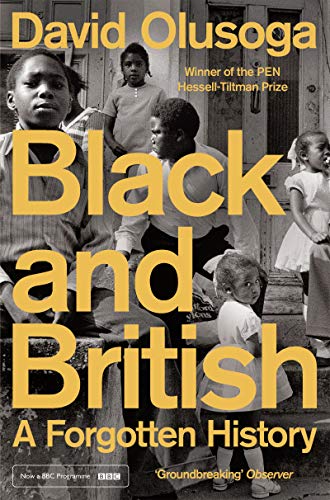
Full description not available
P**.
Excellent content and style
A most interesting read. David is an excellent researcher, and writer who is well grounded in his subject. Having seen some of his TV series, I was very pleased that the book is just as good. David wants us to realize that British history is by definition also Black history - there can and should be no separating of the two.
K**C
Fantastic!!
This is an amazing book. Very in depth and worthwhile. You will not be disappointed!
M**R
An Essential Read
Even if you never read this book, it’s existence does an important job for you - it tells you that there is a significant history of black people in Britain. Long before the arrival of West Indian immigrants in the 1950s, there was a appreciable black presence - in Roman Britain, in Elizabethan Britain, in Georgian Britain, in Victorian Britain, fighting for Britain in the first and second world wars. There has been, and will continue to be, a concerted attempt to write black people out of British history and this book does a necessary job in giving them back their place in our history.I come from Liverpool - former slaving port, former cotton port, former blockade-running port for the confederate South in the American Civil War. My ancestors were Irish - probably escaping the great famine in the 1840s. The African derived community in Liverpool began with slavery in the 1750s. So in terms of Britishness, the black people of Liverpool are more British than I can hope to be.That these sorts of qualification are needed says all we need to know about racism in Liverpool and elsewhere.Turning to the book itself - it is a masterly and scholarly piece of work. Well researched, well told, informative, engaging and, in many ways, life changing. Seeing how attitudes to black people ebbed and flowed over the years confirms that our current racism is not something we are doomed to live with, but something that can and will, hopefully, change.David Olusoga is a black Briton, and the opening of the book takes us back to his childhood in the North-East and the racist attacks that his family had to endure in the 1970s at the hands of the National Front. That anyone should have to endure this kind of treatment is an indictment to the politicians of that era and the people who believed and followed them.He then takes us to the slaving fortress of Bunce Island, in Sierra Leone to show even worse horrors before beginning the history proper with the Roman legions and progressing through the centuries from when black servants and courtiers were a symbol of wealth and Africa was a fabled land of strange races and curious customs. The slave trade and the movement for it’s abolition seems to have been a high point in the regard for black people by the British, but once it was abolished, the familiar patterns of racism reappeared, this time bolstered by the pseudo scientific concepts of racial Darwinism (not supported by Darwin, by the way - and not really by any actual scientists).The book then progresses through the first-world war when debates raged over whether black troops should be deployed in Europe, to the first recorded racial murder - in Liverpool 1919 when Charles Wooton, who had served in the Royal Navy during the war, was drowned in Queens Dock by a mob of white Liverpudlians - possibly even including my ancestors.During the second world war, there was some encouraging signs of progress when the appalling treatment of black GIs by their white American counterparts evoked greater sympathy on the part of the British - though this was soon forgotten after the war and in the subsequent decades. Very few white people emerge with any credit from this long sad tale but enough do to encourage those us to do better in future and to take a stand for universal humanity.My final word - this is not a sad book, not a tale of woe - and much more than just a catalogue of the lives of the black British. It is also a celebration of how much black Britons have contributed to British life and to the country. An essential read.
E**W
For those that are not clued to all the best history themed Twitter fights
Thoroughly researched and far ranging, David Olusoga's book is topical, necessary, and provides an overview of a neglected element of British history, as well as being essential reading for the contemporary debate about the role (or even existence) of black people in Britain throughout the ages.It might seem strange to begin a review for one historian with a story about another, but bear with me... For those that are not clued to all the best history themed Twitter fights, eminent Classicist Mary Beard recently provoked uproar when she said that Roman Britain was ethnically diverse after a BBC cartoon dared to include a black Roman soldier and his family. It was not supposed to represent the 'typical' but the 'possible'. Some of the vitriol she received was unfathomable and all because, it seems to me, that there seems to be a whole lot of people who want to see this country as the whitest of white places. Most importantly, the potential for reasoned debate based on evidence was shut down by denial, personal attack, and modern ideological ideas about race. It was a vivid demonstration of the intellectual space into which Olusoga was stepping.Indeed, this is the period with which he begins his chronological history, noting the role of imperialism that brought different peoples to these lands and how much later it would take Britons to Africa [loc 760]. From Roman soldiers to black slaves to WW2 GIs, Olusoga traces the changing role of black men and women in British society, as well as the attitudes towards them. The specific focus is on the international slave trade, with a much smaller section on post 1900, but there are significant holes in the story due to the nature of the evidence. He notes the difficulties in researching a subject with limited primary/autobiographical sources, especially when looking at black women, which is why there is inevitable repetition of the big names such as Olaudah Equiano. This is no surprise as the underlying theme of the book is the deliberate exclusion of black men and women from the historical record, an interpretation which might have seemed extreme had it not been so clearly illustrated in contemporary debates. That the subject has only recently come to the forefront indicates we have a long way to go.With all of the horror contained within, it would be impossible to point to a worst time or greatest act of immorality, yet for me, the story that stopped me in my tracks was that of the slaver ship, the Zong. On a journey in 1781, fears arose that there was not enough water to last the trip, so over a period of days, 133 slaves were thrown overboard and left to drown. Even worse, once in port, the slavers tried to cash in the insurance policy on the slaves they had killed, for the loss of their property. The cruelty and sheer disregard for human life that this evinces sickened me, yet it is one of many stories of inhuman action towards people simply because of the colour of their skin.And the best part of it? The stories that run in the background of the book, often without detail, because they represent the lives of ordinary people, every shade of colour, who lived and loved and married each other despite social conventions, laws, or any other issue that might have stopped them. Real people living as families, producing children, being friends. In a society where race can still affect your opportunities in life, these are the things to hold on to then and now.Highly recommended.
F**E
A very balanced treatment which should be read by all British people.
I decided that this was one of those books that one "ought" to read with the expectation that it would be a longer version of those Guardian articles which compare the British to the perpetrators of the Holocaust. Instead I found a very well balanced account of the history of Black British people. The way in which the slave trade corrupted British principles was a frightening lesson in how a country can go backwards. Accounts of court judgements back to the sixteenth century insisting that justice was colour blind and that there was no basis for slavery in England slipped into increasing support for industrial scale slave trading. Despite the slave trade, he describes how racism, though never absent, was not a major issue until the second half of the nineteenth century when social Darwinism and eugenics gave it a kind of pseudo-scientific respectability which was only blown away when the Nazis took these to their horrible conclusion. The disgraceful way in which the black populations in the West Indies were treated after emancipation was new to me but the most disturbing revelation was the blatant racism of the post war Labour governments from Attlee to Wilson and Callaghan that came as a real shock. By contrast Olusoga is highly complimentary about Ted Heath's immediate and unqualified reaction to the notorious Powell speech (he doesn't mention how Heath overturned Wilson's shocking treatment of the East African Asians). This is a very important book that should be read by British people of whatever ethnicity.
M**M
A Forgotten and Often Ignored History.
Black and British is an excellent account of Black history in Britain from the British Nigerian historian, DavidOlusoga, written to accompany his television series of the same name.Even today, many people still think that the arrival of black people in the UK came about with the docking ofthe SS Empire Windrush in 1948, but black people have been here for centuries. If you were able to time -travel back in time to Roman Britain you would have seen black roman soldiers guarding Hadrian's Wall,and the Roman Emperor Septimius Severus also a black African, administered his Roman Empire from York,showing a black influence in Britain from the earliest times. Slavery rears its ugly head with a history ofBritain's part in this evil trade. There were black chattel slaves and also free black people in Tudor England.This is an excellent book which throws light onto a subject that needs to be on the National Curriculum.Published in 2016 by Macmillan624 pages.
V**L
Brilliant book
Brilliant book - a well-researched and measured account of some of the worst, and best, parts of British history. It details the appalling cruelty of the slave trade, and slavery itself, and the disregard for the humanity of others that allowed both these and less dramatic forms of abuse to flourish. It also depicts the concern and commitment to others' well-being, of both Black and White people, that opposed it and the complexity of the political, social and personal processes involved.I have long known that we British are a hotch potch, both ethnically and culturally, and that everyone has an immigrant background, if you go back into pre-history, but I had no idea of the variety of ways in which Black British people have contributed to the story of the country since Roman times. The book is fascinating - the author brings the (in)humanity of the story to life without losing the attention to detail and evidence that make it such a compelling read. I'm thinking of buying the print version too!
Trustpilot
2 months ago
1 month ago