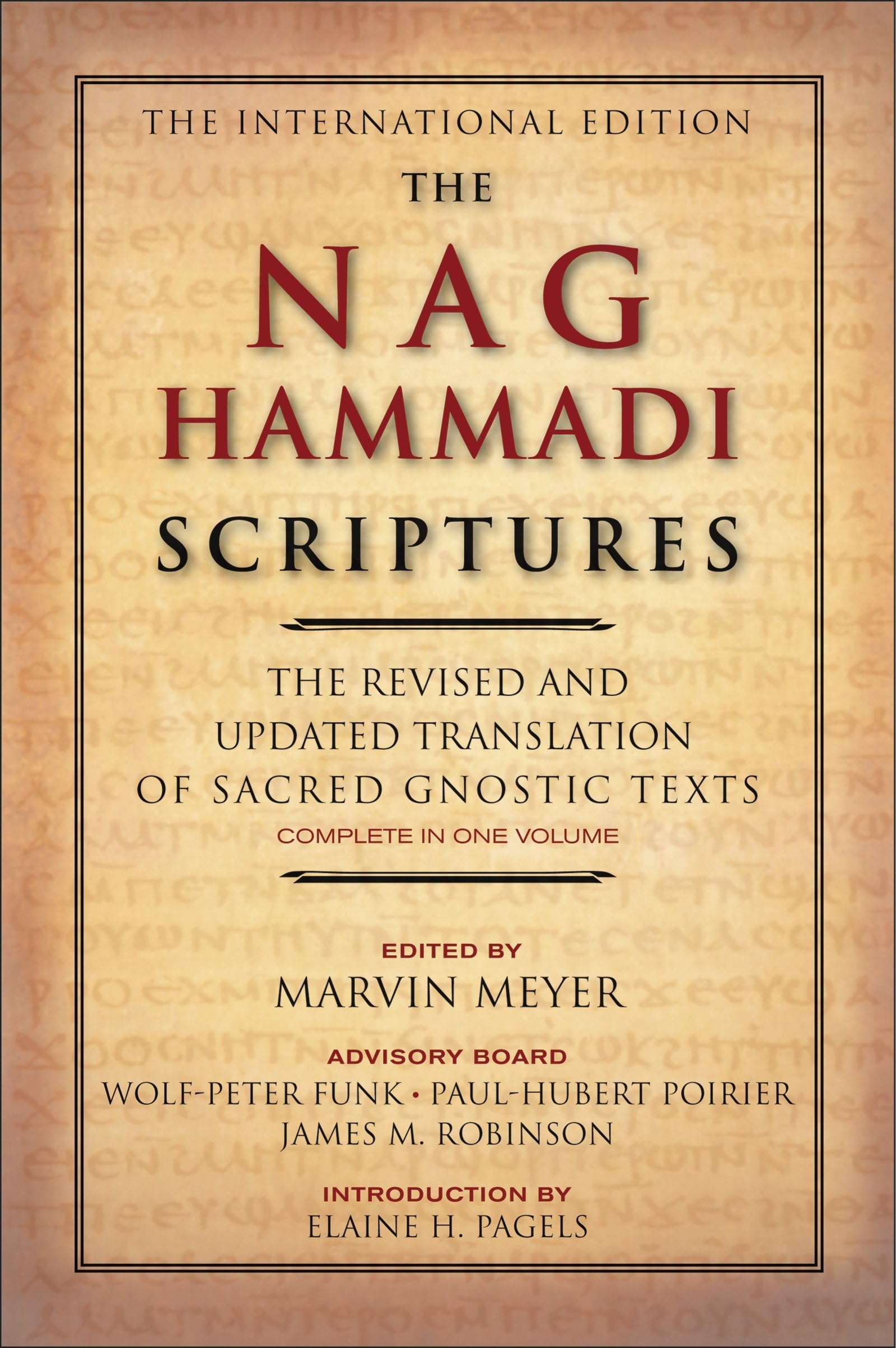

The Nag Hammadi Scriptures: A Study of Gnostic Scriptures and Early Christian Thought
Product ID: 1307347
Desertcart purchases this item on your behalf and handles shipping, customs, and support to Romania.
The Nag Hammadi Scriptures , edited by Marvin Meyer, is the most complete, up-to-date, one-volume, English-language edition of the renowned library of Gnostic manuscripts discovered in Egypt in 1945, which rivaled the Dead Sea Scrolls find in significance. It includes the Gospel of Thomas, the Gospel of Mary, and the recently discovered Gospel of Judas, as well as other Gnostic gospels and sacred texts. This volume also includes introductory essays, notes, tables, glossary, index, etc. to help the reader understand the context and contemporary significance of these texts which have shed new light on the complex history of early Christianity and ancient Gnostic thought. The landmark compilation of ancient manuscripts that constitute The Nag Hammadi Scriptures is a discovery that challenges everything we thought we knew about the early Christian church, ancient Judaism, and Greco-Roman religions. This essential scholarly edition offers a direct encounter with foundational Gnostic gospels and sacred texts: The Gnostic Gospels: Read the complete texts of the Gospel of Thomas, the Gospel of Mary, and the recently discovered Gospel of Judas in a single, accessible volume. Complete Nag Hammadi Library: Explore the most complete, up-to-date English edition of the entire renowned library of manuscripts discovered in Egypt in 1945. Scholarly and Accessible: Navigate these ancient writings with the help of comprehensive introductory essays, notes, a full glossary of terms, and a complete index. A New Look at Early Christianity: Discover ancient texts that challenge long-held beliefs about the early Christian church, ancient Judaism, and Greco-Roman religions. Review: In amazing bye - This is an amazing book! It truly reveals a completely fresh and unexpected perspective on Jesus, uncovering sides of him that are rarely explored in traditional teachings. It challenged my preconceptions and deepened my appreciation for his life and message in ways I never anticipated. This version keeps the original enthusiasm while making it more polished, eloquent, and engaging—perfect for sharing on Goodreads, desertcart, or with friends! If you have the book’s title or more details about what specifically surprised you, I can refine it even further. 😊 Review: A lot more information - This book explains so much more than I thought it would.
| Best Sellers Rank | #4,463 in Books ( See Top 100 in Books ) #3 in Gnosticism (Books) #3 in Mythology & Folklore Encyclopedias #6 in Religion Encyclopedias |
| Customer Reviews | 4.7 out of 5 stars 4,031 Reviews |
W**Z
In amazing bye
This is an amazing book! It truly reveals a completely fresh and unexpected perspective on Jesus, uncovering sides of him that are rarely explored in traditional teachings. It challenged my preconceptions and deepened my appreciation for his life and message in ways I never anticipated. This version keeps the original enthusiasm while making it more polished, eloquent, and engaging—perfect for sharing on Goodreads, Amazon, or with friends! If you have the book’s title or more details about what specifically surprised you, I can refine it even further. 😊
J**E
A lot more information
This book explains so much more than I thought it would.
J**S
After Mary said these things, she was silent, since it was up to this point that the Savior had spoken to her.
I began reading the Nag Hammadi scriptures in the early 80's when the James Robinson The Nag Hammadi Library: A Translation of the Gnostic Scriptures was first published. It was a hard read, mostly because there was so much missing (lacunae). This version makes it much more understandable but not without a price (see the excellent review by John Aaron regarding a little too much translation). Oh well, nobody is/was perfect except one. When I began reading this version, I imagined a round table of scholars who picked apart the essense of these ms's with the metaphorical microscope as a team and debated each and every translation problem. For how could only a few decide what the texts were saying with so many missing fragments and even whole pages/chapters? They used correlations with all available manuscripts to extract the essence of each manuscript and "fill in the blanks" to make it readable to the average person like me. Yes, it must have been like that. In some cases like The Gospel of Mary (of Magdala), we may not know all of what the High Priest said after he returned from death with just this manuscript because the first three chapters are missing. Maybe they wound up as fire-starter material for some poor people in Egypt? I don't blame them; we all need light/heat/food to dispel the darkness. A perfect solution. There are other works that are said to be the teaching of The Christ after he returned like Pistis Sophia: The Gnostic Tradition of Mary Magdalene, Jesus, and His Disciples . Yet, even the remnants of the Gospel of Mary are so profoundly beautiful; it is the single most beautiful thing I've read in my life. I need to find an older version to see where they deviate but, again, the essence must be there and only made clearer in this version. For anyone unfamiliar with the Gospel of Mary, imagine the scene given in Luke 24:10-11... "10 It was Mary Magdalene, Joanna, Mary the mother of James, and the others with them who told this to the apostles. 11 But they did not believe the women, because their words seemed to them like nonsense." Why did their words seem like nonsense? Perhaps because they were so profound as to be not believable? Or perhaps for a more "practical" reason; the editors of the Bible did not want these more in depth details to be known. Teachings like this... "Peter Asks Mary to Teach: Peter said to Mary, “Sister, we know that the Savior loved you more than all other women. Tell us the words of the Savior that you remember, the things you know that we don’t because we haven’t heard them.” Mary responded, “I will teach you about what is hidden from you.” And she began to speak these words to them. ... "Mary Discusses Vision and Mind: She said, “I saw the Lord in a vision and I said to him, ‘Lord, I saw you today in a vision.’ “He answered me, ‘Blessed are you for not wavering at seeing me. For where the mind is, there is the treasure.’ ~ The Nag Hammadi Scriptures (p. 743) I'd like to say more about the Gospel of Mary but it's hard without giving examples and Amazon would probably say it's copyright infringement and not put up my review. For another good example of how the NH not only clarifies but expands and elucidates, see Mark 8:27-30 - Jesus asked them, "who do people say I am?" In the Bible, Peter (and others) respond "You are the Messiah" "one of the prophets" etc. But is that all of it? There were some other replies like that of Thomas... "Jesus said to his disciples, “Compare me to something and tell me what I am like.” Simon Peter said to him, “You are like a just messenger.” Matthew said to him, “You are like a wise philosopher.” Thomas said to him, “Teacher, my mouth is utterly unable to say what you are like.” Jesus said, “I am not your teacher. Because you have drunk, you have become intoxicated from the bubbling spring that I have tended.” And he took him, and withdrew, and spoke three sayings to him. When Thomas came back to his friends, they asked him, “What did Jesus say to you?” Thomas said to them, “If I tell you one of the sayings he spoke to me, you will pick up rocks and stone me, and fire will come from the rocks and consume you." ~ The Gospel of Thomas, 13 So did Jesus say "who do the people say I am?" He already knew what people said before they said or thought it. Isn't it more plausible that Jesus asked his desciples, who were closest to him, who they thought he was? There is so much more in the NHS especially regarding the Old Testament. That the word "Elohim" is both singular and plural is a clue. El is really the singular of Elohim. The names of God in the OT have been reduced to meaningless interchangable words. Yahweh, Jehovah, Elohim; do these names all mean the same thing? Are they interchangable like a car, a vehicle, an automobile? I think not. The belief of early Christian Gnostics was that the "God" of the OT was not the one true God. The one that Jesus called "Father." This is the key to understanding the OT. The "demigurge" or archon(s) are themselves temporary and subordinate to God the Father and Christ. If only Christians would put aside what they were TOLD by their Mystery Babylon occult rulers and read/research for themselves. "For what goes into your mouth will not defile you; rather, it is what comes out of your mouth that will defile you.” ~ The Gospel of Thomas 14, Matthew 15:11 "Jesus did many other things as well. If every one of them were written down, I suppose that even the whole world would not have room for the books that would be written." ~ John 21:25 I suppose He said many other things as well.
S**L
A must have for anyone studying the Bible
Interesting book! I wouldn't mind if the print were larger, but then I'm getting older. John 21:25 - "But there are also many other things that Jesus(Yeshua) did; and if they were all to be recorded, I don't think the whole world could contain the books that would have to be written!" I believe these are some of those books. It is a collection of Papyrus bound books, not scrolls, found near the city of Nag Hammadi in Upper Egypt, in a clay jar, sent to translators as a collective around the world, English speaking, French, German. These people obviously dedicated much of their lives to translating and piecing together evidence of other works as well..."Gospel of Thomas", "Gospel of Philip", "Wisdom of Jesus Christ", "Dialogue of the Savior". This is a must have for anyone studying the Bible.
C**W
Good compendium.
New but dinged up as I am resigned to expect for loosely packed books from Amazon. Subject matter is fascinating.
R**R
Quite a bit to think about ...
This isn't a book! It's actually a magic portal through which the reader tumbles from one dimension to another. Sometimes the results are unsettling, but one is always left believing that, however much new got found in the next dimension, a lot is still there waiting to be discovered. The blah cover of Nag Hammadi Scriptures makes it look like just another dry, boring now-let's-study-the-Bible type book. Instead it's a ticket for fascinating time travel out of the present and back to a murky, confusing past; from one civilization to another; from one rigid belief system to another; from one religion to another. You get bounced from reality to myth, and then all the way back again -- provided you still want to return. This ancient anthology is an impressive job of scholarship and clear translation, and it oozes with bunches of helpful footnotes, introductions and leads for further study. If it has a flaw, I think it is that, found here and there throughout the volume, are faint hints of traditional Christian ideas. Sometimes one senses the editors may be trying a little too hard to reconcile some orthodox Christian belief or other with what they assume the ancient authors were saying or thinking. And the book certainly wants to make you believe that everyone with a point of view needs to have earned a degree from some obscure school of theology or religion. But ignore all that. If you buy the book, you've got the right to make up your own mind about what it says. And if there ever was a topic about which everyone's entitled to their own slant, this must be it. As all readers will, I have a bias. I am a very devout Buddhist, steeped primarily in the religious traditions of Sri Lanka. The revelations I derived from the Nag Hammadi Scriptures were that passage, after passage, after passage is at least compatible with (and sometimes nearly identical to) Theravadan Buddhist teaching, and that both Gnostic ideas and Buddhism seem closer to one another than either one does to today's Christian practices. All of which suggests to me that, though the world doggedly perpetuates and exalts countless images of, names for and ideas about "gods", you don't have to be a great scholar or professional theologian to recognize that, in the end, there is after all only one. To me this book argues most eloquently that, whoever or whatever that god may be, a wise search for him/her starts by a dive deep within the human psyche.
S**A
Good read
Great book, came on time
N**E
Excellent
I love this book. It has a lot of lost info of the Bible and gives a great perspective.
M**M
Recommend
Important scriptures that should be read by everyone who has an interest in theology or esotericism.
M**A
Este es un libro extraordinario que reúne la totalidad de documento de Nag Hammadi.
Excelente libro para quienes desean profundizar en el estudio de las escrituras apócrifas.
P**A
👌
Fantastic
M**F
Small print
The book is very interesting but, unfortunately, the print is small and will strain your eyes after a while.
S**E
Good read on Gnostic scriptures
A neat translation on "Nag Hammadi" Scriptures. Recommended for seekers and people those who are interested on early christianity.
Trustpilot
2 months ago
1 week ago