
DOWNLOAD THE APP


Customer Services
Copyright © 2025 Desertcart Holdings Limited
DOWNLOAD THE APP


🚐 Stay Ahead on the Road with 24/7 Tire Intelligence!
The EEZTire-TPMS6ATC is a cutting-edge tire pressure monitoring system designed for RVs and trailers, offering real-time 6-second interval updates on tire pressure and temperature for up to 26 tires. Featuring a large color display, rechargeable battery with 60-hour runtime, and customizable sensor options, it ensures continuous safety and optimal fuel economy. Its motion-sensitive alerts and easy programming make it a trusted choice for professional travelers seeking peace of mind on every journey.


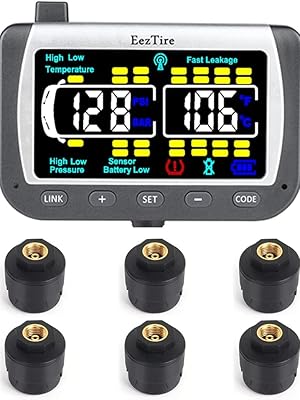


| ASIN | B009BEGV6S |
| Best Sellers Rank | #410,202 in Automotive ( See Top 100 in Automotive ) #104 in Aftermarket Tire Pressure Monitoring Systems (TPMS) |
| Brand | EEZ RV Products |
| Brand Name | EEZ RV Products |
| Customer Reviews | 4.1 out of 5 stars 1,125 Reviews |
| Item Dimensions | 12 x 10 x 3 inches |
| Item Weight | 1.2 Pounds |
| Item dimensions L x W x H | 12 x 10 x 3 inches |
| Manufacturer | EEZ RV PRODUCTS |
| Material | Rubber |
| Material Type | Rubber |
P**Y
Works perfectly for me. I have some tips that may help.
I see wildly different reviews on this product. Some give 1 start and others give 5. I have used the system since April 2018 on my GMC 350 and have zero issues. I thought I would comment on some of the reviews that I have seen. I believe I may know what is causing their issues. One guy shows a pic of a blown out tire and the system reading pressure in it. That is not likely. The system alarms in seconds if a sensor is removed (ie zero air pressure). It is easy as pie to test. Unscrew a sensor and you will get beeps immediately with a flashing tire showing what one it thinks is flat. Chance are his sensors were mixed up. One of them is probably reading zero. Just not the one he thought was on that tire. I suspect that at some point the sensors were mixed up and installed on different tires. The screw on type sensor have to be removed every time air is added. It is very easy to mix them up. They tell people to label them, but most probably don't or the labels fell off because they didn't cover them with clear fingernail polish like the manual suggests. I think a lot of issues are related to not knowing how to or not being efficient at programming the system. Programming is very easy if you follow the directions. There are a number of people that have great videos that walk step by step through it. I think the key is to program the sensors on your kitchen table first. Then take them out to the vehicle. It is easier than crawling around and trying to get to every tire and code it before the system times out. If the system times out the work is not saved and you have to start over again. I think that is the root of the problem for people complaining about having to keep programing the sensors over and over again. The next common issue I am seeing are people complaining about sensors dropping out while driving. RF interference will cause problems. If you have wireless cameras, refrigerators running, and other stuff that can generate RF interference around your vehicle it could cause problems. The way to solve that is by using a repeater. The repeater needs to be closer to the receiver than to the tires. Don't put a repeater in the very back of a 5th wheel and then expect it to transmit all the way to the tow vehicle. They recommend that the repeater should be installed in the front bay of the 5th wheel that is closest to the truck. Not in the back or middle. Metal can cause problems for it as well. The transmitter needs to be in a place that has the least amount of metal between it and the tires/receiver. I've seen people complain about the pressure readings. The EEZ RV guys have a video that talks about the valve stem and that the sensor needs to be able to push it in so air comes out that the sensor can read. In some cases those pushpins are in too deep and when screwing the sensor on it does not push them in at all or far enough to let sufficient air out to read. My bet is this is the problem for the ones complaint about that. This makes them think the batteries are not working and get frustrated when battery changes don't fix the problem. All it takes is a valve stem tool. Unscrew it slightly or replace it with another one. An easy test would be to screw the sensor you think is having problems on a bike or something else to test with. If it is getting a reading from another valve stem then chances are this is the issue. The only thing that I do not like is having to unscrew the low profile sensor every time I need to add air in the dual tires. They are very difficult to reach and unscrew. I can't put them in fast enough to minimize air loss either. The trick to get a good reading is to over fill the tire and reinstall the sensor. Let the system get a good reading, which will be high. Then slightly unscrew the sensor to let some air leak out. Screw it back on and get a good reading again. Going from high to low will let you get an perfect cold pressure setting. Most people fill to the exact cold pressure sitting and then when they screw the sensors on the tire pressure drops below the optimal reading. I am a bit tired of doing this though. I just ordered flow through sensors for my dual wheels. I believe it will be easier to put air in them. The front tires or ones with the valve stems facing out are easy. Speaking of tire pressure readings, gauges are different. Temperature makes a big difference in getting an actual reading. Most air gauges do not have temperature calibration. This is why the EEZ sensors may read different than a tire gauge. One guy mentioned that he had a calibrated racing sensor, but that doesn't mean it is temperature compensated. I have a Steelman 9797 (https://www.amazon.com/gp/product/B004IQ9I6O/ref=oh_aui_search_asin_title?ie=UTF8&psc=1) gage that is temp and pressure calibrated. It matches the EEZ readings exactly. The thing was $140. The only way to perfectly test the reading between the EEZ and a tire gauge is to use a properly calibrated gauge that takes into account ambient pressure and temperature. Another thing to note that I am not in love with his the anti-theft cover. Lots talk about this on here. I agree with them. I took them off. I could have left them on the front tires, but I don't think this is really that hot of an item to steal. If one ever gets snagged I may rethink this, but so far I haven't heard of anyone actually having their tire sensor stolen. They only work with the system they were purchased for. Every manufacturer has a different frequency and encryption. I have had zero issues with it on my GMC 350. I have driven it over 14,000 miles so far with the same batteries and sensors. The thing to keep in mind is that this system isn't just plug and play. It works perfectly if you take time and plan out the install. The main tip is to program it inside the house with every sensor on a table. Test it and get comfortable with how it works before installing the sensors on a vehicle. Problems are harder to troubleshoot after the system is installed.
G**F
Very Pleased with EEZTire system for my RV and Toad.
Update: It's almost 2 years since posting my review below, and the system has worked flawlessly. No problems. Original review (below) stands as written. After checking on-line, it appears to me that this tech has changed a bit over the years, and many use similar or the same sensors. Anyway, I went with EEZTire TPMS from Amazon. It had a couple features that I wanted: Flow through sensors, portable, rechargeable and small sized display, and replaceable batteries on very small, light sensors. The price was right too. $449. Customer service from them was amazing. I ordered a 10 sensor kit on Amazon, and within 1 hour, I got a call from a guy there who asked what kind of toad we had. Huh? I told him a Honda CRV. He suggested that I go with the non flow-through for that. While on the phone with him, I walked out and saw that, indeed, the valve stem sticks straight out, almost to the outer edge of the tire. With the longer flow-through style sensor, they would be snapped off if I rubbed a curb. Changed on the phone with him to the non-flow through for the 4 toad sensors. Very glad I got that call. He also pre-apologized for the instruction sheet that would be enclosed as they are updating it and put his card in the box to walk me though the install if needed. Install - indeed, the instructions were confusing as they evidently had previous versions that operated differently. The newest version turned out to be so simple, even an idiot like me could do it. Just walk around the rig, monitor in hand, and with the tire position flashing on the monitor, screw on any sensor. It automatically programs itself into the system when it sees air. So far, so good. The monitor has an on-off switch and also a motion sensor to let it go to sleep. I just leave it switched off until we go somewhere. Only have to plug the monitor in to recharge every 60hrs of operation (we'll see), but I have it mounted on my dash, close to a 12v outlet, so that should not be an issue. It's fun to see the CRV tires from my coach when it's not even hooked up, but sitting in the driveway. Anyway, I thought I'd pass this on. If further experience yields any problems, I'll update again, but so far am extremely pleased with the EEZTire system and their customer service. Gordon
M**D
Good unit. Old style vs. new color display.
New review of color screen unit vs. older black and white unit: Being familiar with this TPMS unit, I purchased another for a different vehicle and trailer. The original unit is still working well after several years, thus the purchase of a newer version. I thought installation would be a snap but I was wrong. I could not get the wheel sensors to do a "desk top" pairing while in my shop. I tried holding the sensor where indicated on the main unit with no luck. I banged the sensors on my desk as described in the manual to "wake them up" to no avail. I took the sensors apart to check the battery voltage and all registered 3.0 volts, down .2 volts from a new one. The manual states to replace batteries 2.8 volts or lower, so this wasn't the issue. So what gives? Anyway I took the unit down to my house, reviewed the EEZ video which verified everything I was doing was correct. I tried pairing again, this time inside my house. The sensors all paired one at a time almost instantly. ????? I don't know why my change in location would matter, but it did. After that I was home free, or so I thought. I finished installing all 8 sensors (truck and trailer), verified they were sending info and thought I was done. I then tried to mount the main unit on its suction cup base. Nope. It wouldn't slide in and lock. It would just fall off. ??? Really? I tried pushing it into place until I literally thought I would break the mount with that much force and FINALLY it snapped into place. Just more lousy Chinese manufacturing at its finest right there. Now, is the color screen worth it? For me, not really. The older one is easily readable and has a really long battery life. This new one will "dim" into a night screen if you pass through a shadow. It's rather annoying as it flashes bright/dim/bright if you're driving down a tree lined road. The battery life on the older unit was really impressive and usually didn't need charging for several days. On the color one, I drove 77 miles and it already dropped 1 bar on the battery meter. I did drive another 80 miles and the battery indicator didn't drop any more. So, I don't know how to interpret this indicator on the new one. I would sum this up by saying there is a major push by manufacturers to give us "newer and better" products which seldom are. Over complication and fixing things that aren't broken seems to be the theme. The unit performed fine but I would have gladly settled for the older, trouble free version. Original review of older style black and white screen unit. This unit worked well on a recent 1000 mile trip. The set up is fairly easy to set up. The main issue I had was not leaving enough difference between cold static tire pressure and operating pressure psi. This led to a multiple (annoying) alarm several times during the first day of the trip until I could change the setting from 110 psi to 120 psi. Unfortunately after I changed the upper alarm pressure to 120 psi (or thought I did), I was annoyed the next day of the journey with the same issue. (I missed by one lousy psi and the alarm would blare each time the tire increased from 110 psi to 111 psi in the original setting). I then re-read the instructions to make sure I was doing this correctly but to no avail. The unit would not accept the reprogramming. So, reading the advertised 24/7 three year support statement furnished in the box, I called the "support line". I was greeted with something like:"This is so and so with EEZ and I'll be out of the country for 3 weeks with no cell service, but you can call "Donald" at blah blah...". Great. I'm in Nowheresville with sketchy cell service looking for answers. I called "Donald" 3 times in 12 hours and got voicemail each time. Donald did however call me back (probably assuming I needed to talk with him). Luckily I was in cell range at the time. "Donald" had a very heavy Asian accent and was very difficult to understand. Cell phones didn't help the issue either. It turns out that if you reset the operational parameters of the unit, you must press the "set" button after it defaults to the temperature setting. This I DID do, BUT you must hold it down for 3-4 seconds until it beeps. Just so you know if you run into the same problem... After this was resolved, the unit worked great and I never had to worry about it afterwards. Other tidbits: 1. Make sure you check the tire sensor units for air leaks after installation. I had one tire deflate prior to the trip and resolved it by tightening and checking the valve stem for leaks with soapy water. 2. The battery life is amazingly long. 3. If you buy the "anti-theft" sensors, you can discard them if you don't want to mess with the issue of using the anti-theft tool when adding air to the tires. The "anti-theft" jacket is 2 piece and simply unscrews like a mason jar and can be removed. Then just screw in the sensor to the valve stem without it. 4. The suction cup mount never moved or fell off the windshield in 14 days. I wish my Garmin unit was that good. 5. The "support" line may be a guy working out of his garage somewhere. If you can get past that, the unit itself seems reliable. 6. The monitor does not report tire pressure accurately. It reads about 5 psi lower than actual pressure. I have 6 tire gauges-3 of them are digital and 3 are analog. All read within 1 psi of the others. So either all 6 of my gauges are off or this unit reads "light". Keep this in mind when setting your high and low psi settings.
B**.
Well made product, easy installation and accurate, consistant performance.
Recently installed on our two axle 34' fifth wheel trailer. Installation seemed straight foward and went as described. After mounting the stem mounted transmitters the receiver, within several minutes, registered the respective pressures and temperatures. The head unit display is legible and easy to read and the overall quality of the components seems good. After inflating all four tires to the same pressure as measured on my tire guage the unit reported the same pressure in the pickup cab to within one PSI. This system replaced another maker's which used transmitters mounted inside the wheel on the valve stem. That system, even with their "amplifier" was very slow in registering data and, after only a few months, began sending random false alarms. After a few panic stops only to find nothing wrong I scrapped that system and so far, after several hundred miles, am satisfed with this product. The only small concern I have is that the through-fill feature of my sending units make them little on the long side and they may be more vulnerable to hitting something like a high curb, etc. If you have never had a tire self destruct on your recreational or RV it may seem that this type of device is unnecessay but once you have seen the havoc the steel belted tread from a disintegrating tire can do to the side and under carriage of your coach, not to mention the risk of trying find a place to get off the road safely on a busy freeway or two lane mountain road you will understand why it's critical to know what going on with your tires, out of sight and 20+ feet behind you. This product is recommended.
S**M
Stated range is false. Don't Expect Support!
Does not work to spec 5% of the time according to support. Then they make excuses and will NOT resolve it. I bought a set of 8 of these this Summer and in concept they were great. The problem is that while the product is rated for up to 53ft with no a repeater, it "sometimes" does not work. I have a 34ft TT and the sensors work until you start driving, then the signal falls off. I called the company and talked to Donald who appears to be the importer and he admitted he has seen this on some units. He said it happens on like 5%, then he looked for excuses asking me about other electronics I owned, and finally settling on "it could be the frame of your trailer"! The reality seems to be that the signal is weak. Other brands often include a repeater. EEZ says that's not needed because theirs will reach. Except when they don't, but they leave that out. Donald said they can't take all the blame if it does not work as advertised. What world is this guy living on? He said I should buy a repeater for it. I said they needed to deal fix this and make it work as advertised. He claimed he could not and told me to send an email to the company that makes them overseas and maybe they will help me. Then said the conversation was over. The setup was easy and the product concept seems good. All that was ruined with service that is beyond incompetent. For the sake of saving a couple bucks the company refuses to fix the problems and honor the warranty of the claims they make for the product. This kind of service is not acceptable. I'm not sure where I'll go from here but be warned. If the product does not work well for you, you'll be looking at having to spend more money to upgrade the product to make it work the way it was advertised in the first place.
E**N
Worked great going from Michigan to Alaska and back to Michigan, 5 stars for support, too.
I bought this system for a trip from Michigan's Upper Peninsula through western/north western Canada, and into Alaska (north of Anchorage). I was pulling a heavily loaded two axle travel trailer and my pickup box was loaded up as well. When installing the sensors, I had trouble getting some of the sensors to register. After messing with it for an hour or so decided to call the help number included with the product. It was later in the evening, around 8 or 9 central time, but I actually got a real person on the line. He was very helpful, despite my frustration, and walked me through the proper steps. I give 5 stars for such helpful service! It was great knowing the air pressure and temperature of all eight of my tires. I was in some very desolate areas... hundreds of miles between cell phone signals... and this system gave me extreme peace of mind throughout the US and Canadian plains, Canadian Rockies, the Top Of The World Highway, and throughout the Alaskan mountains and two-tracks. Where it was especially comforting and beneficial was when I was traveling from Trappers Creek, Alaska to Petersville, Alaska. That road is VERY rough, with many pot holes, large dirt-embedded rocks, and washboard conditions. It took me 3-1/2 hrs to drive that 32 miles stretch of road. Once charged, the main display/receiver will last quite a few days before needing to be recharged. I like that. And I like that the backlit display that automatically dims at night. I left my travel trailer in Alaska and came back with about 750 pounds loaded into my pickup box. I took the sensors off the camper and brought them back with me. I didn't know how to reprogram the receiver so I would get a "beep" every time it got to the sensors taken off the camper. That was annoying, but my fault, as I didn't want to take the time to find out how to reprogram it. So I just bucked up and lived with it. The sensors were still on the truck tires of course, and leaving Dawson Creek, BC at night going about 45 mph, I hit a pot hole of about 2 feet across and 8" deep. Both front and back tires hit and I immediately looked at my receiver to check my air pressure. It was a wonder that I hadn't broke something on the truck or blew a tire, but all was well. Probably would have on the camper, had I been towing it. This system will for sure always be with me on long trips from now on.
S**K
Some simple tips!
Addendum: As I stated below, I was very happy with this product,BUT, If you have a trailer longer than 20 feet,( mine is thirty) you should probably buy the repeater. I was on a long trip with my fifth wheel, and I started loosing the connection to the back passenger side wheels. I Replaced the batteries and that solved the issue, but only for a short time. Then I had the repeater delivered to one of the stops on my trip, then following the placement instructions, I wired it to the marker light hot wire and presto, every thing worked as it was supposed to. Just buy the repeater. What good is the product if it quits while you are traveling. ? I don't know if the warrantee on Amazon is any better, but it is easier to purchase from the manufacturer's web site than on amazon. I still think this is a more than worth while product. Oh, one more thing. DO NOT buy the longer (through input) wheel sensors/transmitters. They are too long and too fragile. Buy the shorter ones. It is not a big deal to have to remove the wheel transmitters if you need to put air in one tire. Chances are that will never happen. If a wheel is loosing air you likely have a tire issue and will need more than just air replacement. . End of Addendum: First let me say that eeztire seems very concerned about you having a good experience with their product. They include extra batteries tools and rubber seals with the unit. Every thing you need is in the kit. I purchased the flow thru sensors and was surprised that they do not weigh enough to cause my tires to need re-balancing. My tow vehicle is a Toyota Tundra with stock tires and rims. It appears that if I get too close to a curb, I could damage these flow through sensors. So if that is a concern and your willing to give up convenience when filling a tire, you might want the shorter sensors.. Some easy tips for an easy install: Make sure you follow the directions. Read and understand them before you start. They are detailed and simple to use and have a couple of options. I did all the settings before I installed the units on the vehicles. I think that might be teh easiest way. Make sure the locking screws on the sensors are backed out far enough so they do not contact the valve stems threads, before you want to lock the sensor. I read one reviewer that had an issue cross threading when installing the sensor, I suspect the screw was in too far. If when you start, you have a valve stem that does not have a cap on it, I recommend screwing a cap on first to clean the dirt out of the threads rather than using the more expensive sensor to clean the threads. My tires are all set at forty pounds. When I creating my settings I used the default minimum tire pressure warning of 35 pounds. When everything was completed the EEZTire system showed one tire was about 36 pounds so I made a mental note to put air in the tires.. The next morning when I got in my truck, the temerature had dropped from the previous day, and the alarm went off saying I had a low tire and the unit indicated which tire it was and indicated that the pressure was below 35 pounds. None of the other tires showed the pressures on the screen yet, but I was not even out my short drive way yet. Barley moving. People have mentioned that it takes a while before the tire pressure shows up. This is true. How ever, even though the tire pressure was not showing on the screen yet, I had a warning of a low tire. I'm very satisfied with that. since I knew I did not have a leak, and I recognized teh issue, I continued to drive, and since driving causes tires to warm slightly and for the air to expand, that 36 pound tire took very little time to be above the warning limit. Then , after all the tires had warmed up , I took the time to inflate all the exact same pressure. One or two pounds difference on each tire will not make a difference. After a few days of not extreme temperature changes , I find that the tire pressure changes as much as five pounds. I am extraordinarily happy with this device. Two years ago I had an expensive flat tire on my fifth wheel. I am confident this will prevent another. Almost forgot, I originally used the suction cup mount to fasten the monitor to the windshield and had it low on the dash. When I moved it up to barely below the rear-view mirror, it received the signal from the back wheels better and faster. If the suction up mount continues to hold after several months, , I will likely hard wire to the dome light so the wire does not have to drape down to the 12v cigarette socket.
A**R
If you want accuracy, apparently this is not the system for you, according to the manufacturer
I purchased this system to use with my newly purchased motorhome after being told by several different sources how important it is to stay on top of my tire pressures in the 22.5 tires and what damage they can do if they fail. The system works as advertised, with one exception, all the readings are low by 4-5 psi. Maybe 4-5 psi isn't significant, but I would like to know why. I have three different tire pressure gauges of three different types, which all agree on pressure readings +/- 1 psi. The monitor is consistently 4-5 psi below the gauges. I contacted customer service at Eez and they responded pretty quickly and eventually called me (Phil called). Basically he told me I'm being too anal, my gauges are probably off, I should change my alarm parameters if I get too many alarms, and eventually hung up on me after saying he didn't have time for any more discussion. Consequently, my options are to return the system and buy another brand, or use it and assume it's always going to be 4-5 psi under and set my alarms with that in mind! I like the system, but I don't like the situation I have been presented with and I don't like being told I am too anal, especially, when it has been burned into my mind that this is a very important issue. Otherwise, why would I spend hundreds of dollars on a TPMS in the first place! I probably could give this a 4 star or even 5 if it was accurate and I had never spoken to PHIL!
Trustpilot
1 month ago
2 weeks ago