
DOWNLOAD THE APP


Customer Services
Copyright © 2025 Desertcart Holdings Limited
DOWNLOAD THE APP
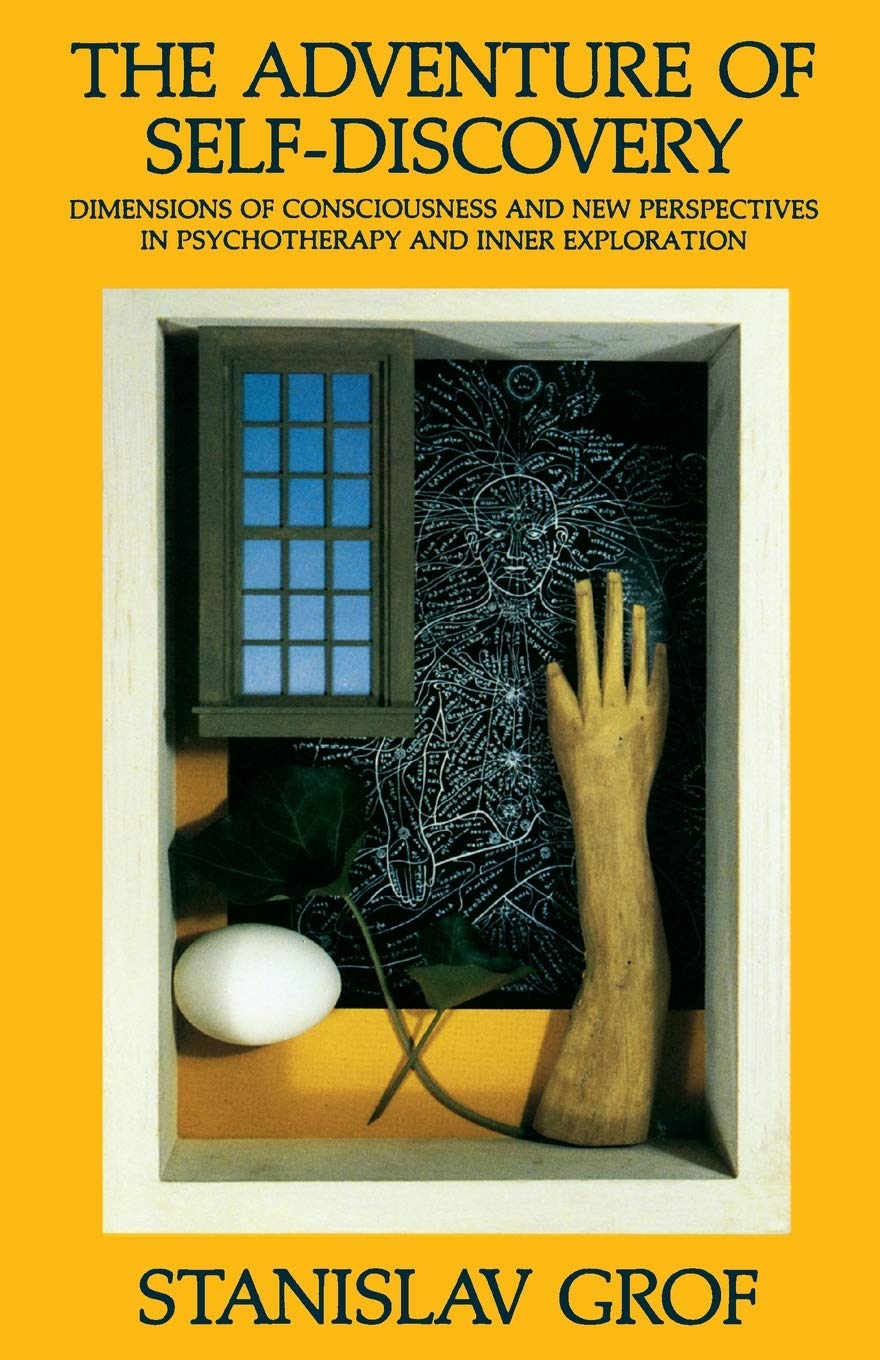
The Adventure of Self-Discovery: Dimensions of Consciousness and New Perspectives in Psychotherapy and Inner Exploration (SUNY Series in Transpersonal and Humanistic Psychology) [Grof, Stanislav] on desertcart.com. *FREE* shipping on qualifying offers. The Adventure of Self-Discovery: Dimensions of Consciousness and New Perspectives in Psychotherapy and Inner Exploration (SUNY Series in Transpersonal and Humanistic Psychology) Review: Essential Perspective, but Not for the Layperson - Synopsis: This book is composed of two distinct parts, which are actually identified in the subtitle. The first of the two is a long litany of Grof's explanation of dimensions of consciousness. Within this portion of the book Grof identifies various perspectives and interpretations of psychological gestalts, experiences of mystical states, psychedelic states and correlation of his perinatal matrices. Here there is a strong influence of Jungian philosophy and the emergence of various elements of Humanistic psychology. In the second part of the book Grof enters the stage of giving an overview of his holotropic theory and transitions into the important implications of this therapy along with aspects of psychedelic experience. While partitioned, relevant continuity does exist between the two. The Objective Perspective: Grof's material is not for everyone, especially the laypeople. Had I not been a psychology major and a frequent reader of philosophy, mythology and familiar with indigenous tribal and Eastern cultures I would have been emphatically lost. The material on the dimensions of consciousness is complex and intrinsically connected with various archetypes of mythology. The references that are made throughout this material are something, I think, is of integral importance for actually comprehending the information. So unless you have some background in mythology, psychology and indigenous tribal and Eastern cultures then I do not recommend this book because it delves into advanced psychology and integrates references that will just become perpetually obfuscating. Each of the dimensions of consciousness that Grof discusses actually deserves a complete volume for itself. This portion of the book is probably the most contentious when it comes to relation to the academic and scientific fields. A brief overview of each is just not adequate for instigating legitimate interest into these levels of consciousness. While I disagree with Grof on some of his interpretations, there are some instances where his position is not clearly distinguished from a psychoanalytic interpretation or a literal belief in the result. On page 284, the last sentence of the first paragraph Grof asserts quite erroneously that he has proven the thesis of his book "that there is no basic difference between psychedelic experiences and nonordinary states of consciousness induced by other techniques." This is superficial. You cannot hyperventilate and experience "basically" the same experience that you do with psilocybin; you cannot experience "basically" the experience with LSD that you do with dimethyltryptamine; all of these states are distinct in their own regard and affluent in profundity and alien nature to any other experience. I am not defaming non-psychedelic mystical states by any means, or am I elevating psychedelic experiences as more hierarchical, but they are separate from each other. The Subjective Perspective: I applaud Grof for his very professional, scientific (for what science will accept) and scholarly approach to the realms of altered states; he adds class to the endeavor of self-exploration. He has given a new perspective of mystical experiences over all. These experiences are essential in expanding our knowledge of the depths and dimensions of the human psyche. The brain as a cellular structure may be subject to the laws of physics, but the manifestation of the Mind is independent of physics and linear-narrow-fundamentalistic-science which attempts to negate anything it cannot readily explain, ironically trouncing the scientific method and process, which essentially is Positivism in its prime. The nature of Mind transcends all of this myopia. As a true "medicine-man" of society he is concerned with the therapeutic potential of interpreting mystical states as opposed to completely dismissing them based on mechanistic science. He asserts that the dimensions of consciousness are a "fascinating phenomena...that should be systematically studied...[, and] [t]o discard...these experiences and the conceptual challenges associated with them just because they do not fit the current paradigms in science certainly is not the best example of a scientific approach" (108). I admire Grof for going against the grain of his field and trekking into the taboo and unconventional, that is the way we elicit Novelty. It is far too easy to "go with the flow," but it takes true devotion to break beyond the borders of acceptance, which often makes one the mockery of a particular field. Grof admonishes against frivolous and unstructured self-exploration with psychedelics, which I concur. Entheogens are a very precarious, but profound, experience. They are not for everyone, and I never advocate anyone to take them, because those who can actually trek those realms and return without psychosis is very limited. On this issue I agree with Timothy Leary, there is only about ten percent of the population that is truly mature enough, intellectual enough and psychologically sound enough to experiment with these substances. Recreational use is precipitous and reckless abandon to those of us that utilize these in a ritualistic and scientific exploratory method of understanding the depths of consciousness to gain novel insights into ontological and philosophical paradigms. This literary work is essential for all credible psychonauts that fit the previously described candidate. Having come into reference to Timothy Leary, Grof is definitely distinguished from Leary; and Terence McKenna for that matter. Each of these three men have exclusive and venerable properties about them, and other aspects one would like to discard, albeit, each has their distinct territory. While I originally came into the entheogenic revolution by way of Martin Ball I then followed up references in his book to Terence McKenna's philosophy. I later progressed to Leary, and now to Grof; Grof is more scientifically sophisticated with his approach, almost to a fault. Leary is my immanent mentor of all; our ideals for culture, society and philosophy are identical, which I acquired and refined prior to even having knowledge of him. The only difference is that his tool of choice was LSD. His philosophy is astounding and his affinity with Socrates and evolving culture through NOVEL philosophy is commensurate to my own. In the beginning, as a psychologist, he started in the way of scientific interest but Harvard abrogated those studies and subsequently did not offer another contract to Leary. The most unfortunate thing Leary did for the movement was bring too much attention to it, and to fundamentalists back then, which were in all facets of society, he was the "devil," so they mounted an Inquisition on the Mind and initiated the ominous drug war. (After all it was the drugs that made woman want to work and have rights, blacks to want to have rights, and the college students to protest the war and oppose a draft.) McKenna has his exclusive realm in the nature of reviving botanical shamanism into the contemporary culture, along with various cultural and philosophic imports intermingled with theories of alien worlds, new dimensions and novelty. Grof has utilized his interest in these substances to reorient certain rigid conventions in psychology and psychotherapy, which illuminates his scientific approach by and through experimentation. All of the three stands alone, but their unity is that they realized the profundity and novel insights that are to be garnered from this realm of the taboo. In closing, the brain is a mysterious quantum tool that has an obvious affinity and, possibly, an evolutionary precursor with entheogenic properties that manifested its neurochemistry. Negating this undermines the complexity of the mind-brain paradigm and, in the words of Grof: "The future task for serious research remains unbiased scientific scrutiny of the mostly anecdotal claims and modern reformulation of the underlying theories" (149). - D.R.Thomas Review: !!! Absolutely Outstanding !!! - This is, without a doubt, one of the best books I have ever read. Period. There is a level of self-evident truth permeating its contents, the same way that one could navigate mathematical conjectures that have no known exceptions and seem inevitably due to be formally explained. I adore the courage that enabled these issues to be explored and this work to become a reality. Pages 260-263 is an absolute gem- among the best, most concise solution I have ever seen to solving the problems of the world. Want a nearly-as-awesome encore? Continue through Page 273.
| Best Sellers Rank | #470,283 in Books ( See Top 100 in Books ) #519 in Popular Psychology Psychoanalysis #622 in Medical Psychotherapy TA & NLP #757 in Popular Psychology Psychotherapy |
| Customer Reviews | 4.4 4.4 out of 5 stars (68) |
| Dimensions | 5.5 x 0.78 x 8.5 inches |
| ISBN-10 | 0887065414 |
| ISBN-13 | 978-0887065415 |
| Item Weight | 1 pounds |
| Language | English |
| Print length | 344 pages |
| Publication date | January 31, 1988 |
| Publisher | State University of New York Press |
D**S
Essential Perspective, but Not for the Layperson
Synopsis: This book is composed of two distinct parts, which are actually identified in the subtitle. The first of the two is a long litany of Grof's explanation of dimensions of consciousness. Within this portion of the book Grof identifies various perspectives and interpretations of psychological gestalts, experiences of mystical states, psychedelic states and correlation of his perinatal matrices. Here there is a strong influence of Jungian philosophy and the emergence of various elements of Humanistic psychology. In the second part of the book Grof enters the stage of giving an overview of his holotropic theory and transitions into the important implications of this therapy along with aspects of psychedelic experience. While partitioned, relevant continuity does exist between the two. The Objective Perspective: Grof's material is not for everyone, especially the laypeople. Had I not been a psychology major and a frequent reader of philosophy, mythology and familiar with indigenous tribal and Eastern cultures I would have been emphatically lost. The material on the dimensions of consciousness is complex and intrinsically connected with various archetypes of mythology. The references that are made throughout this material are something, I think, is of integral importance for actually comprehending the information. So unless you have some background in mythology, psychology and indigenous tribal and Eastern cultures then I do not recommend this book because it delves into advanced psychology and integrates references that will just become perpetually obfuscating. Each of the dimensions of consciousness that Grof discusses actually deserves a complete volume for itself. This portion of the book is probably the most contentious when it comes to relation to the academic and scientific fields. A brief overview of each is just not adequate for instigating legitimate interest into these levels of consciousness. While I disagree with Grof on some of his interpretations, there are some instances where his position is not clearly distinguished from a psychoanalytic interpretation or a literal belief in the result. On page 284, the last sentence of the first paragraph Grof asserts quite erroneously that he has proven the thesis of his book "that there is no basic difference between psychedelic experiences and nonordinary states of consciousness induced by other techniques." This is superficial. You cannot hyperventilate and experience "basically" the same experience that you do with psilocybin; you cannot experience "basically" the experience with LSD that you do with dimethyltryptamine; all of these states are distinct in their own regard and affluent in profundity and alien nature to any other experience. I am not defaming non-psychedelic mystical states by any means, or am I elevating psychedelic experiences as more hierarchical, but they are separate from each other. The Subjective Perspective: I applaud Grof for his very professional, scientific (for what science will accept) and scholarly approach to the realms of altered states; he adds class to the endeavor of self-exploration. He has given a new perspective of mystical experiences over all. These experiences are essential in expanding our knowledge of the depths and dimensions of the human psyche. The brain as a cellular structure may be subject to the laws of physics, but the manifestation of the Mind is independent of physics and linear-narrow-fundamentalistic-science which attempts to negate anything it cannot readily explain, ironically trouncing the scientific method and process, which essentially is Positivism in its prime. The nature of Mind transcends all of this myopia. As a true "medicine-man" of society he is concerned with the therapeutic potential of interpreting mystical states as opposed to completely dismissing them based on mechanistic science. He asserts that the dimensions of consciousness are a "fascinating phenomena...that should be systematically studied...[, and] [t]o discard...these experiences and the conceptual challenges associated with them just because they do not fit the current paradigms in science certainly is not the best example of a scientific approach" (108). I admire Grof for going against the grain of his field and trekking into the taboo and unconventional, that is the way we elicit Novelty. It is far too easy to "go with the flow," but it takes true devotion to break beyond the borders of acceptance, which often makes one the mockery of a particular field. Grof admonishes against frivolous and unstructured self-exploration with psychedelics, which I concur. Entheogens are a very precarious, but profound, experience. They are not for everyone, and I never advocate anyone to take them, because those who can actually trek those realms and return without psychosis is very limited. On this issue I agree with Timothy Leary, there is only about ten percent of the population that is truly mature enough, intellectual enough and psychologically sound enough to experiment with these substances. Recreational use is precipitous and reckless abandon to those of us that utilize these in a ritualistic and scientific exploratory method of understanding the depths of consciousness to gain novel insights into ontological and philosophical paradigms. This literary work is essential for all credible psychonauts that fit the previously described candidate. Having come into reference to Timothy Leary, Grof is definitely distinguished from Leary; and Terence McKenna for that matter. Each of these three men have exclusive and venerable properties about them, and other aspects one would like to discard, albeit, each has their distinct territory. While I originally came into the entheogenic revolution by way of Martin Ball I then followed up references in his book to Terence McKenna's philosophy. I later progressed to Leary, and now to Grof; Grof is more scientifically sophisticated with his approach, almost to a fault. Leary is my immanent mentor of all; our ideals for culture, society and philosophy are identical, which I acquired and refined prior to even having knowledge of him. The only difference is that his tool of choice was LSD. His philosophy is astounding and his affinity with Socrates and evolving culture through NOVEL philosophy is commensurate to my own. In the beginning, as a psychologist, he started in the way of scientific interest but Harvard abrogated those studies and subsequently did not offer another contract to Leary. The most unfortunate thing Leary did for the movement was bring too much attention to it, and to fundamentalists back then, which were in all facets of society, he was the "devil," so they mounted an Inquisition on the Mind and initiated the ominous drug war. (After all it was the drugs that made woman want to work and have rights, blacks to want to have rights, and the college students to protest the war and oppose a draft.) McKenna has his exclusive realm in the nature of reviving botanical shamanism into the contemporary culture, along with various cultural and philosophic imports intermingled with theories of alien worlds, new dimensions and novelty. Grof has utilized his interest in these substances to reorient certain rigid conventions in psychology and psychotherapy, which illuminates his scientific approach by and through experimentation. All of the three stands alone, but their unity is that they realized the profundity and novel insights that are to be garnered from this realm of the taboo. In closing, the brain is a mysterious quantum tool that has an obvious affinity and, possibly, an evolutionary precursor with entheogenic properties that manifested its neurochemistry. Negating this undermines the complexity of the mind-brain paradigm and, in the words of Grof: "The future task for serious research remains unbiased scientific scrutiny of the mostly anecdotal claims and modern reformulation of the underlying theories" (149). - D.R.Thomas
S**S
!!! Absolutely Outstanding !!!
This is, without a doubt, one of the best books I have ever read. Period. There is a level of self-evident truth permeating its contents, the same way that one could navigate mathematical conjectures that have no known exceptions and seem inevitably due to be formally explained. I adore the courage that enabled these issues to be explored and this work to become a reality. Pages 260-263 is an absolute gem- among the best, most concise solution I have ever seen to solving the problems of the world. Want a nearly-as-awesome encore? Continue through Page 273.
J**.
Recommended Read
I bought this for my son who loves to read books he can learn something from. He told me this was one of his favorite most recent books I have sent him. My son had specifically asked me to find books by Stanislav Grof because he had read another of his books and love it as well. I find it interesting because I have been in the profession of teaching a lot of these techniques for over two decades and my son never really took an interest. Perhaps he did internally and he is finally accepting this. Granted I am no Stanislav Grof but regardless I am happy that my son took an interest in his writings and is enjoying it. A good read - recommended.
B**E
A must read for the Jung crowd.
I had hoped to learn more about the actual techniques used in the holotopic sessions but most of that information is already available from kundalini breath techniques and pranayama. That aside, the book is fascinating and well written. If you are familiar with Jungian psychology, archetypes, and symbols of mythology you will deeply enjoy this book.
P**S
Wonderful Mind-Opening Book!!!
I must say I am impressed with Prof. Grof. This book has opened my mind far and wide. As a student of non-traditional psychology I would like to see this item as one of compulsory lectures. Great introduction to Transpersonal Psychology & Psychiatry, Psychedelic Therapy, and a very comprehensive guide to the studies of consciousness! Not an easy book. It tears the walls of what we consider "normal thinking" or accepted (yet outdated) "logic". As I write I am ordering other books by Stanislav and Christine Grof.
A**R
Damaged book
New book came damaged.
B**R
Makes think
The book is clearly organized, with good and sensible examples. Makes you think in all the amount of knowledge that we humans ignore. And all the explorable universe of posibilities . However, the use of drugs, is complex, dificult and unadvisable for most, but the very few well prepared, like Dr. Grof, and in a very special enviroment. Thank you
S**S
A must-read for psychedelic and meditative experiencers
This book is a great launching point for people interested in experimenting with psychedelics, holotropic breathing, or other deep meditative practices. It will open your eyes to a narrative beyond the reductionist stick worldview we are usually presented with.
T**I
Als Einführung in das Thema vielleicht brauchbar, aber wenn man andere Bücher von Grof kennt, bringt dieses nicht unbedingt etwas Neues und bleibt bisweilen sehr allgemein und weitschweifig.
E**E
ok
B**T
Interesting.
N**N
Grea.t
Trustpilot
1 month ago
1 month ago