We remain fully operational. Our teams are working around the clock to ensure your deliveries continue safely.

DOWNLOAD THE APP


Customer Services
Copyright © 2025 Desertcart Holdings Limited
DOWNLOAD THE APP
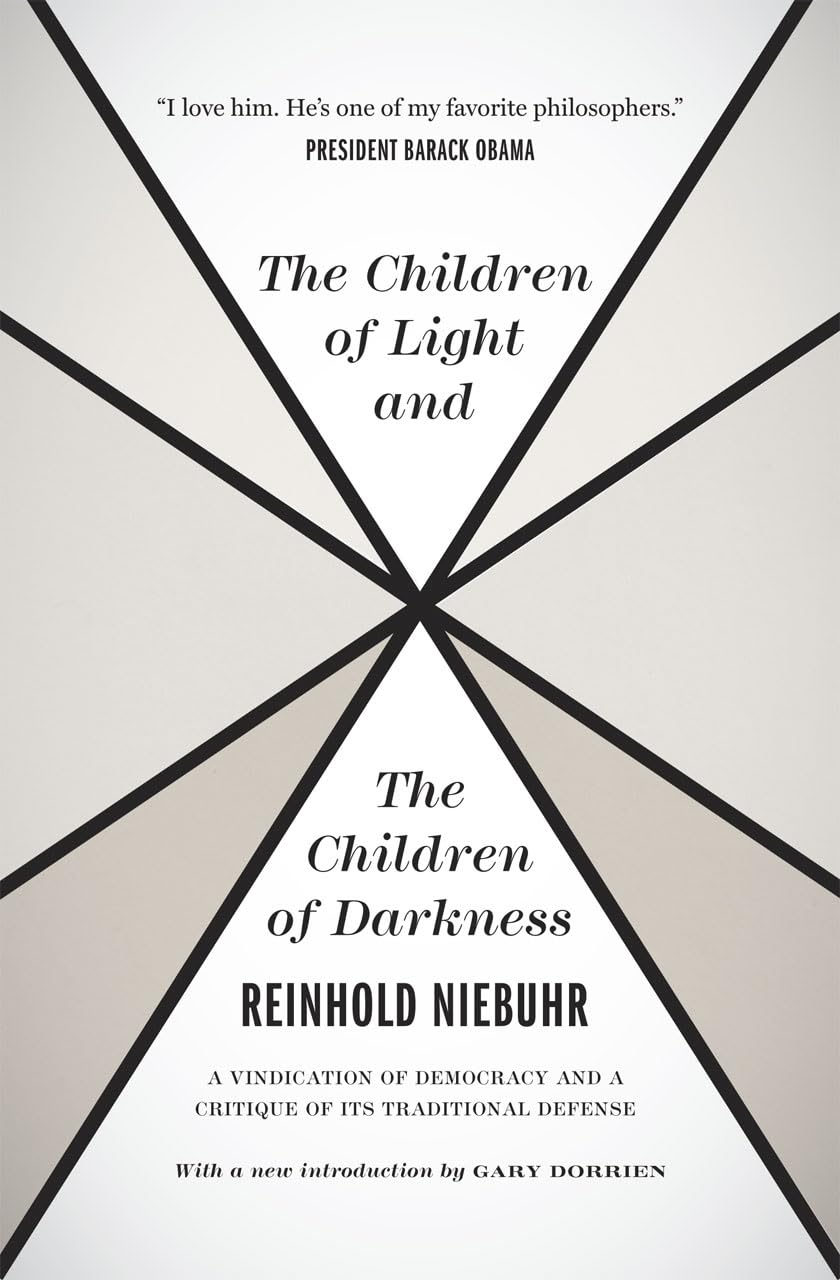
The Children of Light and the Children of Darkness: A Vindication of Democracy and a Critique of Its Traditional Defense [Niebuhr, Reinhold, Dorrien, Gary] on desertcart.com. *FREE* shipping on qualifying offers. The Children of Light and the Children of Darkness: A Vindication of Democracy and a Critique of Its Traditional Defense Review: A Clear-Eyed View of Democracy - Niebuhr was an American theologian and political thinker active in public life from the 1920s to the 1960s. In a very helpful introduction to my edition of The Children of Light and the Children of Darkness, Gary Dorrien (Reinhold Niebuhr Professor of Social Ethics, Union Theological Seminary, and Professor of Religion, Columbia University) provides a useful account of Niebuhr’s thinking over his long career. Dorrien also provides a succinct statement of some of Niebuhr’s most important themes and insights about politics and ethics: the problems of human “fallibility, sin, and ambiguity”; the understanding that human groups will always place self-interest first and foremost and therefore a struggle for power will ensue; occasionally individuals could overcome self-centeredness when motivated by love; and Jesus provides no direction with the issue of political ethics. This last proposition severs Niebuhr from the Social Gospel proponents with whom he once shared allegiance. In arguing that Jesus taught no political ethic, Niebuhr identified a central lacuna in the Gospels that later tradition sought to rectify. Thus, Niebuhr takes up issues that St. Augustine struggled with near the beginning of Christianity in Late Antiquity. Following the lead of Augustine, along with influences (theologically) from Luther and Calvin, Niebuhr develops a realist stance of Christian (and secular) ethics toward the political world. In his Introduction, Dorrien describes The Children of Light and the Children of Darkness, as “written at midcareer as Niebuhr was coming fully into his own, is the most comprehensive statement of his political philosophy.” Niebuhr, Reinhold, The Children of Light and the Children of Darkness: A Vindication of Democracy and a Critique of Its Traditional Defense. University of Chicago Press. Kindle Edition (Introduction by Gary Dorrien). A careful consideration of this work suggests ways in which we can think about bridging the gap between individual ethics that require love and eschew violence against the realities of political power. In a quote that should rival Churchill’s for its pithy and ironic defense of democracy, Niebuhr wrote: “Man's capacity for justice makes democracy possible; but man's inclination to injustice makes democracy necessary.” Id. (Forward to the First Edition (1944)). Niebuhr identifies democracy with the rise of the bourgeois in Europe and then in America. It arose because individuals wanted to protect themselves and their property. So a new balance was struck, one in which freedom from constraint and arbitrary exercise of power became of the utmost importance. But Niebuhr also realized the larger issues of freedom and community that arise from this background. He writes: Democracy can therefore not be equated with freedom. An ideal democratic order seeks unity within the conditions of freedom; and maintains freedom within the framework of order. Man requires freedom in his social organization because he is “essentially” free, which is to say, that he has the capacity for indeterminate transcendence over the processes and limitations of nature. This freedom enables him to make history and to elaborate communal organizations in boundless variety and in endless breadth and extent. But he also requires community because he is by nature social. He cannot fulfill his life within himself but only in responsible and mutual relations with his fellows. Id. (pp. 3-4) Niebuhr is not a simple cheerleader for bourgeois democracy; to the contrary, he is a sharp critic of it and of capitalism as a social and economic system. He states: Bourgeois individualism may be excessive and it may destroy the individual's organic relation to the community; but it was not intended to destroy either the national or the international order. On the contrary the social idealism which informs our democratic civilization had a touching faith in the possibility of achieving a simple harmony between self-interest and the general welfare on every level. Id. (p. 7) But it is this faith that Niebuhr spurns, the belief in progress and the inevitability of social improvement endorsed by those he terms “the children of light”. Niebuhr describes the children of light: Those who believe that self-interest should be brought under the discipline of a higher law could then be termed “the children of light.” This is no mere arbitrary device; for evil is always the assertion of some self-interest without regard to the whole, whether the whole be conceived as the immediate community, or the total community of mankind, or the total order of the world. The good is, on the other hand, always the harmony of the whole on various levels. Devotion to a subordinate and premature “whole” such as the nation, may of course become evil, viewed from the perspective of a larger whole, such as the community of mankind. The “children of light” may thus be defined as those who seek to bring self-interest under the discipline of a more universal law and in harmony with a more universal good. Id. (pp. 9-10) He then describes the “children of darkness”: “The children of darkness are evil because they know no law beyond the self. They are wise, though evil, because they understand the power of self-interest.” Id. (p. 10). Where the children of light are naïve, the children of darkness are knowing. Niebuhr argues that for the children of light to succeed in bringing about a better world, they must learn the ways of their cynical counterparts. And in what may shock some contemporary readers, Niebuhr includes Marxists (at least some) among the children of light: idealistic in believing self-will and conflict can be finally resolved. He writes: The Marxists, too, are children of light. Their provisional cynicism does not even save them from the usual stupidity, nor from the fate, of other stupid children of light. That fate is to have their creed become the vehicle and instrument of the children of darkness. A new oligarchy is arising in Russia, the spiritual characteristics of which can hardly be distinguished from those of the American “go-getters” of the latter nineteenth and early twentieth centuries. And in the light of history Stalin will probably have the same relation to the early dreamers of the Marxist dreams which Napoleon has to the liberal dreamers of the eighteenth century. Id. (pp. 32-33) Note that Niebuhr wrote this during the war, when Stalin led one of our allies in a great titanic struggle and when Roosevelt believed he could woo Stalin into joining a liberal post-war world. While Niebuhr’s equivalence of American “go-getters” with the leaders of the Kremlin seems far-fetched, his comparison of Stalin to Napoleon and crushed dreams is prescient. Niebuhr sums up his brief for the children of light: The preservation of a democratic civilization requires the wisdom of the serpent and the harmlessness of the dove. The children of light must be armed with the wisdom of the children of darkness but remain free from their malice. They must know the power of self-interest in human society without giving it moral justification. They must have this wisdom in order that they may beguile, deflect, harness and restrain self-interest, individual and collective, for the sake of the community. Id. (pp. 40-41). Niebuhr recognized the modern nation-state as the primary actor in international politics. About it, he writes: “The morally autonomous modern national state does indeed arise; and it acknowledges no law beyond its interests. The actual behaviour of the nations is cynical. But the creed of liberal civilization is sentimental.” Id. (p. 33). Thus a conflict, especially open and obvious (and continuing) in American history between the idealists (Wilsonians we may say) and the moral realists (of whom Niebuhr is perhaps the most articulate). This dichotomy in American practice runs all through American history in the 20th century. Our most “Machiavellian” president[i], Richard Nixon, admired Wilson and saw himself carrying on the Wilson legacy while he proved himself a master of geopolitical realism in the American interest. President Obama, who cited Niebuhr as his “favorite philosopher”, walks a fine line between brutal realism, Niebuhr-like caution, and American idealism, sentimentality, and nationalism. Lest one think Niebuhr too pessimistic, we should note that he supports efforts to limit conflict and build institutions: “The problem of overcoming this chaos and of extending the principle of community to worldwide terms has become the most urgent of all the issues which face our epoch.” Id. (p. 153). In fact, that we may think of a “world community has two important sources that allow such a concept to enjoy any reality. The first source is religion. Niebuhr writes: While the religions of the east [earlier referring to the Confucian and Daoist traditions of China and the Hindu and Buddhist traditions of India] were generally too mystic and otherworldly to give historic potency to universal ideals, their emerging universal perspectives must be counted as added evidence of the fact that there has been a general development in human culture toward the culmination of religions and philosophies in which the meaning of life and its obligations were interpreted above and beyond the limits of any particular community.[ii] Id. (pp. 156-157). Niebuhr identifies the developments in the technical realm as the other impetus toward a world community. Taken together, the reality of a single world community is more than a liberal pipe dream. Yet, against this, Niebuhr identifies the centrifugal force and predicts that “international politics of the coming decades will be dominated by great powers who will be able to prevent recalcitrance among the smaller nations, but who will have difficulty in keeping peace between each other because they will not have any authority above their own powerful enough to bend or deflect their wills.” Id. (p. 171). In making these observations, Niebuhr criticizes realism in international relations almost as harshly as liberal institutionalism: It is indicative of the spiritual problem of mankind that these realistic approaches [to international relations] are often as close to the abyss of cynicism as the idealistic approaches are to the fog of sentimentality. The realistic school of international thought believes that world politics cannot rise higher than the balance-of-power principle. The balance-of-power theory of world politics, seeing no possibility of a genuine unity of the nations, seeks to construct the most adequate possible mechanism for equilibrating power on a world scale. Such a policy, which holds all factors in the world situation in the most perfect possible equipoise, can undoubtedly mitigate anarchy. A balance of power is in fact a kind of managed anarchy. But it is a system in which anarchy invariably overcomes the management in the end. Despite its defects the policy of the balance of power is not as iniquitous as idealists would have us believe. For even the most perfectly organized society must seek for a decent equilibrium of the vitalities and forces under its organization. If this is not done, strong disproportions of power develop; and wherever power is inordinate, injustice results. But an equilibrium of power without the organizing and equilibrating force of government, is potential anarchy which becomes actual anarchy in the long run. The balance-of-power system may, despite its defects, become the actual consequence of present policies. The peace of the world may be maintained perilously and tentatively, for some decades, by an uneasy equilibrium between the three great powers, America, Russia and Britain. [iii] Id. (pp. 173-175) Niebuhr goes on to consider the histories and practices of particular nations: the U.S., Britain, Russia, and China, and how they will relate the new order in the post-war world, displaying prophetic insight through his observations. He also notes (again) the tension between individual morality and political realities that create tensions: “Hypocrisy and pretension are the inevitable concomitants of the engagement between morals and politics. But they do not arise where no effort is made to bring the power impulse of politics under the control of conscience. The pretension that it has been brought completely under control is thus the hypocritical by-product of the moral endeavour.” Id. (pp. 184-185). He sums up the quandary with this pronouncement: “The field of politics is not helpfully tilled by pure moralists; and the realm of international politics is particularly filled with complexities which do not yield to the approach of a too simple idealism. Id. (p. 186). In the end, Niebuhr concludes that we must strive for the impossible: community where none is fully realized peace where it is never final. This book seems to me less fundamental and comprehensive than Niebuhr’s Moral Man and Immoral Society, but both works give us guidance as far as guidance can be found. As with Buddhism, we have to conclude that we have no definitive standards for conducting political life from the founders. The Christian tradition has built theories (often conflicting), but none can fairly claim to have arisen directly out of the Gospels or the New Testament. And we cannot turn to Niebuhr for rules of ethics: he provides none. He opposed Roosevelt’s arms build-up before Munich, and then he rallied in support of the fight against Fascism. In the early 60’s he supported the U.S. effort in Vietnam, but he later became a vocal critic of the war. Niebuhr’s thought is marked by ambiguity, irony, and equivocation. One shouldn’t turn to it if you are looking for the answer to whether a particular policy or course of political conduct meets a given test of morality or ethics. There are no easy answers. For instance, should the U.S. use drones on known Islamic terrorists plotting the death of Americans when we know that innocents will be killed? Should we arm rebels and bomb when American are murdered, even though the “collateral damage” (so Orwellian) will claim innocent lives? The litany of tough practical and moral choices could continue indefinitely. There is no existing answer book unless one takes a position of absolutism. Review: It's a good book, and probably a classic in terms of ... - I read this for a course on geopolitics and American foreign policy -- it is definitely worth having in your collection of books but I don't foresee it being reread by myself within the next two years. It's a good book, and probably a classic in terms of contemporary political philosophy, but if you're a hardcore realist you will probably be irritated in certain parts of Niebuhr's work.
| Best Sellers Rank | #119,376 in Books ( See Top 100 in Books ) #102 in Democracy (Books) #141 in Religion & Philosophy (Books) #387 in History & Theory of Politics |
| Customer Reviews | 4.2 4.2 out of 5 stars (96) |
| Dimensions | 8.05 x 5.32 x 0.47 inches |
| Edition | 8.2.2011 |
| ISBN-10 | 0226584003 |
| ISBN-13 | 978-0226584003 |
| Item Weight | 9 ounces |
| Language | English |
| Print length | 190 pages |
| Publication date | September 1, 2011 |
| Publisher | University of Chicago Press |
S**F
A Clear-Eyed View of Democracy
Niebuhr was an American theologian and political thinker active in public life from the 1920s to the 1960s. In a very helpful introduction to my edition of The Children of Light and the Children of Darkness, Gary Dorrien (Reinhold Niebuhr Professor of Social Ethics, Union Theological Seminary, and Professor of Religion, Columbia University) provides a useful account of Niebuhr’s thinking over his long career. Dorrien also provides a succinct statement of some of Niebuhr’s most important themes and insights about politics and ethics: the problems of human “fallibility, sin, and ambiguity”; the understanding that human groups will always place self-interest first and foremost and therefore a struggle for power will ensue; occasionally individuals could overcome self-centeredness when motivated by love; and Jesus provides no direction with the issue of political ethics. This last proposition severs Niebuhr from the Social Gospel proponents with whom he once shared allegiance. In arguing that Jesus taught no political ethic, Niebuhr identified a central lacuna in the Gospels that later tradition sought to rectify. Thus, Niebuhr takes up issues that St. Augustine struggled with near the beginning of Christianity in Late Antiquity. Following the lead of Augustine, along with influences (theologically) from Luther and Calvin, Niebuhr develops a realist stance of Christian (and secular) ethics toward the political world. In his Introduction, Dorrien describes The Children of Light and the Children of Darkness, as “written at midcareer as Niebuhr was coming fully into his own, is the most comprehensive statement of his political philosophy.” Niebuhr, Reinhold, The Children of Light and the Children of Darkness: A Vindication of Democracy and a Critique of Its Traditional Defense. University of Chicago Press. Kindle Edition (Introduction by Gary Dorrien). A careful consideration of this work suggests ways in which we can think about bridging the gap between individual ethics that require love and eschew violence against the realities of political power. In a quote that should rival Churchill’s for its pithy and ironic defense of democracy, Niebuhr wrote: “Man's capacity for justice makes democracy possible; but man's inclination to injustice makes democracy necessary.” Id. (Forward to the First Edition (1944)). Niebuhr identifies democracy with the rise of the bourgeois in Europe and then in America. It arose because individuals wanted to protect themselves and their property. So a new balance was struck, one in which freedom from constraint and arbitrary exercise of power became of the utmost importance. But Niebuhr also realized the larger issues of freedom and community that arise from this background. He writes: Democracy can therefore not be equated with freedom. An ideal democratic order seeks unity within the conditions of freedom; and maintains freedom within the framework of order. Man requires freedom in his social organization because he is “essentially” free, which is to say, that he has the capacity for indeterminate transcendence over the processes and limitations of nature. This freedom enables him to make history and to elaborate communal organizations in boundless variety and in endless breadth and extent. But he also requires community because he is by nature social. He cannot fulfill his life within himself but only in responsible and mutual relations with his fellows. Id. (pp. 3-4) Niebuhr is not a simple cheerleader for bourgeois democracy; to the contrary, he is a sharp critic of it and of capitalism as a social and economic system. He states: Bourgeois individualism may be excessive and it may destroy the individual's organic relation to the community; but it was not intended to destroy either the national or the international order. On the contrary the social idealism which informs our democratic civilization had a touching faith in the possibility of achieving a simple harmony between self-interest and the general welfare on every level. Id. (p. 7) But it is this faith that Niebuhr spurns, the belief in progress and the inevitability of social improvement endorsed by those he terms “the children of light”. Niebuhr describes the children of light: Those who believe that self-interest should be brought under the discipline of a higher law could then be termed “the children of light.” This is no mere arbitrary device; for evil is always the assertion of some self-interest without regard to the whole, whether the whole be conceived as the immediate community, or the total community of mankind, or the total order of the world. The good is, on the other hand, always the harmony of the whole on various levels. Devotion to a subordinate and premature “whole” such as the nation, may of course become evil, viewed from the perspective of a larger whole, such as the community of mankind. The “children of light” may thus be defined as those who seek to bring self-interest under the discipline of a more universal law and in harmony with a more universal good. Id. (pp. 9-10) He then describes the “children of darkness”: “The children of darkness are evil because they know no law beyond the self. They are wise, though evil, because they understand the power of self-interest.” Id. (p. 10). Where the children of light are naïve, the children of darkness are knowing. Niebuhr argues that for the children of light to succeed in bringing about a better world, they must learn the ways of their cynical counterparts. And in what may shock some contemporary readers, Niebuhr includes Marxists (at least some) among the children of light: idealistic in believing self-will and conflict can be finally resolved. He writes: The Marxists, too, are children of light. Their provisional cynicism does not even save them from the usual stupidity, nor from the fate, of other stupid children of light. That fate is to have their creed become the vehicle and instrument of the children of darkness. A new oligarchy is arising in Russia, the spiritual characteristics of which can hardly be distinguished from those of the American “go-getters” of the latter nineteenth and early twentieth centuries. And in the light of history Stalin will probably have the same relation to the early dreamers of the Marxist dreams which Napoleon has to the liberal dreamers of the eighteenth century. Id. (pp. 32-33) Note that Niebuhr wrote this during the war, when Stalin led one of our allies in a great titanic struggle and when Roosevelt believed he could woo Stalin into joining a liberal post-war world. While Niebuhr’s equivalence of American “go-getters” with the leaders of the Kremlin seems far-fetched, his comparison of Stalin to Napoleon and crushed dreams is prescient. Niebuhr sums up his brief for the children of light: The preservation of a democratic civilization requires the wisdom of the serpent and the harmlessness of the dove. The children of light must be armed with the wisdom of the children of darkness but remain free from their malice. They must know the power of self-interest in human society without giving it moral justification. They must have this wisdom in order that they may beguile, deflect, harness and restrain self-interest, individual and collective, for the sake of the community. Id. (pp. 40-41). Niebuhr recognized the modern nation-state as the primary actor in international politics. About it, he writes: “The morally autonomous modern national state does indeed arise; and it acknowledges no law beyond its interests. The actual behaviour of the nations is cynical. But the creed of liberal civilization is sentimental.” Id. (p. 33). Thus a conflict, especially open and obvious (and continuing) in American history between the idealists (Wilsonians we may say) and the moral realists (of whom Niebuhr is perhaps the most articulate). This dichotomy in American practice runs all through American history in the 20th century. Our most “Machiavellian” president[i], Richard Nixon, admired Wilson and saw himself carrying on the Wilson legacy while he proved himself a master of geopolitical realism in the American interest. President Obama, who cited Niebuhr as his “favorite philosopher”, walks a fine line between brutal realism, Niebuhr-like caution, and American idealism, sentimentality, and nationalism. Lest one think Niebuhr too pessimistic, we should note that he supports efforts to limit conflict and build institutions: “The problem of overcoming this chaos and of extending the principle of community to worldwide terms has become the most urgent of all the issues which face our epoch.” Id. (p. 153). In fact, that we may think of a “world community has two important sources that allow such a concept to enjoy any reality. The first source is religion. Niebuhr writes: While the religions of the east [earlier referring to the Confucian and Daoist traditions of China and the Hindu and Buddhist traditions of India] were generally too mystic and otherworldly to give historic potency to universal ideals, their emerging universal perspectives must be counted as added evidence of the fact that there has been a general development in human culture toward the culmination of religions and philosophies in which the meaning of life and its obligations were interpreted above and beyond the limits of any particular community.[ii] Id. (pp. 156-157). Niebuhr identifies the developments in the technical realm as the other impetus toward a world community. Taken together, the reality of a single world community is more than a liberal pipe dream. Yet, against this, Niebuhr identifies the centrifugal force and predicts that “international politics of the coming decades will be dominated by great powers who will be able to prevent recalcitrance among the smaller nations, but who will have difficulty in keeping peace between each other because they will not have any authority above their own powerful enough to bend or deflect their wills.” Id. (p. 171). In making these observations, Niebuhr criticizes realism in international relations almost as harshly as liberal institutionalism: It is indicative of the spiritual problem of mankind that these realistic approaches [to international relations] are often as close to the abyss of cynicism as the idealistic approaches are to the fog of sentimentality. The realistic school of international thought believes that world politics cannot rise higher than the balance-of-power principle. The balance-of-power theory of world politics, seeing no possibility of a genuine unity of the nations, seeks to construct the most adequate possible mechanism for equilibrating power on a world scale. Such a policy, which holds all factors in the world situation in the most perfect possible equipoise, can undoubtedly mitigate anarchy. A balance of power is in fact a kind of managed anarchy. But it is a system in which anarchy invariably overcomes the management in the end. Despite its defects the policy of the balance of power is not as iniquitous as idealists would have us believe. For even the most perfectly organized society must seek for a decent equilibrium of the vitalities and forces under its organization. If this is not done, strong disproportions of power develop; and wherever power is inordinate, injustice results. But an equilibrium of power without the organizing and equilibrating force of government, is potential anarchy which becomes actual anarchy in the long run. The balance-of-power system may, despite its defects, become the actual consequence of present policies. The peace of the world may be maintained perilously and tentatively, for some decades, by an uneasy equilibrium between the three great powers, America, Russia and Britain. [iii] Id. (pp. 173-175) Niebuhr goes on to consider the histories and practices of particular nations: the U.S., Britain, Russia, and China, and how they will relate the new order in the post-war world, displaying prophetic insight through his observations. He also notes (again) the tension between individual morality and political realities that create tensions: “Hypocrisy and pretension are the inevitable concomitants of the engagement between morals and politics. But they do not arise where no effort is made to bring the power impulse of politics under the control of conscience. The pretension that it has been brought completely under control is thus the hypocritical by-product of the moral endeavour.” Id. (pp. 184-185). He sums up the quandary with this pronouncement: “The field of politics is not helpfully tilled by pure moralists; and the realm of international politics is particularly filled with complexities which do not yield to the approach of a too simple idealism. Id. (p. 186). In the end, Niebuhr concludes that we must strive for the impossible: community where none is fully realized peace where it is never final. This book seems to me less fundamental and comprehensive than Niebuhr’s Moral Man and Immoral Society, but both works give us guidance as far as guidance can be found. As with Buddhism, we have to conclude that we have no definitive standards for conducting political life from the founders. The Christian tradition has built theories (often conflicting), but none can fairly claim to have arisen directly out of the Gospels or the New Testament. And we cannot turn to Niebuhr for rules of ethics: he provides none. He opposed Roosevelt’s arms build-up before Munich, and then he rallied in support of the fight against Fascism. In the early 60’s he supported the U.S. effort in Vietnam, but he later became a vocal critic of the war. Niebuhr’s thought is marked by ambiguity, irony, and equivocation. One shouldn’t turn to it if you are looking for the answer to whether a particular policy or course of political conduct meets a given test of morality or ethics. There are no easy answers. For instance, should the U.S. use drones on known Islamic terrorists plotting the death of Americans when we know that innocents will be killed? Should we arm rebels and bomb when American are murdered, even though the “collateral damage” (so Orwellian) will claim innocent lives? The litany of tough practical and moral choices could continue indefinitely. There is no existing answer book unless one takes a position of absolutism.
A**R
It's a good book, and probably a classic in terms of ...
I read this for a course on geopolitics and American foreign policy -- it is definitely worth having in your collection of books but I don't foresee it being reread by myself within the next two years. It's a good book, and probably a classic in terms of contemporary political philosophy, but if you're a hardcore realist you will probably be irritated in certain parts of Niebuhr's work.
G**S
relevant today and tomorrow
i stumbled upon a copy of this book in a Salvation Army store sometime in the early 1980's. Best 25cents i have ever spent! :-) it is unsurpassed, imho, in predictive power and fairminded, broadminded useful analysis regarding certain macro-political concerns of the modern era. Written during a time when the evil capabilities of humankind were stripped of their disguises and protestations and rationalizations and perfume, this book lays down foundational principles for how and why a checksandbalances sort of democracy is the least bad of all forms of human government. The portions of the book written as critique are damning in showing how we can twist the most noble-sounding notions to horrifying cruelty with no other motive than banal selfishness, and do so on massive scales. It touches lightly also on the notion of why the assumption of their being a God to see as a creator and designer, and as an AllGoodOne to Whom/Which we all must answer is a better approach than assuming we are truly self-governing.In this sense, it should be of interest to those interested in human depravity, original sin and related concepts, and the question of what it might take for humanity to overcome our thoroughgoingly superbrutal history, and whether a need for redemption is present, etc. I think this makes a terrific companion to Churchill's speeches and writings, and some of the other history, holocaust literature and biography/memoirs of the era. g s morris ps this book was briefly referenced during former President Ronald Reagan's funeral
M**K
Reinhold Niebuhr's political philosophy is best on the topics of property and pluralism. His writing style is such that the book is heavy-going.
Trustpilot
3 weeks ago
4 days ago