
DOWNLOAD THE APP


Customer Services
Copyright © 2025 Desertcart Holdings Limited
DOWNLOAD THE APP

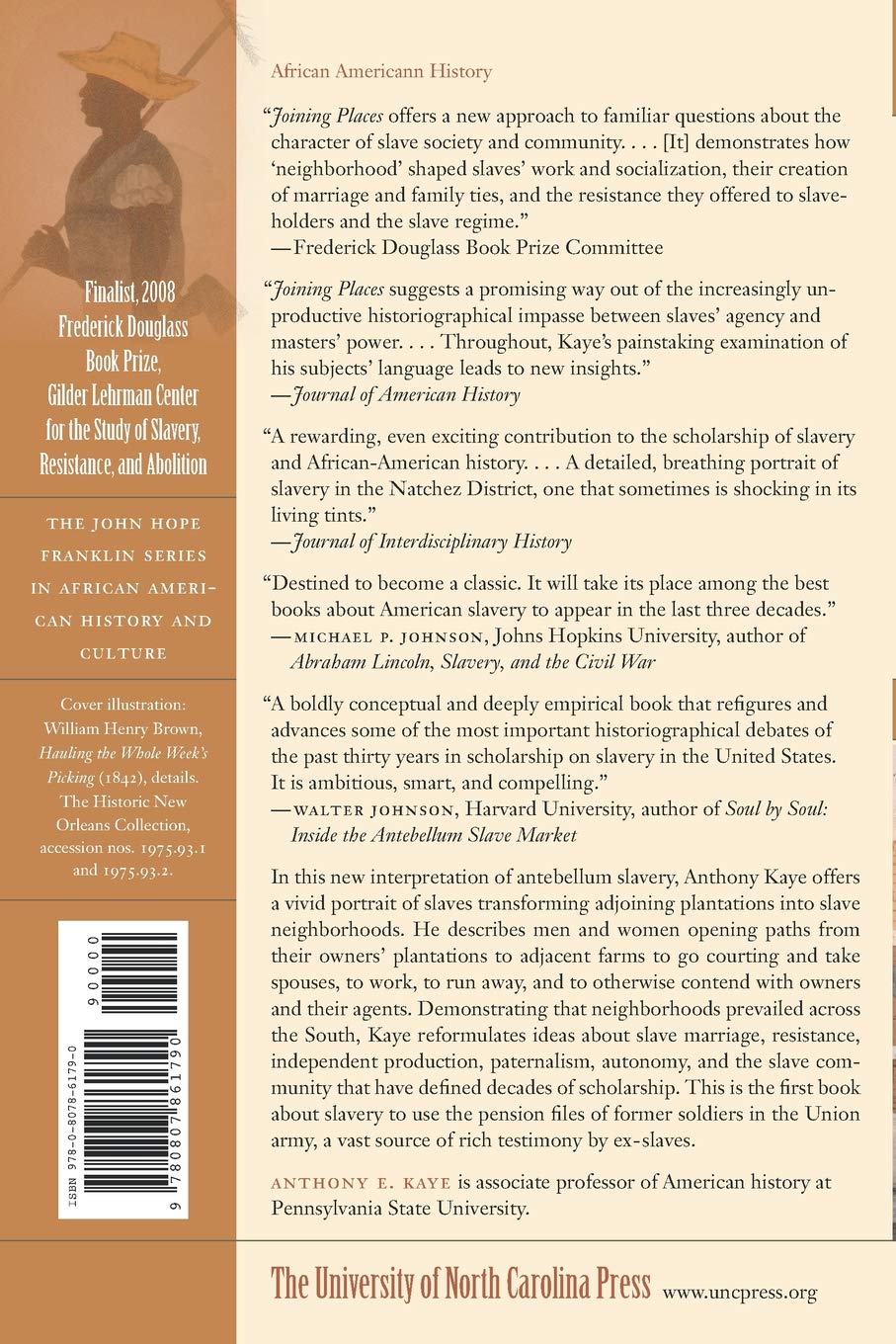
desertcart.in - Buy Joining Places: Slave Neighborhoods in the Old South (The John Hope Franklin Series in African American History and Culture) book online at best prices in India on desertcart.in. Read Joining Places: Slave Neighborhoods in the Old South (The John Hope Franklin Series in African American History and Culture) book reviews & author details and more at desertcart.in. Free delivery on qualified orders. Review: This is a fantastic book. Anthony Kaye's argument that we should recognize the distinct neighborhoods around which and through which enslaved people built their lives makes a key contribution to scholarship on slavery in the American South. Kaye looks in depth at the Natchez district, but he also compares the region to other areas, making this book interesting and important for a wider audience. I highly recommend this book. Review: Great book
| ASIN | 0807861790 |
| Country of Origin | India |
| Customer Reviews | 4.6 4.6 out of 5 stars (19) |
| Dimensions | 15.54 x 2.13 x 23.5 cm |
| Edition | New |
| ISBN-10 | 0807831034 |
| ISBN-13 | 978-0807861790 |
| Item Weight | 544 g |
| Language | English |
| Part of series | The John Hope Franklin Series in African American History and Culture |
| Print length | 376 pages |
| Publication date | 1 August 2009 |
| Publisher | The University of North Carolina Press |
L**Y
This is a fantastic book. Anthony Kaye's argument that we should recognize the distinct neighborhoods around which and through which enslaved people built their lives makes a key contribution to scholarship on slavery in the American South. Kaye looks in depth at the Natchez district, but he also compares the region to other areas, making this book interesting and important for a wider audience. I highly recommend this book.
K**N
Great book
A**K
ok
S**D
I can only assume the negative review accompanying mine is due to the mild redundancy that one faces with most historical narratives. One has to accept, when picking up a book like this one, that in order to represent a historical argument it is the responsibility of the author to give multiple examples on each point, otherwise it would be like a scientist only testing a hypothesis once or twice. When reading a book like this one, reading his major points and then skimming the examples he gives will give you more benefit than trying to read it cover to cover, word for word. Later, if you need to cite the examples he uses in your own studies, Kaye has provided ample material. Ultimately this is a good book, especially for cultural geography of the American South in terms of understanding that slave-planter relations were not as cut and dry as popular media would have one believe. Also, many of the social practices put into play in Louisiana and Mississippi during the antebellum period were still alive in primarily black neighborhoods as late as the civil rights era and a few can be found going strong today. That is a significant point. Does this author reinforce one or two valid points a little too exhaustively? Possibly, but overall I found this book to be a good read (As long as you're not expecting a page turner!)
O**K
There are no other reviews of this book because nobody has ever finished it. It is nothing but one long run on cliche'. Are my twenty words up yet? It is that awful.
Trustpilot
1 month ago
1 month ago