Some deliveries may take a little longer than usual due to regional shipping conditions.

DOWNLOAD THE APP


Customer Services
Copyright © 2025 Desertcart Holdings Limited
DOWNLOAD THE APP

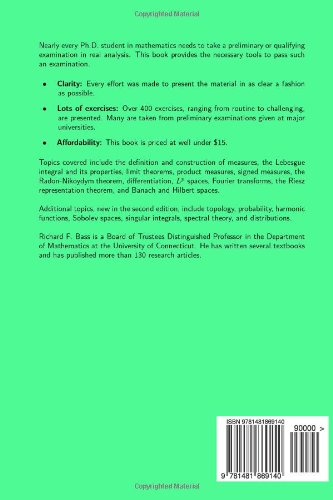
Real Analysis for Graduate Students, Second Edition
P**K
Worthy as a text for a course following Rudin's Principles
Truly a great value as the author intended. Measure theory, Lebesgue integration, functional analysis up to distributions or generalized functions are covered. Even Caratheodory's Extension Theorem which aids in constructing measures is covered as is probability and some point set topology. The conventional proofs are given as this is intended as a study aid for grad students. I would only point out some minor details regarding the preparation needed to follow this text. The first seven chapters of Rudin's Principles 3rd gives all but one theorem. Proposition 1.5 which states that an open subset of R can be written as the countable union of disjoint open intervals can be found in Royden's Real Analysis 3rd (available online as a pdf) on p.42. The minor detail is the word countable-it is used in the sense of finite or countably infinite as explained in Royden. This is equivalent to what Rudin calls" at most countable." Seems trivial but for the single open interval subset you might think you could write it as a countably infinite union of disjoint open intervals (hence leaving out or not covering the endpoints of these intervals-yikes!)-when in fact you're done with the single interval. The only difficult part then is proving the disjointness of intervals which you find relies on the order relations implicit in the definitions of supremum and infimum as used in the proof construct. Countability follows easily then as the real numbers are dense in the rationals.
S**H
Comprehensive, lucid, and inexpensive
I wish I had this book when I started learning measure theory. It provides a very comprehensive treatment of measure and various topics that arise from it. Starting with measure theory, the author goes on to Lebesgue and Riemann integration, and then compares them. The latter is what we learn in calculus courses, but it is not well-behaved under limiting operations; hence the need for Lebesgue's theory. This is followed by a chapter on differentiation, which I would say ends the first part. The second part comprises topics that I would put under functional analysis --- Lp, Banach, and Hilbert spaces. The third is a single, but masterful, chapter on topology that covers in 50 pages what takes twice as much space in many books. None of the brevity comes at the cost of clarity -- it aims to be useful, rather than to be encyclopaedic. Finally, come various applications of the material covered so far --- probability, harmonic functions, and singular integrals. I have just started reading the book, but proofs are very easy to read. There is a fine line between too little detail, and so much detail that one misses the wood for the trees; this books manages to walk that line. Every student of advanced/ graduate-level real analysis should have a copy.
J**E
Nice Book
This is a very good book on real analysis. I like the breadth and depth of the book and the generous set of exercises it provides. Also it goes at the subject directly and does not use more abstraction than is needed to get tot the results. Surely, anyone who masters the materiel here will be prepared for prelims in mathematics - provided the student is not going to specialize in analysis - which is the author's stated goal. The book is well paced - with most of the chapters giving a nice sized chunk and getting to the essential results. The author is also to be commended for writing a book that a graduate student can afford!
I**W
Best book for self-study.
I am an engineering PhD student. I wanted to each myself Functional Analysis and Measure Theory. This book is by far the best, that I found. It is certainly more suitable for self-study compared to other more commonly used textbooks. Although this book seems more voluminous compared to other ones, the logic flow is so clear that one can just read through the proofs and understand the entire concept. When I was learning by myself and needed to learn these concepts fast, I had difficulty quickly imputing concepts that were presented more compactly in books like Folland's. I highly recommend this book.
W**.
Wanted to love it but...
Initially, I loved this book as it seemed to elucidate concepts better than our prescribed text (Lieb & Loss), however, as other reviewers have pointed out, the lack of hints or solutions to the exercises make it difficult to self-learn from. I realize that this is uncommon in graduate texts, but a little help goes a long way.On top of this, the printed version is outdated, with typos that cause major headaches if one is not constantly checking the errata in the author's website.Use as supplement only.
G**R
Good but incomplete
As others have said, it would have been great to have during my grad school days. One shortcoming, in my opinion, is the lack of hints and/or solutions for the exercises and the author states he cannot provide them.Most students will be working through the book on their own. With no feedback, the value of the exercises and thus the text, is severely diminished. Something more like the two volume set "Problems and Theorems in Analysis" (Polya & Szego) would be substantially better.
A**A
Great book to study graduate level analysis
This book is perfect if you want to exercise more than just read theory of analysis. I have been using this book as preparation for my first qualifying examination in Analysis, and simultaneosly has been very useful because each chapter contains a very compact review (couple of pages) of the core material of each section.There are a lot of important problems to grasp the subject, and I would totally recomend this book since it is a nice complement to those classical books as Rudin, or Fomin-Kolmogorov.
G**Y
I would recommend this to anyone who has studied advanced calculus (say ...
This is a no-nonsense approach to real analysis. I would recommend this to anyone who has studied advanced calculus (say having read Borden, A Course in Advanced Calculus), and linear algebra (having read something like Axler, Linear Algebra Done Right). The writing is concise and clear.
J**.
Just buy it and enjoy
Not enough time for me to go into it properly at the moment ...and in some ways I am totally unqualified to give a criticism(maths)HoweverJust buy it.The content would appear to be well-balanced with a similarly introduced series of problems.The author has produced this book himself (read the short intro for his motivation) and done an heroic job. A rugged wipe proof cover, nestles his presentation in a perfect to me print weight for the titles, subtitles and text, on the best quality paper.If you can buy two pints of beer for less let me know.I think he deserves a medal for totally unselfish and brilliant service to education, but he probably has a few of those already.
V**N
Une référence
Ce livre de Bass est une référence pour l'étudiant de Licence 3 de Mathématique fondamentale.En effet il couvre une grande partie du programme ( Mesure, Intégration, Probabilité, Topo ) ainsi que des sujets connexes.Ce n'est pas la référence absolue, mais c'est un livre a posséder. Il faut, je pense, pour une compréhension profonde des domaines enseignés, aller compléter sur des ouvrages bien précis selon la spécificité choisie. Je conseille par exemple le bouquin d'analyse fonctionnelle de Michel Willem qui est excellent.En conclusion, ce livre est un compagnon pour l'étudiant, mais ce compagnon aime être accompagné :)Bonne lecture.
Trustpilot
1 month ago
1 month ago