Some deliveries may take a little longer than usual due to regional shipping conditions.

DOWNLOAD THE APP


Customer Services
Copyright © 2025 Desertcart Holdings Limited
DOWNLOAD THE APP

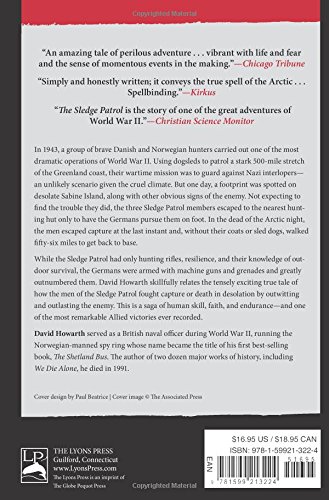
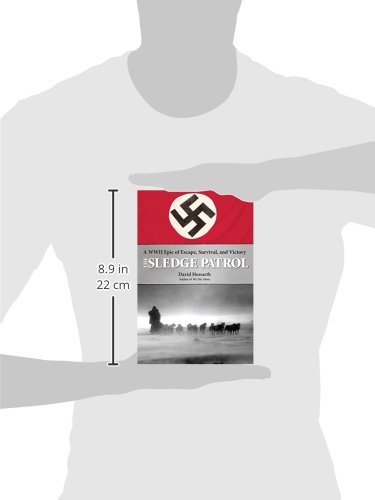
Full description not available
M**L
Another side to the Big One
"The Sledge Patrol" is set in eastern Greenland during World War 2. Yes, that conflict even extended to the remote Danish colony. Greenland was strategic because weather patterns for Western Europe and surrounding waters form there. This was of obvious and vital interest to the American, British and German navies. Early in the War, the Danish colonial weather stations had broadcast reports "in the clear". Anyone, including the Germans could pick them up. Two critical events take place: Eske Brun, the Danish colonial head decides he had the power to resist German interest in his territory- and formed the Greenland Army with a force of 9 men. Then the Danish weather reports are sent in cipher so that the German navy can no longer eavesdrop. The Germans land a force to establish their own weather station. This the background to SP. What follows is almost as much a tale of personal honor and battling/surviving the Arctic elements than of military action. There is much dashing to and fro on sledges (dog sleds) to the point where this reader lost track of who was going where. The sides vie to avoid each other more than to engage in combat. And since there is minimal fighting and hence no real "bad guys", I found myself losing track of who was on which side. In fact, most of the men on both sides appear as nice, solid guys. The ending is almost academic. Readers will receive an excellent sense of the fierce and beautiful Greenland geography and Eskimo tradition. Mr.Howarth is an excellent writer and interest in his books appears to be going through a well-deserved revival. But one has to be cautious in recommending SP. It is simply too hard to keep track of the action. Furthermore, the maps are inadequate, adding to the confusion. A positive note: SP is well laid out in an eye pleasing typeface and paper stock. So many of us take such for granted but a tip of the hat to an anonymous graphics person is in order. Cautiously, I'm giving out 4 stars, but 3 may be more appropriate due to my frustrations with the maps. It really would have helped to know where these guys were rather than "somewhere in eastern Greenland".
L**R
Little Known Part of WW II
Like his book "We Die Alone" David Howarth acquaints us with a little know part of World War II, reminding us once again that this was really a WORLD WAR. The occupants of Greenland, faced with helping their home country of Denmark against the German aggression were willing to use their talents and experience. There wasn't much understanding of this war, especially among the native Eskimos, but they were willing to follow orders anyway. No ordinary men could have withstood the problems they incurred, such as traveling dozens of miles without adequate clothing. Although interviews and official documents were used to tell the story I suspect some of the thoughts of the men were fabricated. Also, it's obvious the story was written back in the 50s when religion and Christianity was so much more a part of the life of citizens of most of the world. These days there probably wouldn't have been reference to God, prayer, etc. It was refreshing to hear a variety of people comforted by their faith. I couldn't help but think that if everyone had the convictions of the Eskimos then there probably wouldn't have been a war at all! It was a little confusing sometimes to keep all the people straight and the places they were going. Would have liked to have an actual map of their travels. Also, don't know if this came from the original or from the reprint but there are a lot of typographical errors that tended to distract while reading. I counted one on three consecutive pages, simple things but things that should have been cleaned up by an editor. However, the book is worth reading and just adds another detail to the study of World War II.
A**R
Before The Survivor, There Were Survivors
This true story was written about 5 years after the end of WWII, and it is gripping from the first page. The picture of the men who live, hunt and survive in the unforgiving artic climate of Greenland is astonishing. The imposition of the German war on this pristine, wild and brutal environment is as shocking as what happened when the Germans showed up in Africa--taking mechanized warfare into cultures and lands where life is lived on a subsistence level, by the values of human beings who are not accustomed to seeing other men as enemies.I first read this book at age 14 or 15 and was enthralled. Revisiting it now, it has lost none of its luster. But now I had the pleasure of sharing it with my son, who was just as thrilled with it as I was. He had just gone on a dog sled ride north of Montreal and the portrait of the dog sledges, their role in surviving the Greenland winter and in moving soldiers through the snowed in lands is wonderful. You have to carry a gun on those sledges, to protect against polar bears. What a difference in climate 60 years has wrought.
L**3
Who knew about Greenland's contribution to World War II?
The Sledge Patrol opened my eyes to the amazing peoples of Greenland and their experiences during the second world war. The author does a good job of obtaining the information from the people who actually lived through the times and does not use the opportunity to overly "politicize" the players in this real life drama. I was particularly drawn to the persona of the German captain who was torn between his duty as a German officer and as a human of the artic world. This is information that was never covered in history books. As far as the writing goes, I found several typographical errors (and these errors were NOT due to British variations on the American spelling of words). It was almost as if this book was out of print, and someone chose to re-type the book for the purpose of publishing it again (I really do not know about this kind of thing). But these errors in no way detracted from the information presented.
M**Y
Compelling adventure in a desolately beautiful landscape
The second book by David Howarth that I have read and enjoyed. Keeping in mind that this book was written in the early 1950's and is very much of that era it moves along at a very good pace and is narrated in a clear, concise way. The story is true and Howarth, a British naval officer, met and inetrviewed most of the principal characters before he embarked on recounting this fascinating story. I'm rather drawn to stories set in snowy and wild landscapes (no great surprise then that my own novel The Dragunov Deception starts in Siberia and ends in Bhutan in the depths of winter!) The story, as it unfolds, reveals men of opposing sides and men trying to remain neutral, in the face of global war, all of whom are ultimately driven by their personal beliefs and own moral compasses rather than simply following "higher orders" in the pursuit of national duty. The book is quietly revealing for showing how war try to bends individuals to its way and how some people can become involved but still be true to themselves.
L**N
Winter war in Greenland
This is a small tale from the edge of the war zone. But the impact on the lives involved is as dramatic as any other. War comes to Greenland but the biggest danger is the place its self. Written some time ago now when the people were still around to share their story it is a very sensative telling of the conflict. The loaction is very well discribed so you can understand why war here is so differant from a muddy field in France.
R**S
Five Stars
Utterly gripping.
D**E
Five Stars
as expected
S**S
The sledge Patrol
if you are into quirky WW2 stories this fits the bill, the book is well written and definitely worth a read.
Trustpilot
3 weeks ago
4 days ago