Some deliveries may take a little longer than usual due to regional shipping conditions.

DOWNLOAD THE APP


Customer Services
Copyright © 2025 Desertcart Holdings Limited
DOWNLOAD THE APP

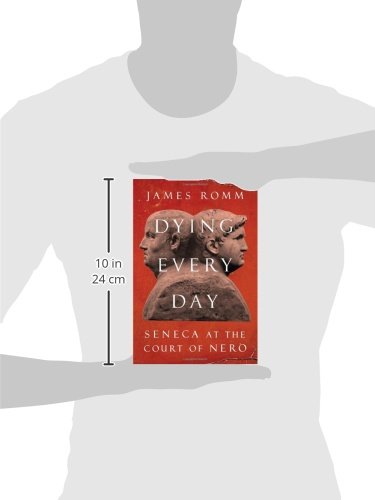
Full description not available
J**S
Superb and complex book and character
This is a superb but a somewhat complex book. It is both a biography of Seneca and a history of the terrible reign of Emperor Nero. This is entirely unsurprising given the essential role played by Seneca in both the education and the reign of the murderous young Emperor and because it is simply impossible to understand the ambivalence of the former without putting him and his works into context.The complexity lies in trying to understand who Seneca really was, or, to be more precise, to understand his ambivalence and ambiguity. Simply put, the philosopher high and lofty moral principles were simply at odds with many of his actions and with the support he gave and the role he played at the Court of Nero. Seneca essentially strived – and ultimately failed – to keep the Emperor from his worst excesses. However, he was also, as the author clearly shows one of the main moral cautions of the regime and he was, to a large extent, used and abused by his protégé, pupil and master.It is this ambivalence, and Seneca’s ultimate failure which he paid with his life, which are striking, hard to explain and tragic. It is also this ambivalence and these gaps between the moral high ground that Seneca wanted to claim and his much less attractive actions that largely make him into an enigma and into a controversial character. He has been portrayed as both an accomplice of Nero and one of his victims and in fact he was both, as James Romm shows so skilfully.James Romm also shows how Seneca managed to put himself into such a position. He was ambitious. He liked money and power, as the vast majority of Roman senators, and this tended to clash with his stoic principles. He also seems to have had a rather high opinion of himself and also managed to deceive himself, believing that he could effectively restrain and influence Nero and become the power behind the throne.As the author also shows, Seneca was well aware of having compromised - and not lived up to - his high principles. He was also aware of having become the accomplice, the moral caution and even the virtual prisoner and hostage of his ex-pupil, an increasingly unstable, paranoid and murderous Emperor. It is this, and the fact that his beloved nephew Lucan was also increasingly a quasi-hostage at Nero’s court that explains this book’s title – “dying every day” - a quotation from one of Seneca’s works.The book’s construction gives the impression of a slow descent to Hell and chaos, reinforcing the story told by the narrative. After “Suicide”, a theme dear to the Stoics, come “Regicide”, the poisoning of Emperor Claudius, and “Fractricide”, the murder of Britanicus by Nero, to prevent Aggripina from using him against her own son. At the very least, Seneca was aware of it and he did nothing to prevent it. This is followed by “Matricide”, Agrippina’s murder on the orders of her son, with the author showing rather well how formidable, unscrupulous and power-hungry the last surviving child of Germanicus was, and how dangerous she could be for Nero when he started to side line her. This was followed by “Maritocide”, Nero’s elimination of his wife Octavia, an act which further tarnished his reputation, and by “Holocaust”, the great fire of Rome during which about two-thirds of the city was destroyed. “Suicide”, the last but one chapter tells the story of the half-backed Piso conspiracy in which Seneca was compromised, although he did not take part directly, and its unsurprising failure. It is this compromising – his nephew Lucan was part of it and would pay it with his life – that lead to Seneca’s suicide. The last chapter (“Euthanasia”) tells the story of the end of Nero’s reign, as opposition mounts against him after three more years of excess and lead to his own suicide, and to a bitter but short civil war.A masterful book which is fascinating, full of insights and paints rather well the suffocating atmosphere that one could breathe at Nero’s Court, and the barely concealed terror that courtiers must have felt at the mercy of an increasingly unbalanced Emperor. This one is easily worth five strong stars and a book that I strongly recommend for all “fans” of the Roman Principate.
Y**R
LIMITS OF ADVISORS
Avant-Garde Politician: Leaders for a New Epoch This highly recommended book can be read in two ways: Rapidly, as a real life power-and-crime drama, more fascinating than the "House of Cards" TV series. Or as a serious study posing one of the most fundamental problems of politics, namely the relations between a ruler and his advisors - in this case the Roman percepts Nero, as increasingly becoming deranged, and his stoic philosopher advisor Seneca.Every ruler depends on advisors, both formal and informal ones. Therefore providing senior political leaders with morally and cognitively high-quality advisors serves as a main way to try and improve governance. Such advisors can be prepared by systematic study, such as at modern public policy schools, while the quality of politicians is largely a chance matter, depending on dynastic inheritance, elections, or party cliques. But this book demonstrates that this is very inadequate: The quality of politicians is critical and no advisor can serve as a substitute for it.Nero was an immoral and in part evil ruler. Efforts by Seneca, while serving as teacher of young Nero, to shape his character failed, as was to be expected. But he continued as a main advisor of Nero, whose behavior contradicted the moral percepts of Stoicism. This created a harsh dilemma for Seneca, faced in real life by most of the few (because of tensions brought out in this book) highly moral advisors of rulers. As put by the author: "Seneca had made the bargain that many good men have made when agreeing to aid bad regimes. On the one hand, their presence strengthens and helps it endure. But their moral influence may also improve the regime's behavior" (p. 122).Seneca has been subjected to harsh criticism for serving an evil ruler while betraying the stoic ideals which he himself developed in outstanding philosophic writings (and also enriching himself and enjoying a good life). He has been diagnosed as having a "compartmentalized mind." As well put in the book: "He had attained both the wisdom of a sage and the power of a palace insider - but could the two selves coexist?" (p. 88).The author, as did Tacitus (himself involved in Roman politics) in his writers on Seneca, leaves the issue open. But I think a crucial point should be emphasized: The very nature of politics involves "dirty hands," and in Imperial Rome (and many other historic situations) also quite some cruel force. Thus, Nero's murder of his mother Agrippina, who clearly was characterized by a lot of what was called "impotentia -an inability to master lust, restrain envy, or tamp down the need for control and power" (p. 78), may well be justified in terms of raison d'etat, however horrible (though not the murder of Octavia). Therefore Seneca should not be accused of having "colluded in the murder of Agrippina" (p. 152).He did his duty.The realities of power are fully brought out by the later stoic Emperor Marcus Aurelius, whose meditations are outstanding, but who engaged in bitter wars and whose reign was marked by prosecution of Christians. This shows that even philosopher-rulers have to dirty and also bloody their hands - and their advisors have to help them do so wisely and effectively.This reality is not faced in the final sections of the book praising Aurelius as a stoic ruler, despite its importance as offering an explanation of Seneca as trying to engage in what I call in my recent book "public interest Machiavellianism." He must have recognized that, in the world as it is a ruler cannot follow the public morality percepts of Stoicism (as distinct from personal ones) without causing statecraft disasters and acted accordingly, while writing for non-rulers and for rulers in a better future. No "split personality" explanation is necessary or appropriate.This important book has an additional critical lesson to offer, which meets the test of history: Even the best of advisors cannot repair basic inadequacies of their politician clients or compensate for them. Therefore, upgrading morally and professionally the quality of advisors is no substitute for systematic efforts to improve politicians. But this increasingly urgent requirement is seldom seriously considered, being still largely a "taboo" subject.Professor Yehezkel DrorThe Hebrew University of Jerusalem
E**Y
"A unified Seneca"
Modern assessments of Seneca fall into two distinct camps - the plutocrat, defender of tyranny and hypocrite (based on the writings of Cassius Dio - who thoroughly hates Seneca and doesn't have a god word to say about him, Tacitus and Suetonius), or the philosopher (based on Seneca's own considerable oeuvre). Mostly the first, as far I can see. Romm promises us "a unified Seneca" reconciling the opposing views, and in this he succeeds admirably in a very readable account of Seneca's association with Nero and a plausible analysis of his motivations and reasons for his actions. It's not a fully rounded picture of the man - Seneca's writings are only considered in as much as they shed light on his dealings with the emperor, but no one should be in any doubt that he had honest intentions in trying to curb Nero but found himself in too deep.
C**E
LEFT FIELD
It's well written and covers Seneca's life fairly well but, like just about everyone else in the last two thousand years the author os just not sure what to make of his subject. He very much ties everything to Seneca's works without really getting to grips with the character of Seneca himself I thought.It's a good read but don't expect to come away that much wiser though the author paints a pretty devastating picture of Nero that's almost more interesting than Seneca.
T**T
Difficult to put down!
An enthralling read, almost like a thriller. The characters come to life and I could imagine myself living in Ancient Rome. Vividly illustrates the dilemma of a decent politician/philosopher caught up in a tyrannical regime.
L**L
Great Book
Never read a book so fast, fantastic insight into the life and times of Seneca at the court of Nero. not heavy to read at all and keeps you wanting to read more
B**M
This book really deserves more attention than it has received ...
This book really deserves more attention than it has received. A fantastically imaginative format for a biography - Romm delves into the unresolved tension between Seneca's persona as a detached philosopher, and his role as an adviser a chaotic and despotic regime.
Trustpilot
4 days ago
1 day ago