
DOWNLOAD THE APP


Customer Services
Copyright © 2025 Desertcart Holdings Limited
DOWNLOAD THE APP
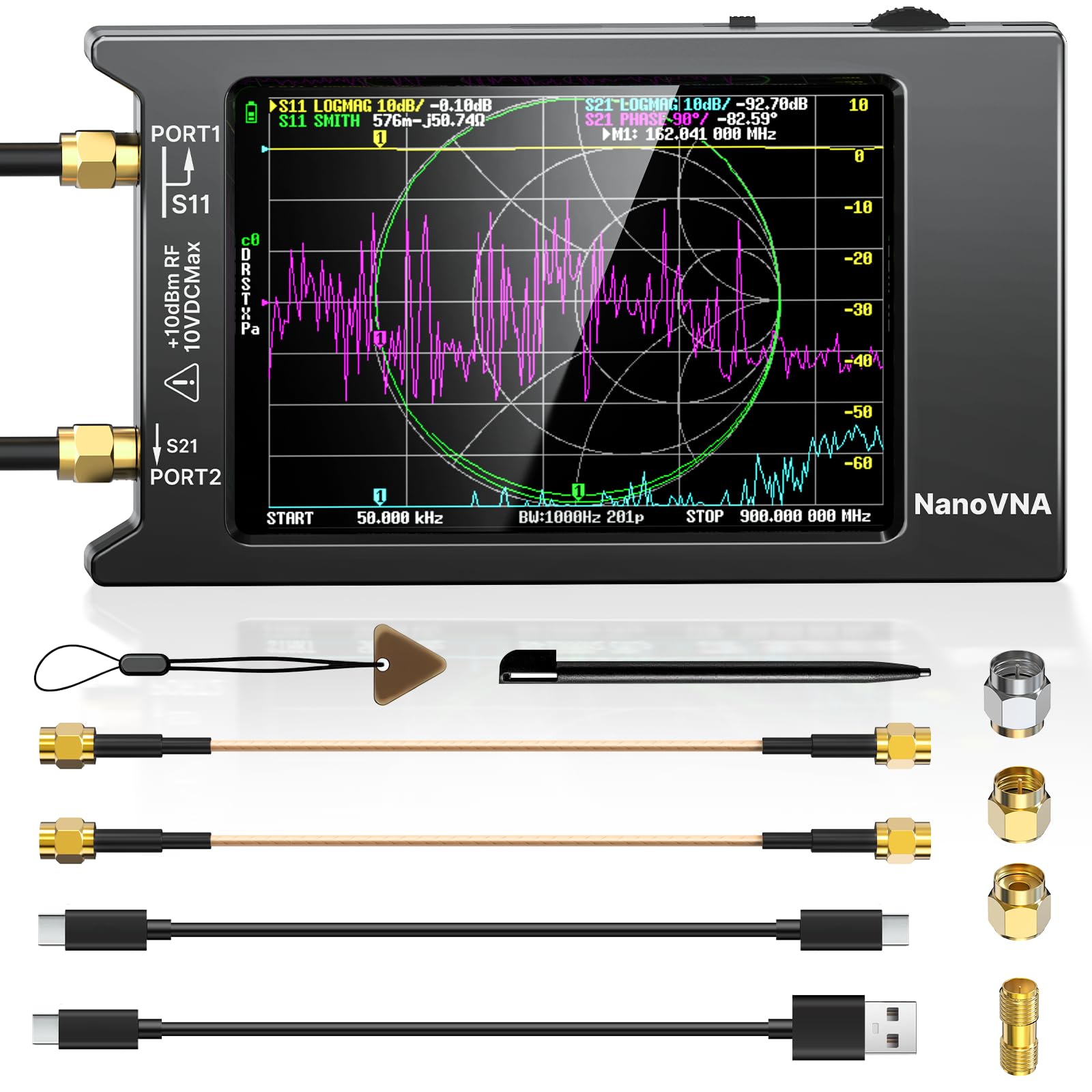
📡 Elevate your RF game with the NanoVNA-H4 — precision meets portability!
The AURSINC NanoVNA-H4 V4.3 is a compact, handheld vector network analyzer featuring a 4-inch touchscreen, 10KHz to 1.5GHz frequency range, and a robust 1950mAh battery. It supports SD card data storage up to 32GB and offers advanced S-parameter measurements ideal for ham radio operators, engineers, and antenna builders. With PC and Android connectivity via NanoVNASaver software, it enables seamless data export and analysis, making it a must-have tool for precise antenna and RF system tuning.


K**L
Finally coverage for 1296 band
I had been sitting on the fence to acquire one of these for a long time primarily because it did not cover 1296MHz where I have and will be spending more time on antennas. A few days ago I took another look and noticed V3.4 2.8 and 4” versions released on Alibaba and now here.Yesterday I received the 4” version NanoVNA-H4. It came nicely packaged as shown in the pictures. It had a Jan 1, 2020 build date using the hugen79 branch, one of the 3 main builds I spotted so far for NanoVNA, and the one specifically developed for this new version hardware. Jan 18th a new build of firmware was released.There is a known bug that if you use a center frequency above 1GHz it may lock up. If this happens you can power cycle to return to normal. Use start and stop rather than center to work around this for now. It is already fixed in another branch’s build as of Feb 2, I suspect it will be fixed soon enough and is an easy thing to avoid.One of the concerns is what device are you buying, a clone or the real thing. Being very recently released I do not think the clones of this model have had time to show up yet, and the photos and text seemed legit so I bit. Looking at the device packaging, paperwork, PCB and the one small case clearance issue existing on my unit, it appears to match the original overseas listing and Hugen79’s own description and seems like the real thing to me. It can be hard to tell sometimes. The firmware upgrade also worked as expected. There is another build of this running in parallel but uses a different BIOS and is more targeted to developers for now but promises to expand future capabilities. BTW the “-H” designation identifies the hugen79 hardware variation from the original edy555 hardware design. The H4 is a 4” version.I ran it through several tests on a commercial 116-174Mhz 75Watt Tx filter, the SG-Labs 1296 PCB 2 element yagi, some dummy loads, various length of cables and it seems to work as expected. I also downloaded and used the NanoVNA-Saver V2.2-1 PC program (I am on Windows 10). All works well there also. The NanoSaver has a lot more real estate so separates charts with configurable sweeps, trace widths, and colors so it can give you a cleaner results display. Additionally it can perform multiple sweeps and average the results. SWR, TDR, and all the usual parameters are shown for each marker. For the cables I tested the TDR function and it worked well also. I have a Samsung Galaxy S10 so has a USB C connector. I used the supplied short USB cable and ran the NanoVNA Web App on my phone and that worked well also. Again, more display real estate, clearer charts.As mentioned earlier there is a known issue with touch screen clearance on front case section (as of this date). You may experience random menu operation. It is due to the lack of clearance between the right edge of the display case cutout and the touch screen edge. This can happen due to variable air gap between the LCD base and the PCB and/or case flexing/warpage, or if you squeeze the case on the right side. I worked around this by slightly warping the case along the right side display edge outward a bit and then holding the unit by the edges while in use. Some put tape on the far right edge of the screen as a spacer. I also tend to use an old stylus pen from an Ancient pocketPC I still have as a museum piece. A suggested fix is small thin plastic washers on each case screw on the PCB between the 2 case halves. No doubt future case production will be adjusted. Was an easy fix once I figured out the problem.Hugen79 released a new build on Jan 18, 2020. I installed that and all works fine still. It is easy to do once you fine the right tool. I tried the most commonly suggested method using a command line tool called dfu-util.exe. It was able to see the VNA USB parameters but it claimed it was not in DFU mode (though it actually was). The latest build lets you go into DFU mode easily (a bootloader mode to update firmware). Just power off, press and hold the switch paddle in, turn the power on, and let go. The screen will be black but you will hear/see the USB device enable on your PC. You can see the device as the “STM Device in DFU Mode” in device manager under USB controllers. Some procedures suggest you run Zadig to install a Libusb driver which I did. I used the LibUSBk version. Not finding a way to make dfu-util work, I found DfuSe_Demo V3.06 from ST Microelectronics. It is a GUI based version of the tool and it worked no problem and easier as well.I have seen web posts were some folks are attempting to use the changes in hardware version 3.4 to update their pre 3.4 devices, particularly in the shielding area, some changing out resistor values and lowering noise by adding more caps inside.The NanoVNA-H4 arrived with the battery fully charged according to the on screen indicator. I plugged it in to ensure it was topped off. I used it for quite some time running on the battery and it still showed full. I believe the previous version batteries were 450-650mAH, at least for the 2.8 versions. This one at 1950mAH give a long operating time.Software mentioned:Zadig.exeLibusb driverNanoVNA-H firmware dated January 18, 2020 V4.0.4.5-12-gea578a2 NanoVNA-Saver.exe NanoVNA Web App for Android, maybe iOS also.Dfu-util.exe (did not work for me)Dfu_Se Demo V3.06.exe (worked well)In conclusion, for me this was worth hopping off the fence and is a great value covering the all the HF through 1296 bands. Well done to the project creators and contributors.
I**.
There's alot here in a small cheap portable package!
Perfect size for field service trips. Solid build. More accurate than the MFJ antenna analyzer. It's got a learning curve. There's a TON of neat stuff to tinker with here! I've already got the RF Explorer Pro and TinySA for low (down to 10KHz and up to 7.5GHz) for my spectrum analyzer needs, so the frequency range will suffice for my HF and 2M, NWS weather radio antenna builds.
K**B
Good to have when purchasing the NanoVNA
spend the extra $ to be able to save all frequencies and capture screen shots.
A**Y
Great value
This VNA makes tuning an antenna easy.
B**Y
Learning curve
I got this just to play around with whole building some antennas. Quite a bit of useful info on this little package. Still learning, but fun.
A**D
Must have!!
Great device. Still learning. Already paid for itself.
L**O
GOOD FOR RADIO USE AT A GOOD PRICE
SEEMS TO DO WHAT I NEEDED FOR ANTENNA WORK
A**R
AURSINC Upgrated NanoVNA-H4 Vector Network Analyzer, Lastest V4.3 10KHz-1.5GHz
This is very nice. I have two of the smaller nano VNAs and the narrow side of this screen is the same as the long side of the little ones.It also has a slightly different menu and it has a place for an SD chip so you can save your settings and more.This is much nicer to handle and use than the smaller ones.
Trustpilot
5 days ago
2 weeks ago