
DOWNLOAD THE APP


Customer Services
Copyright © 2025 Desertcart Holdings Limited
DOWNLOAD THE APP
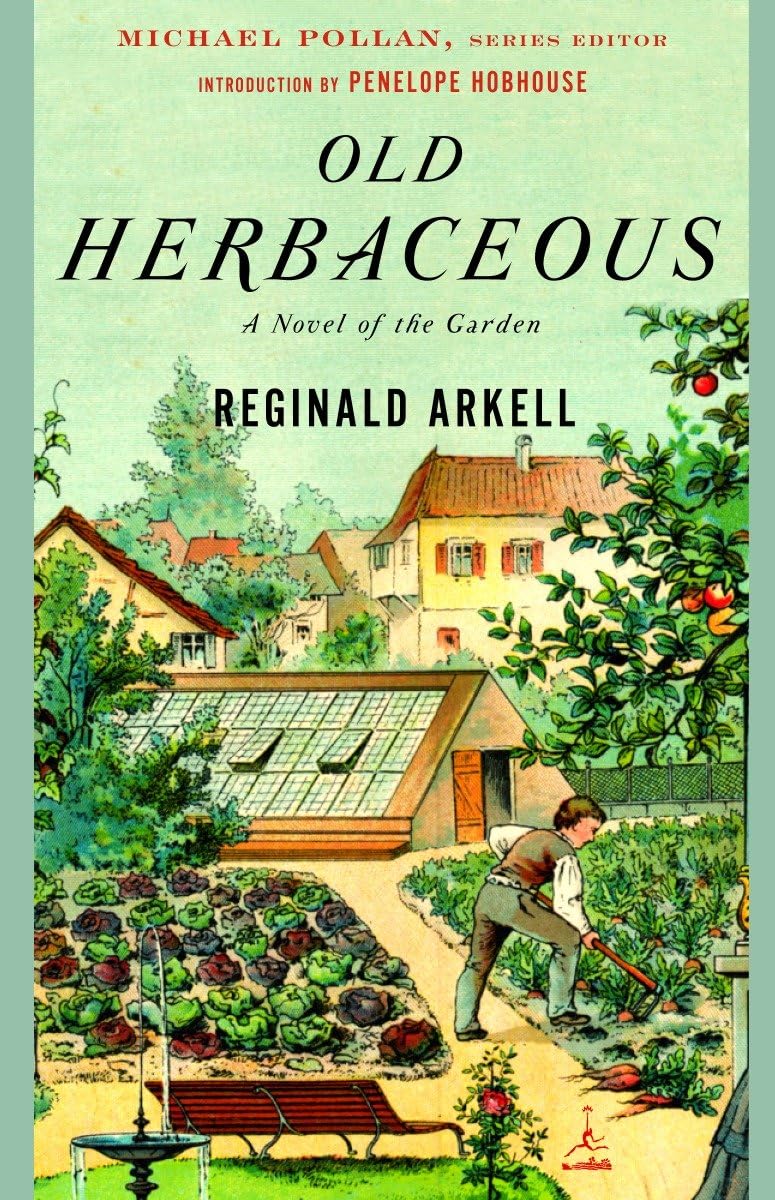
Old Herbaceous: A Novel of the Garden (Modern Library Gardening)
T**R
One of England's Great Gardening Classics
You know, one of the really great things about gardeners is how wonderfully generous they are with advice, most of it rubbish of course and rarely is it advice they themselves follow in anything like a systematic way, as I have noticed. But every so often you pick up a nugget of great value from a gardening acquaintance, and experienced gardeners are always on the lookout for that. So here is something along the line of a pearl of rare price. If you have never read Old Herbaceous by Reginald Arkell, go out and buy this fine book immediately. It was written in 1950, near the end of the author's long life, and it is a novel about a crusty old English gardener near the end of his own long life, looking back on what made him the gardener - and the man - he is now. You can just hear the lilting sing-song of the rural accents of the village characters; Arkell has captured them with perfect pitch. What a lovely and humane book this is, a gentle comedy enriched with sober observation on the practice and philosophy of gardening. It has the broad comedy of Beverley Nichols' great gardening books but also their depth and perhaps a bit more gravitas. It is truly a gem and, though far too brief, something you will take to heart and cherish.But don't just take my word for it. It is a standard-bearer of the Modern Library's gardening series, edited by the best-selling writer Michael Pollan. He writes in his introduction to the series that these are all books for literate gardeners: "And so I read to garden, and gardened to read, counting myself lucky for having stumbled on a sideline with such a lively and lasting literature. For what other pastime has spawned so many fine books?" And that is followed by enthusiastic comments on Old Herbaceous itself by gardening great Penelope Hobhouse.The narrator's tone is elegiac and heavily nostalgic, as is not surprising in a gardener whose life and career began as a foundling and gardener's boy in the Victorian era, saw the great-house golden era of Edwardian times, the economic dislocations of World War I, the roaring twenties and then World War II and the post-war era of shortages and rationing. It plugs directly into the enlivening current that makes the television series "Downton Abbey" so popular: nostalgic, beautifully observed and humane, while history washes over and changes fully realized characters that we love and care about. Officially this is a book about gardening, but really it is a book about saying goodbye, letting go, having your life in its proper perspective at all times, living quietly and with beauty and dignity. All things gardeners are working out in their own gardens the world over.You would have to have a heart of stone not to feel Old Herbaceous' pain in the scene when he has to part with his beloved but now frail Mrs. Charteris, who owned the manor home for many years and has to move into smaller quarters; or when he is cruelly given the sack late in life by the new owners (though this is later rescinded). Here is the likable and sunny Old Herbaceous himself, philosophizing about the good things that come to a man with age: "If you could peel the years from a man's life, as you do the leaves from a globe artichoke, you would find him having his happiest time between the ages of fifty and sixty-five...A golden, mellowing period which brings out all that is best in a man. Kindliness creeps in; cheerfulness spreads its warming rays, even a little humor..."The warming rays and gentle humor of this book are certainly charming. It is a short, nostalgic and deeply humane novel that has earned its place as one of England's great gardening classics.
M**N
Good read especially if you garden.
Love this book. I enjoy gardening and enjoyed his main character and the story line.
R**E
Sentimental as hell. But still.
A great way to spend a couple hours in a gentle, humorous, rich and lovely world.A great escapist drop-in to an old fashioned kinder time.
A**R
a moment in time and a way of life gone but not forgotten.
In the vein of the Merry Hall series by Beverly Nichols and the Miss Read novels, transporting one to life in small villages in England in the early 1900’s—very enjoyable feel-good read.
O**L
A Love Story
He was left on the doorstep like an unwanted zucchini, newly born, frail, and crippled, with one leg shorter than the other. The farm-wife, with a sigh, took him in as an unknown, after a mental check through the village maidens, thinking with six of her own, one more wouldn't make much difference. She and her hard-working husband treat young Herbert the same as her other children. They are expected to work to their utmost from the get-go, require little, stay healthy, and eat hearty.At 14, when youth were expected to be on their own, crippled Herbert is slated to be a farm worker. But this is a resilient, if storm-tossed sparrow, whose character we learn early on. The boy happens on a discarded pair of skates, cleans them up, and finds by adding wood wedges under the crippled leg, his feet have wings and his heart the courage to speed under the lowest bridges on the frozen river. This brings the lad a first taste of sheer happiness and some respite from the casual bullying of the village boys.There is, in such a fellow, more there. What this "more" is, how Herbert Pinnegar finds it within himself, and finds, too, how to give, receive, endure, and grow love shines through this story. We learn, for example,(if we had any question) that gardening can be a blood sport: in the annual agricultural expositions, in the Great Railway Station competition, and in the herbaceous borders. Gardeners need strong minds and hearts, as well as strong backs. And we learn that Beloved Ladies and their true knights can still be found, not as Quixote to Dulcinea but as another Herbert, Bertram de Borne was to Eleanor of Aquitaine.This is, then, a story about gardens, and about England from the late 1900s until after World War II with an appreciation for what was, and what was lost. It is verymuch about love, which, in a way, began also in a garden long long ago.Readers seeking the power & bite of "All Quiet on the Western Front" or "The Jungle", or the adrenalin of "Downton Abbey" may find "Old Herbaceous" not quite their cuppa. Readers who like these but also cherish "On Golden Pond," and the courage that doesn't get medals and probably would not wear them if they came, may love this beautiful book.Highly recommended, for oneself or as a gift to loving & loyal friends, perhaps tucked in a basket of strawberries, which also feature notably in this story.
J**D
A Nice Old Story About A Nice Old Time
Old Herbaceous was first published in about 1950. It is the fictional chronicle of the life of Old Herbaceous, the head gardener at an English manor house. He begins life as a foundling child, early develops a love for flowers which grow along an abandoned canal, and then becomes a gardener at the manor house after impressing the Lady of the Manor at a garden show. Gradually he rises through the ranks of gardeners to eventually become head gardener.This book is pleasing for several reasons. First, it helps us understand what a complex thing an English manor house must have been, with its ranks of servants and underlings. Secondly, it has beautiful descriptions of flowers, shrubs, trees, and other elements of the English countryside. Finally, its a great social history in microcosm of the changes England underwent from the 1870s through the World War II era.In many ways Old Herbaceous is another Goodbye Mr. Chips: a short quiet book about a seemingly unimportant individual who turns out to be much more than he appears.
A**R
Spring Reading
I enjoyed this book. I connected with the old gardener and found the story pleasant. A quick read, perfect for spring reading list.
H**I
A Lovely Read
Beautifully written and a wonderful story.
Trustpilot
2 weeks ago
2 months ago