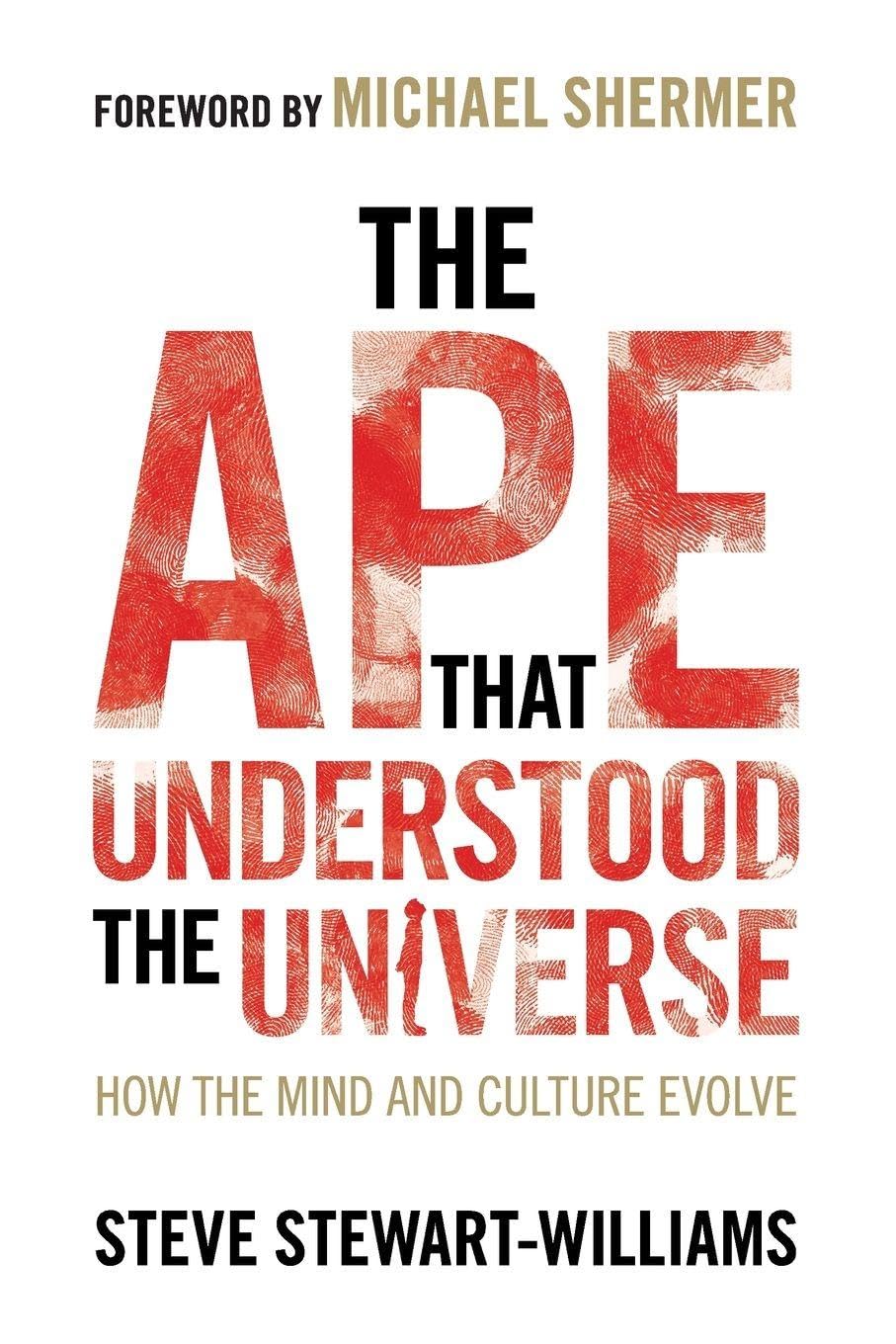
Buy The Ape that Understood the Universe: How the Mind and Culture Evolve by Stewart-Williams, Steve online on desertcart.ae at best prices. ✓ Fast and free shipping ✓ free returns ✓ cash on delivery available on eligible purchase. Review: I came across this book while listening to an episode of Chris Williamson on Youtube. He praised it, and after reading it, I agree with him. This book is informative, easy to understand, engaging, and at time unexpectedly clever. The author will certainly “force” you to think about a subject, or at least force you to take some time to do so, and will do so while explaining how humans behave, and why we should not only rely on popular explanations about our behaviour that rely only on cultural factors. Much like others before him, he argues that genes play a role, an important role, in how we behave. Although my biggest criticism may be that the author sometimes doesn’t go into the hard data, such as how much the difference between A and B be, the amount of references he provides makes up for it. What I mean to say is that this book does a very good work at introducing concepts and ideas, and points you to where you might learn more. Another thing that is very much appreciated how neutral it is. Although he dismissed some arguments made by the people who may criticise his ideas, he does so while also giving them a fair treatment, or at least engages them. The appendix, while not the definitive answer, does provide some insights about the criticisms levied at evolutionary psychology, and provides ways in which we can approach the subject with those may disagree with us. Review: Je n'ai pas appris énormément de nouvelles choses en lisant ce livre, mais quel plaisir de lire une défense si claire, si bien argumentée et si synthétique de cette discipline passionnante qu'est la psychologie évolutionniste. Si vous voulez comprendre la nature humaine de manière profonde, je n'ai pas de meilleurs recommandations. Le livre se finit avec une introduction aux théories de l'évolution culturelle, indispensables compléments à la psychologie évolutionniste pour comprendre la bête humaine dans toute sa profondeur. Les critiques les plus courantes adressées à ces disciplines sont remarquablement bien traitées lors des deux appendices de fin de livre. Mon seul petit regret : je trouve que le thème de la religion est un peu superficiellement traitée, avec notamment aucune mention aux travaux de Pascal Boyer ou Justin Barrett et de la théorie de l'Hyperactive Agency Detection Device.

| Best Sellers Rank | #54,798 in Books ( See Top 100 in Books ) #94 in Popular Applied Psychology #128 in Neuropsychology #20,844 in Textbooks & Study Guides |
| Customer reviews | 4.6 4.6 out of 5 stars (279) |
| Dimensions | 15.24 x 2.49 x 22.86 cm |
| Edition | Revised |
| ISBN-10 | 1108732755 |
| ISBN-13 | 978-1108732758 |
| Item weight | 1.05 Kilograms |
| Language | English |
| Print length | 386 pages |
| Publication date | 21 November 2019 |
| Publisher | Cambridge University Press |
C**R
I came across this book while listening to an episode of Chris Williamson on Youtube. He praised it, and after reading it, I agree with him. This book is informative, easy to understand, engaging, and at time unexpectedly clever. The author will certainly “force” you to think about a subject, or at least force you to take some time to do so, and will do so while explaining how humans behave, and why we should not only rely on popular explanations about our behaviour that rely only on cultural factors. Much like others before him, he argues that genes play a role, an important role, in how we behave. Although my biggest criticism may be that the author sometimes doesn’t go into the hard data, such as how much the difference between A and B be, the amount of references he provides makes up for it. What I mean to say is that this book does a very good work at introducing concepts and ideas, and points you to where you might learn more. Another thing that is very much appreciated how neutral it is. Although he dismissed some arguments made by the people who may criticise his ideas, he does so while also giving them a fair treatment, or at least engages them. The appendix, while not the definitive answer, does provide some insights about the criticisms levied at evolutionary psychology, and provides ways in which we can approach the subject with those may disagree with us.
A**R
Je n'ai pas appris énormément de nouvelles choses en lisant ce livre, mais quel plaisir de lire une défense si claire, si bien argumentée et si synthétique de cette discipline passionnante qu'est la psychologie évolutionniste. Si vous voulez comprendre la nature humaine de manière profonde, je n'ai pas de meilleurs recommandations. Le livre se finit avec une introduction aux théories de l'évolution culturelle, indispensables compléments à la psychologie évolutionniste pour comprendre la bête humaine dans toute sa profondeur. Les critiques les plus courantes adressées à ces disciplines sont remarquablement bien traitées lors des deux appendices de fin de livre. Mon seul petit regret : je trouve que le thème de la religion est un peu superficiellement traitée, avec notamment aucune mention aux travaux de Pascal Boyer ou Justin Barrett et de la théorie de l'Hyperactive Agency Detection Device.
I**Y
A thoughtful and interesting read
B**M
I was listening to @chriswillx podcast where he mentions this book multiple times. I’ve always been fascinated with the subject of evolutionary psychology so I decided to read it and it honestly blew my mind. As Chris says, “As far as I’m concerned, evolutionary psychology is the closest you’re ever going to get at peering under the hood of your own behaviour and discovering why you do the things you do.” This book is a glorious introduction to the world of evolutionary psychology. Witty, jaw dropping insights that will make you see the world through a new lens.
M**L
This book is basically an updated version of The Selfish Gene by Dawkins: selfish genes, sexual selection, prisoner dilemma, reciprocal altruism, parental investment - it all here. Its hard to find here any new ideas if you read "The Gene". What's the catch? The author gives you more examples, more emphasis on psychology than genetics and certainly writes with far more humor.
Trustpilot
1 week ago
1 month ago