
DOWNLOAD THE APP


Customer Services
Copyright © 2025 Desertcart Holdings Limited
DOWNLOAD THE APP

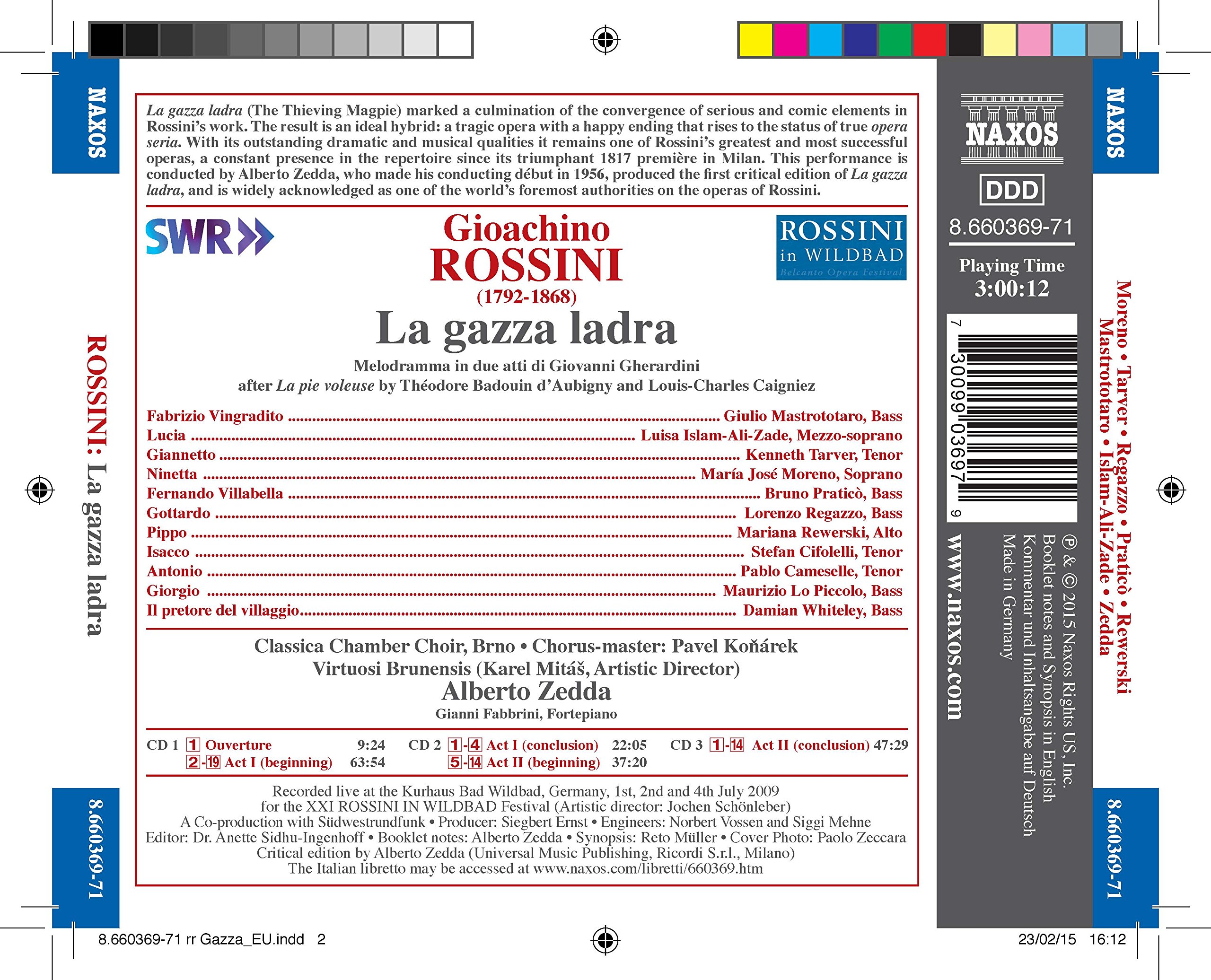
Product Description La gazza ladra (The Thieving Magpie) marked a culmination of the convergence of serious and comic elements in Rossini's work. The result is an ideal hybrid: a tragic opera with a happy ending that rises to the status of true opera seria. With its outstanding dramatic and musical qualities it remains one of Rossini's greatest and most successful operas, a constant presence in the repertoire since its triumphant 1817 première in Milan. This performance is conducted by Alberto Zedda, who made his conducting début in 1956, produced the first critical edition of La gazza ladra, and is widely acknowledged as one of the world's foremost authorities on the operas of Rossini. Though La gazza ladra (The Thieving Magpie) is famous for its overture, the whole opera is rather surprisingly not currently represented on many recordings. The unique selling point of our release is the vastly experienced conductor Alberto Zedda, who made his debut in 1956, and who has worked extensively in Berlin, New York and London. Vitally he produced the first critical editions of many Rossini operas, including this one. Review (this) recording is an important addition to the Rossini discography which should stand La Gazza Ladra in good stead for some years to come. --Gramophone, Oct'15 Review: Five Stars - tremendous performance conducted by the master of rossini Review: Five Stars - excellent
| ASIN | B00V8945OY |
| Best Sellers Rank | 295,086 in CDs & Vinyl ( See Top 100 in CDs & Vinyl ) 11,493 in Opera & Vocal Music 12,863 in Chamber Music (CDs & Vinyl) 24,724 in Box Sets (CDs & Vinyl) |
| Customer reviews | 4.6 4.6 out of 5 stars (33) |
| Item model number | 43173-441049 |
| Label | Naxos |
| Manufacturer | Naxos |
| Number of discs | 3 |
| Product Dimensions | 14.2 x 12.8 x 2.49 cm; 178.04 g |
M**T
Five Stars
tremendous performance conducted by the master of rossini
B**R
Five Stars
excellent
A**L
Five Stars
Boo-ti-ful!
S**S
Truly delightful!
This new recording of “La gazza ladra” is a delight from start to finish. This is hardly a surprise as it’s conducted by the renowned Rossini scholar Maestro Alberto Zedda. In his introductory notes, Maestro Zedda describes the work as a “rescue piece” in which the oppressive feudal aristocracy is replaced by an arrogant official. In this case, he’s the local mayor who amorous advances the heroine has rejected. This tone of the piece is at its most serious in the magnificent judgement scene in the second act and carries through into the finale. I followed the recording with the piano-vocal score based on the critical edition prepared by Maestro Zedda. There are a few welcome excisions in the secco recitatives and a cut of the repeat of Fernando’s second act cabaletta. The cut in the cabaletta isn’t something I regret as it’s the least interesting piece in the opera. In the finale, the verses for Fernando and the Podesta were reversed. I presume this was due to the differences in registers that Maestro Zedda speaks of in the critical notes in the score. The performance is superb. Maria Jose Moreno copes with the very demanding role of Ninetta most successfully. The range is all over the place – sometimes in mezzo, sometimes in soprano territory -- but this is no problem for this artist. Her coloratura is agile and her characterization is touching. Kenneth Tarver as the hero, Giannetto, matches her agility and sings with a lovely tone that I find most appealing. Indeed, all of the cast are excellent, as are the orchestra and chorus. This sound of this recording is particularly clear and spacious, which has not always been the case with live recordings from the Wildbad Rossini Festival. On the whole, this is one of the most satisfying opera recordings I’ve heard in a long time, and it’s at a bargain price! Highly recommended.
M**B
Naxos has done it again! On the heals of its release of a winning recording of Rossini's epic Guillaume Tell, comes this wonderful recording of La Gazza Ladra, which is probably Rossini's finest opera in the semiseria genre. It concerns the plight of a servant girl who is wrongly accused of stealing a silver spoon and is condemned to death. Fortunately in the nick of time the true thief, the thieving magpie (la gazza ladra) of the opera's title, is discovered and all ends happily, but not before the audience is plummeted into the depths of despair thinking that all is lost for the poor girl. Opera semiseria is a mix of the comic and tragic. In that aspect it is similar to Mozart's Don Giovanni which likewise has a mix of varied emotions. With Mozart there is always the specter of the tragic percolating under the surface. However, Rossini being Rossini, he tempers the proceedings with a more optimistic outlook. Still, each opera is a roller coaster ride of virtually all the possibilities inherent in the human experience. Furthermore, in both operas the penultimate scene is a dark hued and powerful tour de force. In a sense both operas are harbingers of the verismo era which was not to manifest itself in earnest for decades to come. Rossini opens the piece in dramatic fashion with the overture's infamous stereophonic double snare drum fanfare. It is interesting to note that several of the overture's themes reappear in the opera proper with interesting and attention grabbing effect. When the curtain rises we find ourselves in a rustic atmosphere that reminds us that one of Rossini's favorite compositions was Haydn's The Seasons. Only this is a version of rustic revelry that ratchets up the action several levels from the Haydnesque model. However, as the piece progress things darken and Rossini uses his famous crescendi to draw the listener into the action. With their repetitive ostinato phrases and rhythms these crescendi heighten the emotions and create an aura of excitement that literally grabs the listener. This is no more evident than during the ensemble that concludes the courtroom scene where the audience learns that the heroine's fate is sealed. All this cumulates in a tragic march to the scaffold where the persistent beat of even more ominous drums is once again heard. The juxtaposition between that and the next scene where it is discovered that it is actually that awful avian (quella gazza maledetta) who is the real thief is the ultimate study in contrasts. Still the roller coaster ride continues and for a fleeting moment the audience is led to believe that the execution of the innocent girl has indeed taken place. When that is discovered not to be the case, the jubilation that concludes the piece knows no bounds. The opera was premiered in 1817 in the aftermath of the Napoleonic wars and as such is a reflection of its time and place. The whole Euorpean continent had just been subjected to a situation similar to that of the characters in the opera. Yes, real everyday people being placed in the middle of the most awful of predicaments was something with which the public was able to identify. That the piece ends on such a high note was something that public needed to experience given the ravages of war to which they had recently been subjected. In some respects one needs to put their mindset into the psyche that permeated that era to totally appreciate what Rossini was saying with this piece. As such the opera proved to be one of Rossini's most popular. In fact the opera became so popular that Pushkin replicated one of its scenes when he wrote his Boris Godunov, which scene was incorporated into the Mussorgsky opera of the same name. A back door instance of Rossinian influence on Russian opera! Regarding the performance it is as fine as exists on CD. That it is conducted by Rossini scholar Alberto Zedda who produced the critical edition of the score for the Rossini Foundation insures an aura or authenticity. This is his second recording of the piece and since that original1970's recording he has not only somewhat changed his approach, but the cast of singers are more adept with the Rossini style and embellish their vocal lines differently. In addition the sound quality if a bit bright is a significant improvement over his previous recording which is anyway now out of print. Therefore, anyone who owns that recording can feel free to get this never version without any reservations. In summation the singing in this set it totally stylish. The Ninetta has a vivid soprano sound that warms up splendidly as the performance progresses. The Gianetto is likewise very fine with a fluent bright tenor sound. The bass who portrays Gottardo has a dark sound that is appropriate for the part. The Fernando has a contrasting lighter bass voice that can sound slightly rough at times. The Pippo is excellent and the supporting cast does as well as any. Even the Lucia does a nice job with her little aria intended as a break in the action. I would rank this performance as being better in sound quality and performance than the Sony recording which offers some overly rough vocalism in the soprano role and some less than pleasant sounds from the tenor. There is also a recording on the Dynamic label that has a cast of singers that perform on a similar level to this Naxos version. I find the sound quality of that version to be ever so slightly warmer and a bit more natural as opposed to the more upfront sound of this release. It is the difference between a balcony and front row center perspective and ultimately a tossup. I own all three versions and prefer both the Naxos and Dynamic to the Sony. In the final analysis this Naxos set is definitely a contender and a no brainier at the asking price. In fact with few exceptions all the recordings in the Naxos Rossini opera series are contenders. As such, Rossini is smiling somewhere up there indeed!
A**O
L'orchestra è costantemente imprecisa, purtroppo si odono sbavature continue, la direzione è pasticciata, la scelta dei tempi è a dir poco imbarazzante, alle volte inspiegabilmente velocissimi altre volte letargici...le voci non all'altezza per una partitura belcantista rossiniana...il tenore è inascoltabile, Bruno Pratico non è in serata, Ninetta impalpabile...registrazione molto deludente...
C**N
Une belle intégrale de la pie voleuse de Rossini par Zedda prise sur le vif. Quelle vie! Magnifique
P**7
Ce n’est pas moi qui le dis, c’est Rossini lui-même. Il faut dire que cette œuvre dure 3 heures ! Il s’agit d’un genre « mixte » : l’opéra « semi-seria ». Comme son nom l’indique, il s’agit d’une histoire plutôt dramatique, mais qui finit bien, et dont le « méchant » est tourné en ridicule par la musique, qui en fait une basse-bouffe. Rossini avait déjà derrière lui des chefs-d’œuvres seria (Tancrede, Elisabetta regina, Otello) et des buffa (L’italienne à Alger, le turc en Italie, le Barbier, la Cenerentola, prédécesseur immédiat de la pie voleuse). Il avait aussi déjà composé un opera semi seria, avec succès (l’inganno felice). Après, il se consacrera plutôt à des œuvres seria, à l’exception du doublé « comte Ory-Voyage à Reims », 2 opéras composés sur la même musique ! Il ne s’agit donc pas d’une des petites œuvres du début, mais de l’œuvre volontairement conséquente d’un maestro parvenu au sommet de son art. Pourquoi, dès-lors, à part l’ouverture très célèbre, à juste titre, cet opéra soit tombé dans l’oubli, jusqu’à sa « résurrection » dans les années 60 ? Il est encore rare de nos jours, il y a peu d’enregistrements CD ou DVD. Est-ce dû à la longueur, au grand nombre d’intervenants, à l’absence de « tube », à la difficulté de ce bel canto, au fait qu’il ne soit ni seria ni buffa ? Sans doute un peu tout ça… (il ne faut pas oublier que la plupart des opéras de Rossini avaient disparus aussi, et que pendant longtemps, « le cygne de Pesaro » n’était plus connu que par son Barbier et quelques ouvertures. L’histoire, tirée d’une pièce française (« la servante de Palaiseau ») est connue : une pauvre servante est condamnée à mort pour vol (d’une fourchette et d’une cuillère : les juges avaient la main lourde en ce temps- là !), accusée à tort puisque la voleuse se révèle à la fin être une pie : vous avez reconnu la mésaventure des bijoux de la Castafiore, dans Tintin (« ciel mes bijoux ! »). Le livret donc « se tient », on a vu plus alambiqué. Harcèlement sexuel, comme on dirait de nos jours, de la part du Podestat (plus méchamment que le comte Almaviva avec Suzanne, quasiment autant que Scarpia, mais ici tourné en dérision), homme chargé de faire appliquer la loi, et erreur judiciaire évitée d’un cheveu : voilà pour l’aspect seria. Côté musical, il y a absolument tout : solos, duos, trios, quintettes, ensembles, bel canto romantique, airs bouffes… Mais il faut reconnaître qu’aucun air (à part l’air d’entrée du Podestat) n’a retenu l’attention des chanteurs dans leurs récitals. Cette musique nécessite des chanteurs de premier plan pour les 4 ou 5 principaux rôles, c’est-à-dire un beau timbre et une très bonne technique. Alberto Zedda, l’un des « redécouvreurs » de Rossini avait déjà enregistré cette œuvre en 1978 et l’avait montée au festival Rossini de Pesaro en 1981. Pour cette production allemande, enregistrée en direct, il a réuni un plateau de chanteurs plutôt jeunes, venant d’un peu partout. A part les 2 voix graves (Bruno Pratico et Lorenzo Regazzo), j’avoue que je ne connaissais personne. On est loin de la distribution de grand luxe de Gianluigi Gelmetti en 1989 au Festival de Pesaro (Ricciarelli, Matteuzi, Ramey…). Dans ce coffret Naxos, pas de livret mais un simple résumé, en anglais et en allemand. On peut toujours se référer au numéro dédié de l’Avant-scène Opéra (mais qui date de 1988). En résumé, une œuvre qui mérite de sortir de l’oubli, et pourquoi pas avec cette version, mais bien sûr il y a à présent l’attrait des versions vidéo… 4 étoiles "seulement" car ce n'est quand même pas une oeuvre exceptionnelle.
D**7
I'm convinced that most of the late Neapolitan operas were written for money, and the well of gorgeous melodies and innovative spells he was weaving 'when the mood really hit', as with Semiramide, left him with "only" his contemporary level of craftsmanship to get him through the commissions. Wow, I hate writing that! But it's true. Buy it for yourself - it's still ahead of the competition. Even Donizetti had the same problem, and of course, it is arguable that he wasn't yet real competition for Sr Rossini as yet!
Trustpilot
2 weeks ago
2 days ago