
DOWNLOAD THE APP


Customer Services
Copyright © 2025 Desertcart Holdings Limited
DOWNLOAD THE APP
📚 Crack the code of options trading and never miss a market move!
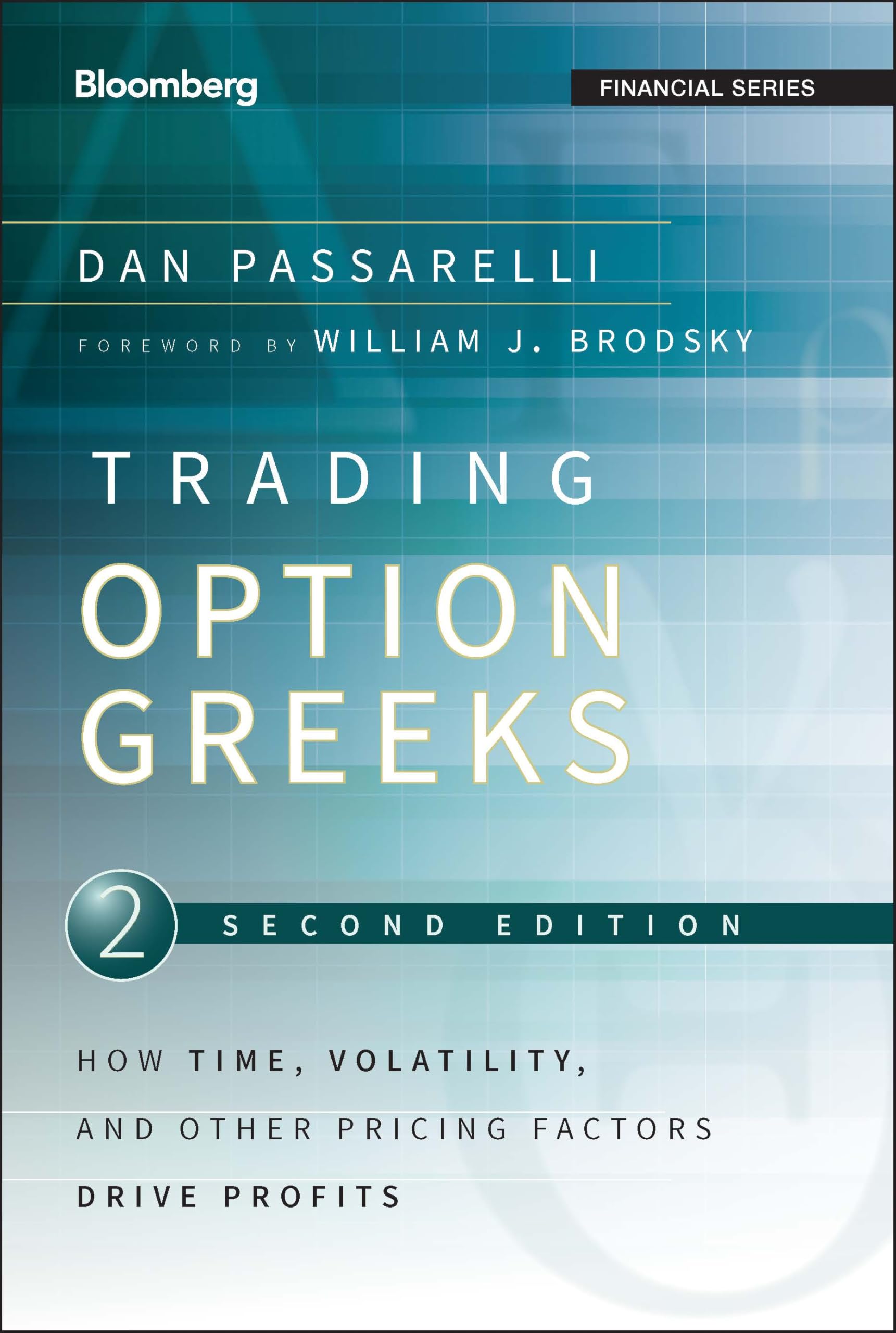
Trading Options Greeks offers a detailed exploration of how time, volatility, and other pricing factors influence options profits. Despite minor editorial errors, it remains a highly recommended resource for both novice and experienced traders seeking practical, math-light explanations of complex concepts. With a strong 4.5-star rating and thousands of positive reviews, this book is a must-have for anyone serious about mastering options trading.
| Best Sellers Rank | 518,481 in Books ( See Top 100 in Books ) 3,924 in Professional Finance |
| Customer reviews | 4.5 4.5 out of 5 stars (464) |
| Dimensions | 16.26 x 4.06 x 23.37 cm |
| Edition | 2nd |
| ISBN-10 | 1118133161 |
| ISBN-13 | 978-1118133163 |
| Item weight | 626 g |
| Language | English |
| Print length | 368 pages |
| Publication date | 28 Sept. 2012 |
| Publisher | Bloomberg Press |
A**R
Essential reading but?????
Having just finished the book, I can say definitively, this is essential reading for anyone venturing into options trading, and it's definitely money well spent. There are errors in the book as pointed out by other reviewers. Typographical errors can be overlooked, but some errors are in-congruent with the actual explanation of key topics, for example, page 228 the author states "the more expensive options are being sold, the less expensive bought" when describing a debit spread? On page 229 he is discussing a Jan/Feb diagonal spread, yet refers to an August expiration from the previous example? On the second to last page he adjusts an iron condor by rolling the credit legs but buys the 39 call/sells the 40 to a debit spread? The worry is that these type of editorial errors, lead the reader to ask "have I missed something in the explanation, or has the author made an error". One word of warning to prospective readers is in the over use of hyphens, in the worse possible places, that mislead the reader into thinking they are minus signs in formulas. The other issue is with the introduction of put call parity. I didn't understand why the author introduces it so early in such a vague way. I then went on to Wikipedia for a more digestible explanation. Then having reached chapter Chapter 6, the book gives a thorough and comprehensive breakdown of the topic -which for me could have been introduced earlier (should have jumped to chapter 6, then gone back to it). My criticisms are submitted to be constructive, not overly harsh. I do commend the author for qualifying all his workings with explanations. As I say, this is a worthy buy delving into the nuts and bolts of options trading. Would I buy the book again, despite these editorial oversights?- definitely. Despite the mention of gamma as a second derivative, all of the maths needed, is basic addition, subtraction and multiplication, so don't be put off buying it for fear you need a degree in maths.
J**A
Four Stars
tells a lot about optios
B**L
A comprehensive book for the one who wants to understand the inner workings of Options. It is an intermediate level book. You should have some prior experience trading to take full advantage of the book. Or at least you need to be familiar with options and how it works.
I**M
Excellent reference book on advanced options concepts!
R**O
Livro excelente. Com pouquíssimo uso de equações matemáticas complexas, o autor consegue passar um bom nível de conhecimento sobre as gregas e operações com opções. Vale muita a pena.
M**G
Allora a livello tecnico e di ricerca matematico/finanziaria il libro di Hull rimane il primo in classifica. Tuttavia devo ammettere che questo è davvero molto interessante perché tralasciando le formule matematiche riesce a far comprendere concetti piuttosto difficoltosi. Ottimo per un approccio operativo alle opzioni.
A**R
Learning to trade options has definitely been a challenge. When I first started, I would get panicky because I could not tell why I was losing money. Dan Passarelli's book on the option greeks helped take the mystery out of it for me as well as helped me learn how to better manage my trades. My first trading coach would have us measure our risk based only on absolute risk, ie if the value of our trade went to zero. But think about it: how many trades have you lost money on because the value of your call, put, or spread went to zero? Probably very few. Nearly all of my losses have been because of day-to-day, incremental risk, and this is what the greeks help us measure. Learning about the greeks is helping me improve my results immensely, and this book has been a huge part of that. Here is a snap shot of some of the things I've learned that have helped me use the greeks to better manage my trades: - Why I make or lose money because of delta and how to use delta to determine when to take profits or cut bait - How to calculate a new delta based on gamma - How to use vega to predict if my trade will make or lose money based on a rise or fall in volatility - Why sometimes it's important to impose a time stop due to theta eroding the value of a long position - The importance of measuring your entire position in regards to each of the greeks (because the greeks are cumulative) As a former market maker, Passarelli used the greeks every day in his trading, and while he takes the time to explain concepts as advanced as gamma scalping, he also breaks things down in simple terms with real-life examples, especially at the beginning. So while there is plenty in here for the advanced trader, novice traders will also find value and have an excellent guide they can use as they grow as traders. This book has a prominent place in my trading library. Passarelli's other book Market Taker's Edge is also a great book and may be easier to digest for those who are brand new to trading. I highly recommend both.
Trustpilot
1 month ago
2 months ago