Some deliveries may take a little longer than usual due to regional shipping conditions.

DOWNLOAD THE APP


Customer Services
Copyright © 2025 Desertcart Holdings Limited
DOWNLOAD THE APP
![L'Eclisse [Blu-ray] [Region B]](https://m.media-amazon.com/images/I/7111xRPlyrL.jpg)
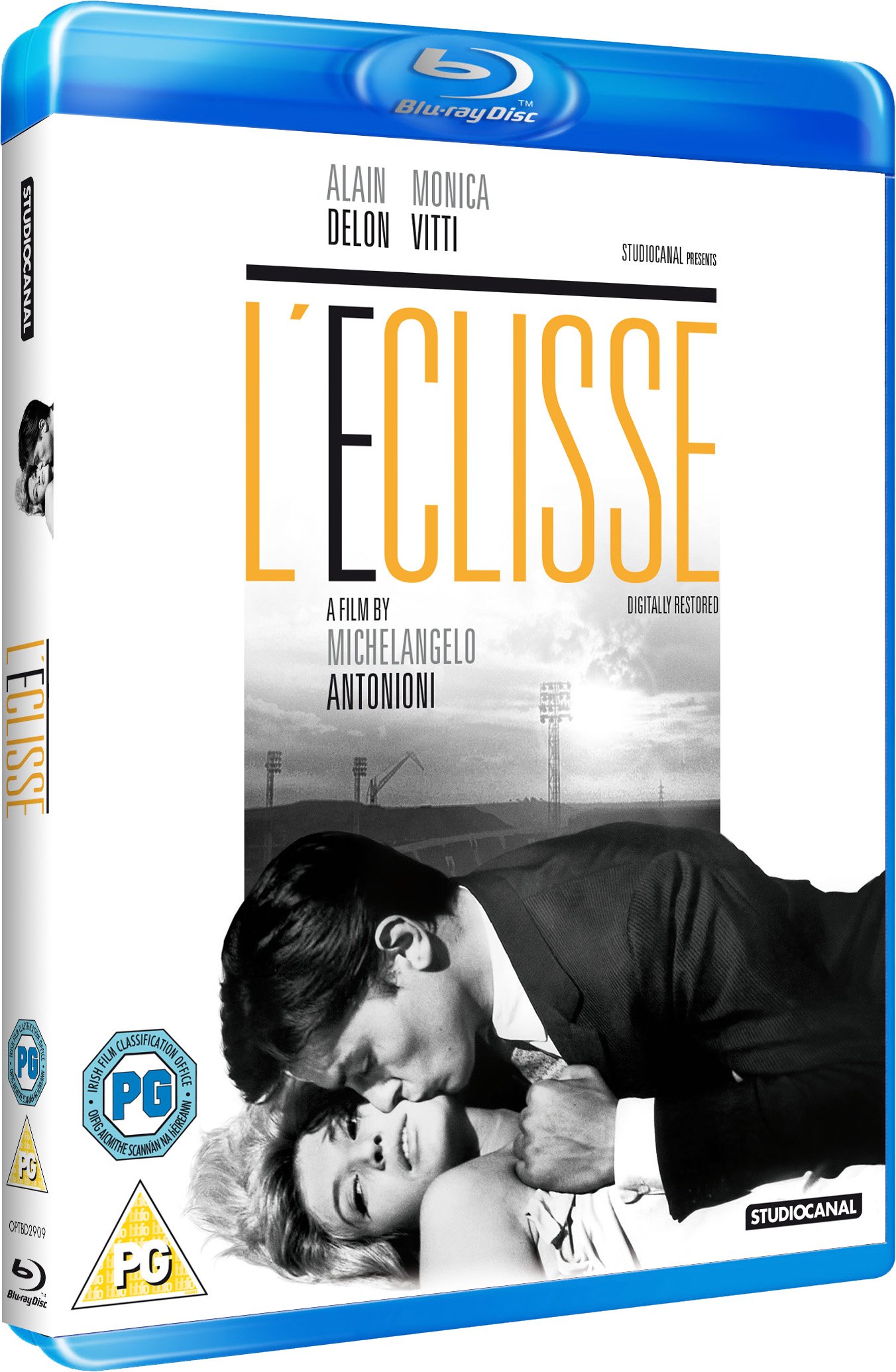
L’Eclisse was the final film in Antonioni’s informal trilogy on contemporary malaise (following L’Avventura and La Notte), a series of films that redefined the concept of narrative cinema. Filmed in sumptuous black and white, and full of scenes of lush, strange beauty, it tells the story of Vittoria (the beautiful Monica Vitti - Red Desert - Antonioni’s partner at the time), a young woman who leaves her older lover (Francisco Rabal – Viridiana), then drifts into a relationship with a confident, ambitious young stockbroker (Alain Delon – Le Cercle Rouge). But this base narrative is the starting point for much, much more, including an analysis of the city as a place of estrangement and alienation and an implicit critique of colonialism. Using the architecture of Rome - old and new - as a backdrop for this doomed affair, Antonioni achieves the apotheosis of his style in this return to the theme that preoccupied him the most: the difficulty of forming true connections amidst the meaninglessness of the modern world. The final shot remains one of the greatest endings in cinema. Bonus FeatureInterview with José Moure (Antonioni biographer) Review: Beautiful. - L'eclisse is a very beautiful movie. However i felt it to be a sad story about a woman - played by the sheer beautiful Monica Vitti - who leaves her current lover and falls in love with a man played by the mighty Alain Delon ( his 60's movies are must haves ao Le Samourai, Cercle Rouge etc ). But there still is sadness and a distance between them. She does not want to fall in love that easy again. There are a lot of silent parts in the movie without dialogues and images of the scenery which makes the move even more beautiful. It is like Antonioni is sniffing around at life itself. The couple regularly meet at the same place and near the end of the movie they make a new appointment however none of the two show up and the movie then ends with a serie of images of streets and people and the streets in daylight and the movie ends at dusk with a street lantern when suddenly the magic word FIN appears. So what have we seen ? The third movie in a trilogy after l'Avventura and La Notte with an open ending. Antonioni is one of the greatest Italian filmmakers ever. Suffice to say this is of highest possible recommendation. A beautiful Blu-Ray reissue is on my wishlist. Review: L'Eclisse - I found this film amazing.Beneath the hedonism and consumerism of modern Italian life there is an austerity of vision and a movement towards abstraction.This is Antonioni at his peak,the black and white period.Monica Vitti has never been better in her exploring the traces of the aftermath of love when she hooks up with the impulsive Delon character.the framing of the shots, the beauty of the cinematography,the use of architecture,the movement from activity to stasis and the marvellous silent ten minute ending,suggestive of apocalypse.Superb end to a great trilogy of films(see).In a world of chaos we have geometry,whether of architecture or of framing a shot,In a world without a relationship to past or present,narrative or nature,we get an immense visual stylisation.There is no story,but a visual metaphor for alienation and silence.Words drain out of the film into an empty barrel,leaving beauty and terror.
| ASIN | B00Y0HN2NG |
| Actors | Alain Delon, Francisco Rabal, Lilla Brignone, Mirella Ricciardi, Monica Vitti |
| Best Sellers Rank | 16,747 in DVD & Blu-ray ( See Top 100 in DVD & Blu-ray ) 5,537 in Drama (DVD & Blu-ray) 6,309 in Blu-ray |
| Country of origin | Poland |
| Customer reviews | 4.1 4.1 out of 5 stars (239) |
| Director | Michelangelo Antonioni |
| Language | Italian |
| Manufacturer reference | 5055201831170 |
| Media Format | Blu-ray |
| Number of discs | 1 |
| Producers | Raymond Hakim, Robert Hakim |
| Product Dimensions | 1.7 x 11.9 x 16.1 cm; 83.16 g |
| Rated | Parental Guidance |
| Release date | 28 Sept. 2015 |
| Run time | 2 hours and 4 minutes |
| Studio | Studiocanal |
| Subtitles: | English |
| Writers | Michelangelo Antonioni |
S**B
Beautiful.
L'eclisse is a very beautiful movie. However i felt it to be a sad story about a woman - played by the sheer beautiful Monica Vitti - who leaves her current lover and falls in love with a man played by the mighty Alain Delon ( his 60's movies are must haves ao Le Samourai, Cercle Rouge etc ). But there still is sadness and a distance between them. She does not want to fall in love that easy again. There are a lot of silent parts in the movie without dialogues and images of the scenery which makes the move even more beautiful. It is like Antonioni is sniffing around at life itself. The couple regularly meet at the same place and near the end of the movie they make a new appointment however none of the two show up and the movie then ends with a serie of images of streets and people and the streets in daylight and the movie ends at dusk with a street lantern when suddenly the magic word FIN appears. So what have we seen ? The third movie in a trilogy after l'Avventura and La Notte with an open ending. Antonioni is one of the greatest Italian filmmakers ever. Suffice to say this is of highest possible recommendation. A beautiful Blu-Ray reissue is on my wishlist.
T**Y
L'Eclisse
I found this film amazing.Beneath the hedonism and consumerism of modern Italian life there is an austerity of vision and a movement towards abstraction.This is Antonioni at his peak,the black and white period.Monica Vitti has never been better in her exploring the traces of the aftermath of love when she hooks up with the impulsive Delon character.the framing of the shots, the beauty of the cinematography,the use of architecture,the movement from activity to stasis and the marvellous silent ten minute ending,suggestive of apocalypse.Superb end to a great trilogy of films(see).In a world of chaos we have geometry,whether of architecture or of framing a shot,In a world without a relationship to past or present,narrative or nature,we get an immense visual stylisation.There is no story,but a visual metaphor for alienation and silence.Words drain out of the film into an empty barrel,leaving beauty and terror.
E**A
Long and slow
I know it's one of the greatest films in the history of cinema taught at universities and stuff, but every time I try to watch it, I never finish. It's too long and too slow. But it has two great actors.
J**R
True gem of forgone cinema.
It is very interesting thing to watch that kind of cinema, because it clearly shows the difference between original thinking and cliche escapism. Funny thing this old black and white flick describes today's world better than any movie made now. The hero is a young woman trapped in a situation where she can not find love around her. She leaves her boyfriend who really cares about her, but can not give her what she's after. She starts to move around and the situation doesn't change much. Everybody, including her mother is money crazed and spend most of their time at the stock exchange market where speculation is main thing. One of her mothers broker is attractive to her, but their relation doesn't go much beyond give and take wrapped around sex. Hence the title. Monica Vitti as usual gives very subtle, delicate performance except a scene at the women's party where they take African costumes and start to dance, where she is unbelievable! The film is worth to watch for this scene only! As I said before this is a rear cinema today, where somebody tries to show us how the most important things are very fragile and the rest is only noisy substitution of life of true emotions.
V**I
L'Eclisse
Very interesting story of unusual relations of two young people. Alain Delon and Monica Vitti are beautiful! Amazing actors!
E**S
Excellent on DVD
As it is unlikely anyone would come across this film by chance, there is no need to describe its artistry. L'Eclisse is strictly for those who appreciate true art films; as it was made in the era when the the term art film meant something. The accompanying analysis by an intelligent critic does the film justice, and gives the viewer further food for thought. Amazon's service, as always was very reliable and the price was indeed an incentive. Films like this are few and far between.
J**S
Reminding Us What The Cinema Was Once About
Not for action fans. Not for comedy lovers. Not for addicts of quick-fire dialogue. Not for those who think all black-and-white movies are out of date. (When was this made? 1962! Forget it.) So why all those five-star reviews? Because anyone who loves film, anyone who enjoys travelling below the surface of things in the company of an observer such as Antonioni must fall under the spell of this great film. They really, really don't make them like this anymore.
A**R
Antonioni masterpiece
Hypnotic mesmerising film. The ending is one of the greatest sequences ever shot.
F**R
Very cool! The final sequence, without any dialogue, is remarkable! The rest of the film is really good, too!
D**S
L'Eclisse visually transcends into an artistic journey through 24 frames per second that displays numerous scenes in which the director Michelangelo Antonioni captures the moment. Each moment offers a unique experience that is passed on to the audience through the eyes of the characters or the audience's own perception. In either case, the visuals play a significant part in this cinematic experience, as it is the visuals that tell the story while dialogue merely adds a little flesh to the bones. Many of these shots that Antonioni provides to the audience could have been free standing photos, or paintings at art museums throughout the world. Thus, L'Eclisse presents a brilliant cinematic experience, as the visuals play with the audience's mind and emotions. The opening scene begins with a shot of a lamp that illuminates a room while the audience only can see a small portion of the room. What the light from the lamp unveils from the darkness is a number of used books, pen, paper, a painting, and a white shirt elbow. The composition of this scene brings so many things to ponder, as the scene goes on for almost 10 seconds. The audience might experience notions such as wondering what kind of books are there, what kind of painting is in the background, or whose elbow it is that can be seen. However, the most important idea might be missed in this scene, which might be the visual metaphor for enlightenment that is provided by the light. The light brings out these questions from the darkness, as it almost wants to encourage the audience to continue to read into each scene that follows the opening shot, which slowly pans to the right unveiling the identity of person whose elbow has been. The pan reveals a man, who remains silent for what seems to be a long moment, who is in deep thoughts. Beside the man, there is a woman in the room, who plays with a picture frame. This moment is also full of artistic expression, as it initially displays the woman's interest for what is in the frame while the camera later shows the same picture frame from an angled and opposite direction. Shooting the frame from two different directions while displaying what the woman could see in the frame suggests that the audience can only see a small portion of the truth, unless the audience can manipulate the angle of what is in the frame and see it from all angles. Combining this notion with the previous of enlightenment provides the idea that the audience can manipulate the truth with their mind. Silence hangs in the air while the man and the woman continue to exist in the same room. Eventually one of the two break the silence, as the audience gets to know the man as Riccardo (Francisco Rabal) and the woman as Vittoria (Monica Vitti). Everything is not revealed at once to the audience, only fragments and pieces, which leaves the audience guessing. Based on the images and the short dialogues it is obvious that they are breaking up a long relationship and Vittoria is not happy with the circumstances. But the reason is left for the audience to contemplate, as they can watch Riccardo agonizingly trying to mend the relationship. After the break up the film continues into a chaotic stock market where the audience can witness people's preoccupation making money. Even Vittoria's mother is too busy making, or saving money, as she tries to tell her that she has broken up with Riccardo. Furthermore, there is a powerful scene at the stock market where the stock traders are forced to stop their trading, as they hold a moment's silence in regards to an esteemed colleague that has died. During this moment of silence the phones continue to ring, and the ringing intensifies while the moment gets longer. It is also revealed to the audience that one-minute cost everyone a lot of money. This scene brings to mind the short time people have to live, and the importance of making the most of the time alive. The story continues as a journey for the audience through Vittoria and people she meets. This journey consists of episodes such as Vittoria meeting two beautiful neighbors one late night, the chasing a dog, the making of a short daily flight, the crash of the stock market, a deadly car accident, and the rediscovery of love among other life adventures. Each and every adventure provides enlightening wisdom, as the story continues to deal with life. Antonioni's clever direction focuses on the small details in a moment, and simultaneously depicts a greater significance in the characters' existence. This is accomplished through great eye for details, as the story visually brings several different notions for the audience to ponder. L'Eclisse encourages the audience to participate cerebrally through its visuals, which also illustrate the importance of good cinematography, mise-en-scene, and direction. The cast performs very well and does not convey too much information while leaving the audience in an artistic twilight where only thought can guide the audience on the right track. The beauty with Antonioni's direction is in the use of symbols and signs in a manner that provides a visual meaning to the audience. Through this visual meaning the audience can interpret what Antonioni attempts to convey through his tale, yet it leaves the audience with the freedom to make their own judgment depending how they manipulate the ideas that Antonioni provides through his visual representations on the silver screen.
E**.
La copertina è arrivata leggermente danneggiata!
M**N
Exceptionnal film. This Criterion Collection item is a region A-coded film, so make sure your Blu-ray player is region A or region-free.
F**O
Film complesso, nel quale la storia è un pretesto per raccontare i personaggi. Penso sia adatto a una visione di tipo riflessivo
Trustpilot
2 months ago
4 days ago