We remain fully operational. Our teams are working around the clock to ensure your deliveries continue safely.

DOWNLOAD THE APP


Customer Services
Copyright © 2025 Desertcart Holdings Limited
DOWNLOAD THE APP

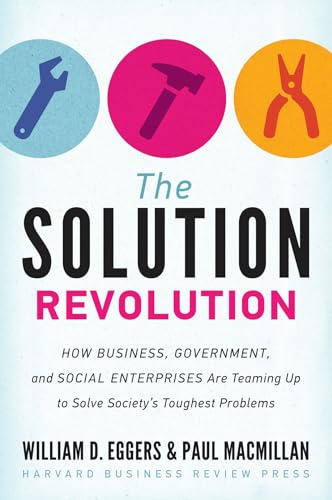
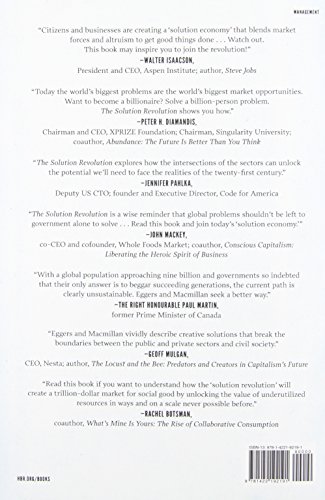
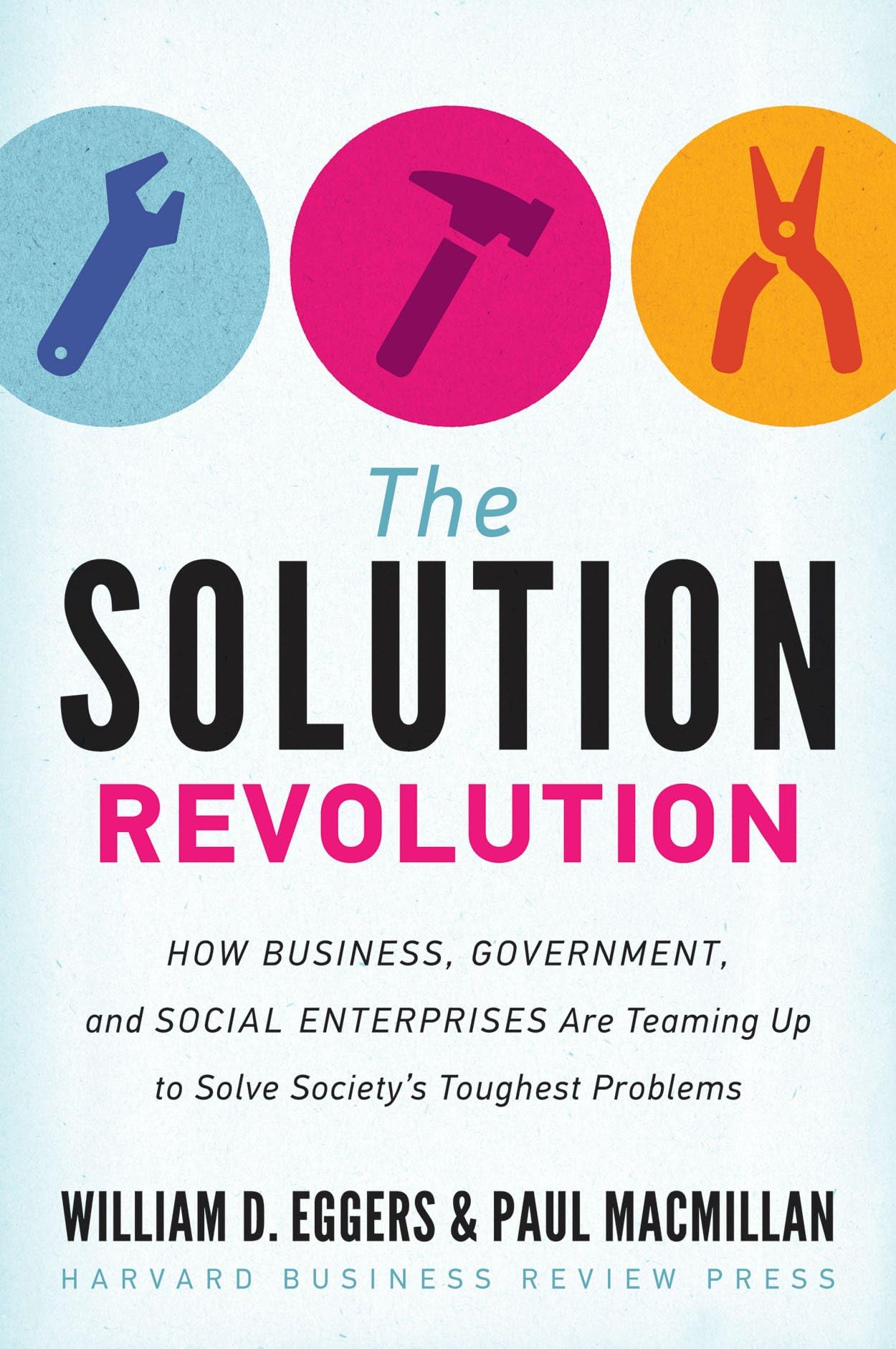
The Solution Revolution: How Business, Government, and Social Enterprises Are Teaming Up to Solve Society's Toughest Problems [Eggers, William D., Macmillan, Paul] on desertcart.com. *FREE* shipping on qualifying offers. The Solution Revolution: How Business, Government, and Social Enterprises Are Teaming Up to Solve Society's Toughest Problems Review: Excellent! - The Solution Revolution: How Business, Government, and Social Enterprises Are Teaming Up to Solve Society's Toughest Problems by Williams D. Eggers, Paul Macmillan "The Solution Revolution" is a fantastic book that introduces a new economic paradigm to solve society's problems. Deloitte's William D. Eggers and Paul Macmillan show readers how players from across boundaries (government, business and philanthropists) come together to address tough societal problems. This is an invaluable resource that illustrates the power of collaboration. This enlightening 306-page book includes the following seven chapters: 1. The Wavemakers, 2. Disruptive Technologies, 3. Business Models That Scale, 4. The Currencies, 5. Public-Value Exchanges, 6. The Ecosystems, and 7. Creating Your Own Solution Revolution. Positives: 1. A well-researched, well-written book. It's inspirational and engaging. 2. Excellent and important topic. Collaboration that leads to the public good. 3. Excellent format that includes a great summary at the end of each chapter. 4. Countless business cases that clearly show the new economic paradigm in action. 5. Even handed, the authors were careful to appear politically neutral. 6. Clearly shows the need for this new paradigm, "Society is witnessing a step change in how it deals with its own problems--a shift from a government-dominated model to one in which government is just one player among many." 7. The central theme of the book up front. "This is a central idea behind the solution revolution: social impact becomes a form of currency with real value to millions--from foundations to governments to venture philanthropists to individual citizens." 8. The six principal features of the solution economy. "* Wavemakers, who solve problems * Disruptive technologies * Business models that scale * Impact currencies * Public-value exchanges * Solution ecosystems" 9. The players engaged in delivering societal solutions. "The Bill & Melinda Gates Foundation is the single most influential philanthropic organization in the world." 10. Great facts. "Today, private philanthropy to the developing world surpasses the monetary contributions of all governments combined." 11. Multirational multinationals, "Partnering with Kamen to expand access to clean water supports Coca-Cola's already far-reaching clean-water initiatives." 12. Well-defined useful terms. "Innovators that mix profit making and social missions fall into two broad categories. First are those whose societal mission is front and center, but for which the market is their instrument of change. These innovators are known as social enterprises." 13. The underrated purchasing power of the marginalized. "One previously marginalized population capturing significant interest is the world's 4 billion people at the `base of the pyramid.' This group collectively represents $5 trillion in purchasing power." 14. The power of "crowdsourcing". 15. Great examples throughout the book, "The Recyclebank model instead sidesteps punitive measures altogether in favor of an incentive-based solution. It was a classic case of carrot versus stick--except that Recyclebank bet on the carrot." 16. Great examples of business models that surpass current public service approaches. "Two Haitian social entrepreneurs, Jean-Ronel Noel and Alex Georges, for example, learned integrated circuit engineering from MIT's OpenCourseWare and subsequently used the knowledge to erect more than five hundred solar street lamps in Haiti's poorest communities." 17. How the solution economy is being reshaped by a new definition of currencies. 18. New platforms that match capital to societal needs. "After returning to Australia, Goldbloom taught himself to write code and launched Kaggle, kick-starting a global exchange of algorithms. Kaggle organizes competitions according to specific data problems, with the most accurate predictive model winning." 19. A great example on affordable housing. 20. A guide on how to change the world. 21. Links and great supporting material. Negatives: 1. The book is so focused on providing positive information that it misses an opportunity to address a lot of the problems or special challenges (there is one example dealing with the special challenges facing entrepreneurs but they are few and far between). 2. No formal bibliography. In summary, I really enjoyed this book. It provides valuable information on how collaboration between government, business and philanthropists lead to solving society's toughest problems. It's engaging, well written and illustrates clearly the value these movements have to the better public. I can provide unlimited praise, I highly recommend it! Further recommendations: "Platform: Get Noticed ina Noisy World" by Michael Hyatt, " Collaborate or Perish!: Reaching Across Boundaries in a Networked World " by William Bratton and Zachary Tumin, " Outliers: The Story of Success " and " The Tipping Point: How Little Things Can Make a Big Difference " by Malcolm Gladwell, " Just Start: Take Action, Embrace Uncertainty, Create the Future " by Leonard A. Schlesinger, " The Hidden Agenda: A Proven Way to Win Business and Create a Following " by Kevin Allen, " The ONE Thing " by Gary Keller, " Switch: How to Change Things When Change Is Hard " by Chip and Dan Heath, " Get Lucky: How to Put Planned Serendipity to Work for You and Your Business " by Thor Muller and Lane Becker "inGenius" by Tina Seelig, "Work with Me" by Barbara Annis and John Gray, "Power: Why Some People Have It and Others Don't" by Jeffrey Pfeffer, " The Power of Habit: Why We Do What We Do in Life and Business " by Charles Duhigg, " Rebounders: How Winners Pivot from Setback to Success " by Rick Newman, and "Drive: The Surprising Truth About What Motivates Us" by Daniel H. Pink. Review: The public purpose sector at work - Eggers and Macmillan have done us a big favour by collecting a compelling compendium of ideas and practical examples of an important phenomenon - what I would call, following Lisbeth Schorr, the "public purpose" sector. This is something that has been developing for some time as governments find themselves stretched in terms of money, ideas and expertise as they confront complex risks and opportunities in a world full of turbulent change. As a result we've been witnessing for a while now various experiments in new combinations of public, private and civil society assets to tackle the big problems we want to solve. What the Solution Economy suggests is that we've reached something of a tipping point in this process. That has two important consequences. One is that the scale, speed and variety of the experiments are all growing as public and private entrepreneurs and social innovators are becoming more confident as they try new ideas and engage a creative cycle that quickly tests ideas to find the ones that work and which can scale. The second consequence is that the public sector itself, as a key institution of policy and governance, is changing shape. Under the relentless pressure of wicked problems, reducing resources and big social, economic and technology changes the work and contours of the formal public sector are changing, sometimes dramatically. New cross boundary collaborations are fueling new solutions and, at the same time, creating new markets for innovation. How define 'public' problems (and opportunities), as well as the instincts and practices we draw on to deal with them, are all changing. In that sense, what is in and out of the public sector is changing and the lines between sectors and different types of player are blurring. But perhaps the most important insight of the book is that the real significance of the solution economy is not that it is new and cool and clever or that it has become a distinct economy in its own right, but rather that its sole measure of performance is the results these new approaches achieve. In the solutions economy, what matters in the end is whether the new ideas and clever new approaches actually work. And if they don't, the instinct that drives the solutions economy follows the advice from Franklin Roosevelt, who reminded us that "it is common sense to take a method and try it. If it fails, admit it frankly and try another. But above all, try something." This is an important, timely and at times provocative book about the way we will need increasingly to set about the big tasks of the rapidly changing world in which we find ourselves.
| Best Sellers Rank | #1,468,807 in Books ( See Top 100 in Books ) #85 in Crowdfunding (Books) #151 in Government & Business #295 in Business Ethics (Books) |
| Customer Reviews | 4.1 4.1 out of 5 stars (130) |
| Dimensions | 6.1 x 1.1 x 9.3 inches |
| ISBN-10 | 1422192199 |
| ISBN-13 | 978-1422192191 |
| Item Weight | 1.15 pounds |
| Language | English |
| Print length | 304 pages |
| Publication date | September 17, 2013 |
| Publisher | Harvard Business Review Press |
B**K
Excellent!
The Solution Revolution: How Business, Government, and Social Enterprises Are Teaming Up to Solve Society's Toughest Problems by Williams D. Eggers, Paul Macmillan "The Solution Revolution" is a fantastic book that introduces a new economic paradigm to solve society's problems. Deloitte's William D. Eggers and Paul Macmillan show readers how players from across boundaries (government, business and philanthropists) come together to address tough societal problems. This is an invaluable resource that illustrates the power of collaboration. This enlightening 306-page book includes the following seven chapters: 1. The Wavemakers, 2. Disruptive Technologies, 3. Business Models That Scale, 4. The Currencies, 5. Public-Value Exchanges, 6. The Ecosystems, and 7. Creating Your Own Solution Revolution. Positives: 1. A well-researched, well-written book. It's inspirational and engaging. 2. Excellent and important topic. Collaboration that leads to the public good. 3. Excellent format that includes a great summary at the end of each chapter. 4. Countless business cases that clearly show the new economic paradigm in action. 5. Even handed, the authors were careful to appear politically neutral. 6. Clearly shows the need for this new paradigm, "Society is witnessing a step change in how it deals with its own problems--a shift from a government-dominated model to one in which government is just one player among many." 7. The central theme of the book up front. "This is a central idea behind the solution revolution: social impact becomes a form of currency with real value to millions--from foundations to governments to venture philanthropists to individual citizens." 8. The six principal features of the solution economy. "* Wavemakers, who solve problems * Disruptive technologies * Business models that scale * Impact currencies * Public-value exchanges * Solution ecosystems" 9. The players engaged in delivering societal solutions. "The Bill & Melinda Gates Foundation is the single most influential philanthropic organization in the world." 10. Great facts. "Today, private philanthropy to the developing world surpasses the monetary contributions of all governments combined." 11. Multirational multinationals, "Partnering with Kamen to expand access to clean water supports Coca-Cola's already far-reaching clean-water initiatives." 12. Well-defined useful terms. "Innovators that mix profit making and social missions fall into two broad categories. First are those whose societal mission is front and center, but for which the market is their instrument of change. These innovators are known as social enterprises." 13. The underrated purchasing power of the marginalized. "One previously marginalized population capturing significant interest is the world's 4 billion people at the `base of the pyramid.' This group collectively represents $5 trillion in purchasing power." 14. The power of "crowdsourcing". 15. Great examples throughout the book, "The Recyclebank model instead sidesteps punitive measures altogether in favor of an incentive-based solution. It was a classic case of carrot versus stick--except that Recyclebank bet on the carrot." 16. Great examples of business models that surpass current public service approaches. "Two Haitian social entrepreneurs, Jean-Ronel Noel and Alex Georges, for example, learned integrated circuit engineering from MIT's OpenCourseWare and subsequently used the knowledge to erect more than five hundred solar street lamps in Haiti's poorest communities." 17. How the solution economy is being reshaped by a new definition of currencies. 18. New platforms that match capital to societal needs. "After returning to Australia, Goldbloom taught himself to write code and launched Kaggle, kick-starting a global exchange of algorithms. Kaggle organizes competitions according to specific data problems, with the most accurate predictive model winning." 19. A great example on affordable housing. 20. A guide on how to change the world. 21. Links and great supporting material. Negatives: 1. The book is so focused on providing positive information that it misses an opportunity to address a lot of the problems or special challenges (there is one example dealing with the special challenges facing entrepreneurs but they are few and far between). 2. No formal bibliography. In summary, I really enjoyed this book. It provides valuable information on how collaboration between government, business and philanthropists lead to solving society's toughest problems. It's engaging, well written and illustrates clearly the value these movements have to the better public. I can provide unlimited praise, I highly recommend it! Further recommendations: "Platform: Get Noticed ina Noisy World" by Michael Hyatt, " Collaborate or Perish!: Reaching Across Boundaries in a Networked World " by William Bratton and Zachary Tumin, " Outliers: The Story of Success " and " The Tipping Point: How Little Things Can Make a Big Difference " by Malcolm Gladwell, " Just Start: Take Action, Embrace Uncertainty, Create the Future " by Leonard A. Schlesinger, " The Hidden Agenda: A Proven Way to Win Business and Create a Following " by Kevin Allen, " The ONE Thing " by Gary Keller, " Switch: How to Change Things When Change Is Hard " by Chip and Dan Heath, " Get Lucky: How to Put Planned Serendipity to Work for You and Your Business " by Thor Muller and Lane Becker "inGenius" by Tina Seelig, "Work with Me" by Barbara Annis and John Gray, "Power: Why Some People Have It and Others Don't" by Jeffrey Pfeffer, " The Power of Habit: Why We Do What We Do in Life and Business " by Charles Duhigg, " Rebounders: How Winners Pivot from Setback to Success " by Rick Newman, and "Drive: The Surprising Truth About What Motivates Us" by Daniel H. Pink.
M**W
The public purpose sector at work
Eggers and Macmillan have done us a big favour by collecting a compelling compendium of ideas and practical examples of an important phenomenon - what I would call, following Lisbeth Schorr, the "public purpose" sector. This is something that has been developing for some time as governments find themselves stretched in terms of money, ideas and expertise as they confront complex risks and opportunities in a world full of turbulent change. As a result we've been witnessing for a while now various experiments in new combinations of public, private and civil society assets to tackle the big problems we want to solve. What the Solution Economy suggests is that we've reached something of a tipping point in this process. That has two important consequences. One is that the scale, speed and variety of the experiments are all growing as public and private entrepreneurs and social innovators are becoming more confident as they try new ideas and engage a creative cycle that quickly tests ideas to find the ones that work and which can scale. The second consequence is that the public sector itself, as a key institution of policy and governance, is changing shape. Under the relentless pressure of wicked problems, reducing resources and big social, economic and technology changes the work and contours of the formal public sector are changing, sometimes dramatically. New cross boundary collaborations are fueling new solutions and, at the same time, creating new markets for innovation. How define 'public' problems (and opportunities), as well as the instincts and practices we draw on to deal with them, are all changing. In that sense, what is in and out of the public sector is changing and the lines between sectors and different types of player are blurring. But perhaps the most important insight of the book is that the real significance of the solution economy is not that it is new and cool and clever or that it has become a distinct economy in its own right, but rather that its sole measure of performance is the results these new approaches achieve. In the solutions economy, what matters in the end is whether the new ideas and clever new approaches actually work. And if they don't, the instinct that drives the solutions economy follows the advice from Franklin Roosevelt, who reminded us that "it is common sense to take a method and try it. If it fails, admit it frankly and try another. But above all, try something." This is an important, timely and at times provocative book about the way we will need increasingly to set about the big tasks of the rapidly changing world in which we find ourselves.
M**T
Life changing and World changing
Wondering whether there is a "next step" after social entrepreneurship and gramine banking? Sure there is! These innovations have world-changing implications. The concept I got the most out of was the solution environment. You know how social problems have networks of complex causes? So do solutions! This serious work offers a great way to look at social issues from a solutions perspective. How will we improve the world if we don't look at issues in new and positive ways? Aspects of the solutions environment all require work and networking, of course. This approach offers great ways to think about the work involved in creating solutions.
R**I
easy read, but consultancy speak
This is an easy read with interesting examples from around the world of new types of solutions and how they transcend boundaries. However, a lot of it is feels like consultancy speak in favour of social enterprises. The book can afford to take a more critical approach to the case studies.
P**T
Educational and entertaining read with an optimistic view on global problem solving
I loved this book. With all the news of war, crime and tragedy, it's easy to forget that there are individuals and organizations out there that are innovating, creating and taking risks to make the world a better place. I was lucky to get an early copy and finished it feeling very optimistic about the future. Since reading the book, I've been thinking differently about CSR and how companies can use their assets and intellectual capital to find solutions to societal problems. I have since purchased several more copies to give as gifts to friends and colleagues.
M**R
Finally Amazon delivered it after a failure..Delivery in tome and that too in good Price.
T**A
Achei o livro excelente. Os novos negócios estão estabelecendo premissas nobres que transformam a dinâmica de mercados que seriam (teoricamente) cegamente orientados por lucros financeiros. Governos, Empresários e ONGs devem operar em sintonia para solucionar problemas, promovendo a melhoria dos negócios (até criando novos mercados), da sociedade e das pessoas.
J**N
Dirty and used book, it has pen lines, yellow highlighter and also a library stamp
M**S
De manière croissante, entreprises, acteurs de la société civile et acteurs gouvernementaux unissent leurs efforts pour redessiner le monde de demain. En effet, entre l’ampleur des enjeux sociétaux et environnementaux d’une part et les ressources limitées des États d’autre part, il devient utopique de se reposer sur la seule action publique. De plus, les évolutions sociétales et technologiques offrent une possibilité sans précédent de mieux coordonner les actions pour une plus grande efficacité collective. Dans The Solution Revolution, William D. Eggers et Paul Macmillan posent les bases de cette nouvelle donne. Ils montrent qu’il est possible de faire converger les intérêts économiques et sociétaux, nombreux exemples à l’appui. Du développement du marché indien du savon par Unilever aux dernières applications smartphone impliquant les citoyens dans la gestion de leur quartier ou favorisant le co-voiturage, ils identifient les leviers sur lesquels s’appuyer pour améliorer son impact sociétal. Loin de discourir sur la philanthropie, les auteurs montrent comment des acteurs très pragmatiques concilient objectifs économiques, contraintes pratiques et volonté d’augmenter leur contribution positive aux enjeux de la société. Les parties II et III regorgent de conseils sur le recours aux technologies collaboratives pour atteindre ses objectifs malgré des ressources limitées. Les parties IV et VI abordent notamment la façon de nouer les bons partenariats et de motiver chacun des acteurs.
A**X
Il libro è davvero interessante. Davvero consigliato. Non ho finito di leggerlo ancora ma mi sento di consigliarlo a tutti!
Trustpilot
1 month ago
1 month ago